When stocks or other securities become unclaimed property, they may be transferred from a brokerage, transfer agent, mutual fund company or other holder to a state unclaimed property program.
What happens next depends heavily on state law.
A state may hold the securities for a period of time, process dividends and corporate actions while they are in custody, and eventually sell the investment if it remains unclaimed. If you claim before a permitted sale, you may be able to receive securities. If the investment has already been sold, your claim may instead be for the applicable sale proceeds.
What are unclaimed stocks and securities?
Unclaimed securities are investments or securities-related property that a holder can no longer return to the rightful owner after the conditions established by state unclaimed property law have been met.
They can include property connected with:
- shares of publicly traded stock;
- mutual funds;
- bonds;
- dividend payments;
- dividend reinvestment plans;
- employee stock accounts;
- brokerage accounts;
- transfer-agent accounts;
- fractional-share proceeds;
- merger or acquisition proceeds; and
- other securities interests.
California, for example, specifically lists stocks, mutual funds, bonds and dividends among common types of unclaimed property.
California State Controller — About Unclaimed Property
How does stock become unclaimed property?
A stock does not become unclaimed simply because you forgot to check its market price or stopped trading it.
State law determines when a securities interest is considered abandoned or unclaimed.
Factors can include:
- lack of contact with the owner;
- returned mail;
- lack of qualifying owner activity;
- the passage of the applicable dormancy period; and
- the specific type of account or security.
The rules are not identical nationwide.
Arizona, for example, currently states that a stock or other equity interest in a business association or financial organization is presumed abandoned if it remains unclaimed for more than three years after the most recent dividend, stock split or other distribution.
Arizona Department of Revenue — Reporting Securities
California also uses state-specific inactivity and notice rules for securities and other business-association interests.
For a broader explanation of the period before property becomes reportable, see What Is a Dormancy Period in Unclaimed Property?.
Does the company try to contact me before transferring the stock?
Often, yes, when required by the applicable state’s due-diligence rules.
California currently requires holders of qualifying unclaimed property to attempt to contact owners before transferring property to the State Controller.
The state also sends notices to certain owners whose property is scheduled to be transferred.
California — Owner Notification Before Transfer
If you receive a legitimate notice from your brokerage, transfer agent or another holder saying that your investment may become unclaimed property, contact the holder before the stated deadline.
Recovering the property while the holder still has it may avoid the state claim process entirely.
Who is the holder of unclaimed stock?
The holder is the business or organization responsible for the property before it is transferred under unclaimed property law.
For securities, that could be:
- a brokerage;
- a transfer agent;
- a corporation;
- a mutual fund company;
- a financial institution;
- a stock-plan administrator; or
- another entity responsible for the investment.
The holder and the company whose stock you own are not necessarily the same organization.
For example:
Holder: ABC Transfer Agent
Security: XYZ Corporation
ABC may be responsible for maintaining the shareholder record even though XYZ issued the stock.
See What Does Holder Mean in Unclaimed Property? for the distinction.
What happens when securities are transferred to the state?
Unlike an ordinary cash balance, securities can actually be transferred or re-registered into state custody.
California’s current remittance instructions say that electronic transfer through the Depository Trust Company (DTC) is its preferred method for delivering many unclaimed securities.
California instructs holders to transfer whole shares to its contracted broker or, in appropriate circumstances, register certificated shares in the name of the State Controller.
California — Remitting Unclaimed Securities
Arizona similarly requires reportable stock to be re-registered for the State of Arizona and provides procedures for DTC and other securities transfers.
Arizona — Securities Remittance
This is why unclaimed securities are different from simply reporting a dollar balance.
Possibly, for a period of time—but not necessarily forever.
States can have laws authorizing them to liquidate securities after they have been held for a certain period.
The timing varies significantly.
| Example | Current treatment |
|---|---|
| California | Under current California law, qualifying securities are generally sold no sooner than 18 months and no later than 20 months after the actual filing date of the applicable report. |
| Arizona | Arizona currently states that securities are liquidated within three years after the state receives them. |
California’s current February 2026 Unclaimed Property Law provides the 18-to-20-month securities sale window.
California Unclaimed Property Law — §1563
Arizona publishes its different rule in its owner FAQ.
Arizona Department of Revenue — Owner FAQ
Can the state sell my unclaimed stock?
Yes, if state law authorizes the sale.
California’s current law states that securities listed on an established stock exchange can be sold at prevailing exchange prices. Other securities can be sold over the counter or by another method the Controller considers appropriate.
If the securities are still in California’s custody when an owner successfully claims them, the claimant is entitled to receive the securities.
If they have already been sold, California law instead provides for payment of the net proceeds received from the sale.
California Unclaimed Property Law — Securities Sales
Will I get my stock back or receive cash?
The answer can depend largely on whether the state still holds the securities when your valid claim is processed.
A simplified version looks like this:
| Status | Possible result |
|---|---|
| State still holds the securities | The claimant may receive securities, subject to the state’s rules and any corporate actions that occurred. |
| State already sold the securities | The claimant may receive the applicable net sale proceeds. |
| Security changed through merger or acquisition | The entitlement may involve successor shares, cash, or another form of consideration. |
| Fractional shares were liquidated | A cash component may be associated with the property. |
Those possibilities are why a securities record cannot be understood simply by looking at the original number of reported shares.
If the sale was authorized under the applicable state’s law, your claim can become a claim for the proceeds from that sale rather than for the original shares.
California provides a particularly clear example.
Its current law states:
- if the securities remain in state custody, an approved claimant is entitled to receive the securities;
- if the securities have been sold, the claimant is entitled to the net proceeds the Controller received from the sale.
The difference is significant.
Imagine 100 shares were transferred to the state and subsequently sold.
If those shares later doubled in value, you should not automatically calculate your claim as:
100 × today’s stock price.
The applicable sale history and state law determine what is recoverable.
Do I get today’s market value if the state already sold the stock?
Not necessarily—and in California, current market value is not the measure once the securities have already been sold.
The state’s current statute provides for the claimant to receive the net proceeds received from the actual sale.
That means later market movements do not automatically change those sale proceeds.
For example:
State sells stock → $4,000 net proceeds
If the same shares would hypothetically be worth $7,000 years later, you should not assume the claim is now worth $7,000.
The treatment in another state can differ, so always verify the jurisdiction holding the property.
What happens to dividends while the state holds the stock?
Dividends and other income can matter.
Under current California law, when property other than money is delivered to the Controller, dividends, interest and other increments realized or accruing at or before liquidation are credited to the owner’s account.
California Unclaimed Property Law — §1562
The California State Controller also explains that owners or heirs are entitled to benefits resulting from corporate actions while securities are being held, including:
- dividends;
- mergers; and
- stock splits.
California — Securities and Corporate Actions
If the securities are subsequently sold, the treatment changes because the owner no longer has the same continuing stock position.
What happens if the stock splits?
A stock split can change the number of shares associated with the property.
Suppose the holder originally reported:
Shares Reported: 100
and while the securities were in state custody the issuer completed a:
2-for-1 stock split.
The resulting securities position may no longer be represented by the original 100-share figure.
This is why Shares Reported should be treated as reporting information rather than a live statement of the number of securities currently due.
Read our dedicated guide: What Does Shares Reported Mean in Unclaimed Property?.
What if the company merges with another company?
A merger or acquisition can change the form of the investment completely.
The original shares could potentially become:
- shares of a successor company;
- a different number of shares;
- cash;
- a combination of cash and shares; or
- another security.
For this reason, an old unclaimed property listing may still reference a company name that no longer exists independently.
California specifically identifies mergers and acquisitions as corporate activity that may need to be researched before a securities claim can be completed.
What happens after an acquisition for cash?
If shareholders of the original company were bought out for cash, the unclaimed investment can eventually become a cash entitlement rather than an active stock position.
For example:
50 shares of Company A
could be converted through an acquisition into:
cash proceeds
based on the terms of the corporate transaction.
This is another reason an old Shares Reported entry cannot always be multiplied by a current market price.
What about spin-offs?
Corporate reorganizations can create new investments associated with the original security.
A spin-off, for example, may result in shareholders becoming entitled to shares in another company.
Whether and how those additional interests are reflected in an unclaimed property claim depends on:
- when the corporate event occurred;
- whether the state still held the securities;
- the state’s applicable law; and
- how the event was processed by the issuer, transfer agent and custodian.
Complex corporate histories are one reason securities claims can require more processing than simple cash claims.
Fractional shares frequently generate a cash component.
California currently instructs holders to convert individual stock-owner accounts to whole shares and liquidate fractional shares, remitting the fractional-share proceeds as cash.
California — Whole and Fractional Shares
Arizona similarly instructs holders handling dividend reinvestment plans to report whole shares and the cash due in lieu of fractional shares.
Arizona — Fractional Share Reporting
This helps explain why the same unclaimed property record can potentially contain both:
Shares Reported + Cash Reported
For the cash field, see What Does Cash Reported Mean in Unclaimed Property?.
What happens to dividend reinvestment plans?
Dividend reinvestment plans—often called DRIPs—can require special handling when they are transferred as unclaimed property.
California currently instructs holders to terminate established DRIPs before remittance, convert them to cash-dividend options and remit dividend earnings in cash.
Arizona does not accept dividend reinvestment plans in book-entry form and similarly requires owner accounts to be converted into whole shares, with cash reported for fractional shares.
Because these procedures are jurisdiction-specific, do not assume your old DRIP remains in exactly the same configuration after being transferred to the state.
What happens to unclaimed mutual funds?
Mutual fund interests can also become unclaimed property.
States can have procedures for transferring the fund account or shares into state custody.
Arizona, for example, requires specific state custody accounts to be established for open-end mutual funds before transfer and instructs holders to pay dividends and capital gains as cash.
California also uses specific transfer procedures for mutual funds.
If you find a mutual fund record, review:
- the number of shares;
- the fund name;
- Cash Reported;
- the reporting holder;
- the reported address; and
- the current claim status.
Do not assume the public listing reflects the fund’s current net asset value or your final claim amount.
What happens to bonds?
Bonds and similar securities can also appear in unclaimed property programs.
California’s current claiming guidelines, for example, specifically identify:
- stock certificates;
- dividend checks;
- bonds;
- debentures; and
- account statements
as examples of documentation that can help establish ownership of securities-related property.
California — Securities Claim Documentation
The treatment of a bond will depend on factors such as whether it matured, was redeemed or remains transferable.
What if the stock is worthless or non-transferable?
This is another area where state rules differ dramatically.
Arizona currently tells holders:
- not to report worthless or non-transferable securities;
- to report them later if they become transferable or regain value.
Arizona — Worthless or Non-Transferable Securities
California takes a different approach. Its current remittance guidance says California law does not exclude worthless or non-transferable securities from reporting requirements.
California — Non-Transferable Securities
What if the company went bankrupt?
A bankruptcy can significantly affect the value or existence of a security.
Depending on what happened, the shares may have:
- lost all economic value;
- been cancelled;
- been exchanged for new securities;
- resulted in a distribution;
- been affected by a reorganization plan; or
- produced another type of financial entitlement.
The original unclaimed property record can therefore remain useful as evidence of a historical interest even if the original stock no longer trades.
But the existence of a record does not guarantee that the original securities still have market value.
No.
Suppose a record shows:
Shares Reported: 100
You still need to know:
- which security was reported;
- whether it still exists;
- whether it split;
- whether it merged;
- whether it was acquired;
- whether the state sold it;
- whether dividends or other proceeds were received; and
- what state law applies.
That is why our separate Shares Reported guide focuses on interpreting the field itself, while this article explains what happens to the investment afterward.
Why might an unclaimed stock record show Cash Reported too?
Securities can generate cash through several mechanisms, including:
- dividends;
- fractional-share liquidation;
- redemptions;
- cash mergers;
- sale of securities;
- capital-gain distributions; or
- other corporate actions.
California’s holder instructions, for example, separately identify remittances for:
- corporate-action proceeds;
- dividends;
- securities sale proceeds; and
- other monetary components.
California — Securities Remittance Categories
So an investment-related property can legitimately contain both cash and shares.
Do I receive dividends after the state sells the stock?
Do not assume that you continue participating in the stock after it has been sold.
California law illustrates the distinction.
Dividends, interest and other increments realized or accruing while the state holds the property and before liquidation are credited to the owner’s account.
Once the securities have been sold, however, the claim is generally for the applicable net sale proceeds and qualifying amounts credited before the liquidation.
Later appreciation or dividends on shares the state no longer owns do not automatically become part of that original stock position.
Can I stop the state from selling my stock?
If you discover that securities are being transferred or are currently held by a state, file or pursue the official claim promptly.
Whether a claim can be completed before a scheduled liquidation depends on:
- the state’s law;
- when the securities were received;
- when the sale is permitted or required;
- whether your claim is complete; and
- the state’s operational procedures.
Do not assume that merely beginning a claim automatically freezes a scheduled sale unless the state confirms that it does.
Contact the official program when the timing is important.
How do I claim unclaimed stocks or securities?
The basic process is:
- Search the official state unclaimed property database.
- Open the property record.
- Compare the owner name and reported address with your history.
- Identify the holder and security.
- Review Cash Reported and Shares Reported separately.
- Start the official claim.
- Provide ownership documents if requested.
- Allow the state to determine the current form of the securities or proceeds.
For the complete claim process, use How to Find and Claim Unclaimed Property for Free.
What documents may be needed to claim stock?
Documentation requirements vary, but potential evidence can include:
- government-issued identification;
- proof of the reported address;
- brokerage statements;
- transfer-agent statements;
- original stock certificates;
- dividend checks;
- bond or debenture documents;
- account statements;
- proof of purchase;
- name-change documentation; and
- estate documents when the owner is deceased.
California’s current claiming guidelines specifically list an original stock certificate, dividend check, bond, debenture or account statement as examples of securities ownership evidence.
If the original certificate is unavailable, California says other evidence can potentially be considered, including proof of occupancy at the registered address or evidence connecting the claimant to the security.
California — Stock and Securities Claim Documentation
See our broader guide: What Documents Do I Need to Claim Unclaimed Property?.
Do I need an old stock certificate?
Not necessarily.
An original stock certificate can be excellent evidence when one exists, but securities have increasingly been held electronically or in brokerage accounts.
Even California’s guidance provides alternatives when an original instrument is unavailable.
You may be able to establish ownership through:
- brokerage records;
- account statements;
- old dividend records;
- proof of purchase;
- historical address evidence; or
- other records accepted by the state.
Do not send an original certificate unless the official claim instructions specifically require it.
What if the stock belonged to someone who died?
The securities history and the estate issue are separate questions.
The state may first need to determine:
What securities or proceeds are currently associated with the property?
Then it must determine:
Who is legally entitled to claim for the deceased owner?
Potential claimants can include, depending on state law and circumstances:
- an executor;
- an administrator;
- a personal representative;
- a trustee;
- an eligible heir; or
- another authorized estate claimant.
See Who Can Claim Unclaimed Money From Deceased Relatives? before filing an estate securities claim.
Why can securities claims take longer?
Securities claims can involve more work than simply confirming a cash balance.
After ownership is verified, the state may need to determine whether the security underwent:
- stock splits;
- mergers;
- acquisitions;
- dividend distributions;
- name changes;
- other corporate actions; or
- a state-authorized sale.
California currently explains that additional research is required after approval of securities claims because corporate activity may have affected the security.
The State Controller says most securities claims are paid within approximately 120 days after approval, although claims requiring extensive research can take longer.
California State Controller — Securities Claim Processing
That is a California example, not a nationwide processing deadline.
See How Long Do Unclaimed Property Claims Take? for the broader picture.
Is there a deadline to claim unclaimed stock?
Claim deadlines and custody periods vary by state.
California currently says there is no time limit for claiming property held through its state unclaimed property program.
California — How to Claim Property
Arizona is different. Its current FAQ states that ownership does not revert to the state until 35 years after the property was reported and that claims can be submitted during that period.
Arizona — Time Limit for Filing a Claim
Those different rules are another reason to check the jurisdiction holding your securities rather than relying on a general nationwide deadline.
Are recovered stocks or sale proceeds taxable?
The fact that property was unclaimed does not by itself determine its tax treatment.
Securities-related claims can involve questions about:
- dividends;
- capital gains;
- sale proceeds;
- tax basis;
- inheritance;
- interest; and
- other investment income.
The information shown in an unclaimed property database generally should not be treated as a complete tax calculation.
For more detail, see Is Unclaimed Property Taxable? and Will I Get a 1099 for Unclaimed Property?.
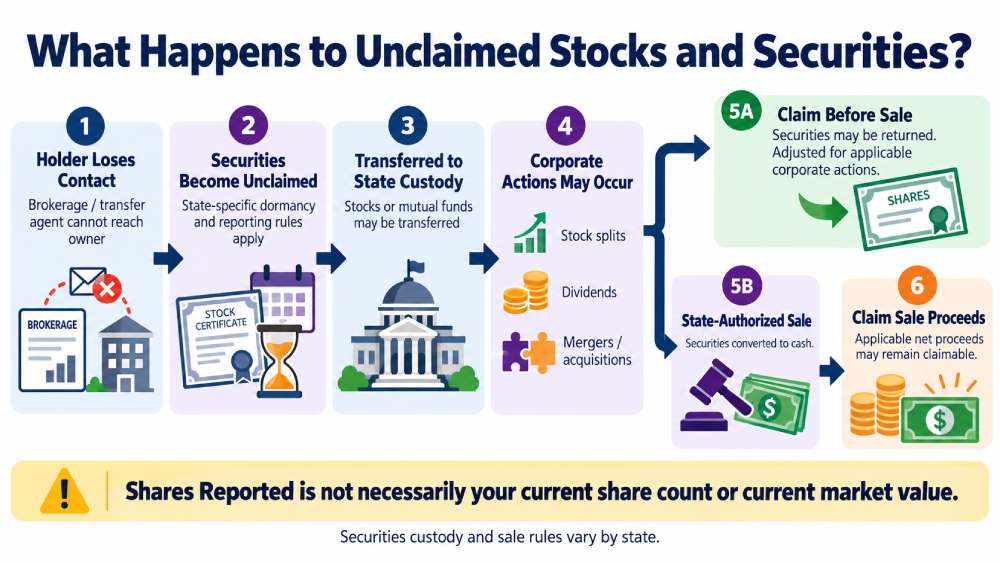
Example: what can happen to unclaimed stock?
Consider this simplified example:
1. Owner holds 100 shares
Jane owns 100 shares through a brokerage or transfer agent.
2. Holder loses contact with Jane
Applicable unclaimed property conditions and the state’s dormancy period eventually run.
3. Shares are reported and transferred
The holder reports Jane and transfers the securities according to the state’s procedures.
4. State holds the securities
Corporate actions can occur while the shares are in custody.
5. Possible stock split or merger
The original 100-share record may no longer describe Jane’s current entitlement.
6A. Jane claims while securities remain in custody
Under a state such as California, an approved claimant may receive the securities or adjusted securities position.
OR
6B. Securities are sold under state law
The investment is converted to cash.
7. Jane claims later
Her claim may now be for the applicable net sale proceeds and qualifying amounts credited before the sale.
Use this process:
- Confirm you are using an official state database.
- Save the Property ID.
- Check the reported owner name.
- Compare the old address with your history.
- Identify the reporting holder.
- Identify the security name.
- Record Shares Reported and Cash Reported separately.
- Start the official claim promptly.
- Submit ownership documents if requested.
- Let the state determine whether the claim currently consists of securities, adjusted securities, cash proceeds or a combination.
Frequently asked questions
What happens to unclaimed stocks?
Unclaimed stocks can be transferred into state custody after meeting the applicable state’s abandonment rules. The state may hold the securities for a period and can potentially sell them if authorized by law. A later claimant may receive securities if they remain in custody or sale proceeds if they were already liquidated.
Does the state sell unclaimed stock?
Some states do. California currently requires qualifying securities to be sold within a specific statutory window, while Arizona states that securities are liquidated within three years of receipt. Rules vary by state.
How long does California hold unclaimed stock before selling it?
Under California’s current 2026 law, securities subject to §1563 are generally sold no sooner than 18 months and no later than 20 months after the actual filing date of the applicable report.
How long does Arizona hold unclaimed securities?
Arizona currently states that securities are liquidated within three years after receipt. The resulting proceeds remain associated with the original owner subject to Arizona’s claim rules.
Possibly. California, for example, returns securities to an approved claimant if the securities remain in state custody. If they have already been sold, the claimant receives the applicable net sale proceeds instead.
Do not assume so. In California, once securities have been sold, the claimant is entitled to the net proceeds received from the actual sale rather than a hypothetical value based on today’s stock price.
What happens to dividends?
Rules vary, but California credits dividends, interest and other increments realized or accruing on securities at or before liquidation to the owner’s account.
What happens if the stock splits?
A stock split can change the number of shares associated with the original position. The Shares Reported field may therefore no longer represent the current entitlement after a split.
What happens if the company merges?
The original stock may be exchanged for successor-company shares, cash or a combination. The state may need to research the corporate action before completing the claim.
They can be converted into cash under state reporting procedures. California and Arizona both have procedures under which fractional shares may result in cash rather than being transferred as fractional stock.
Can unclaimed mutual funds be transferred to the state?
Yes. States such as California and Arizona have procedures for transferring unclaimed mutual fund interests into state custody.
A zero share count does not necessarily mean the property has no value. Check whether the record includes Cash Reported or another property component.
The property may consist primarily of securities. Do not treat a zero cash field as proof that the overall property is worthless.
Why is my securities claim taking so long?
After ownership is verified, the state may need to research corporate actions such as mergers, acquisitions, splits and dividends. California specifically says securities claims can require this additional work.
Can I claim stock that belonged to a deceased relative?
Potentially, if you can establish both the deceased owner’s connection to the securities and your legal entitlement or authority to claim for the estate.
Bottom line
Unclaimed stocks and securities can change significantly after they leave the original holder.
The process can involve:
- transfer of shares into state custody;
- dividends;
- stock splits;
- mergers and acquisitions;
- fractional-share proceeds;
- mutual fund activity;
- state-authorized liquidation; and
- eventual payment of sale proceeds.
That means an old record showing:
Shares Reported: 100
does not necessarily mean:
“You will receive exactly 100 shares worth today’s stock price.”
The state first needs to determine what happened to the investment after it was reported.
If the securities remain in custody, they may potentially be returned under that state’s rules. If they have already been sold, your claim may instead represent the applicable proceeds.
For help interpreting the fields in your record, read What Does Shares Reported Mean in Unclaimed Property? and What Does Cash Reported Mean in Unclaimed Property?.
When you are ready to file, use our complete guide to finding and claiming unclaimed property.
Important information: UnclaimedPropertyGuide.net is an independent informational website and is not affiliated with any state or federal government agency. Securities dormancy, custody, corporate-action treatment, liquidation periods, claim rights and processing procedures vary by jurisdiction. Always verify your specific property with the official state unclaimed property program.