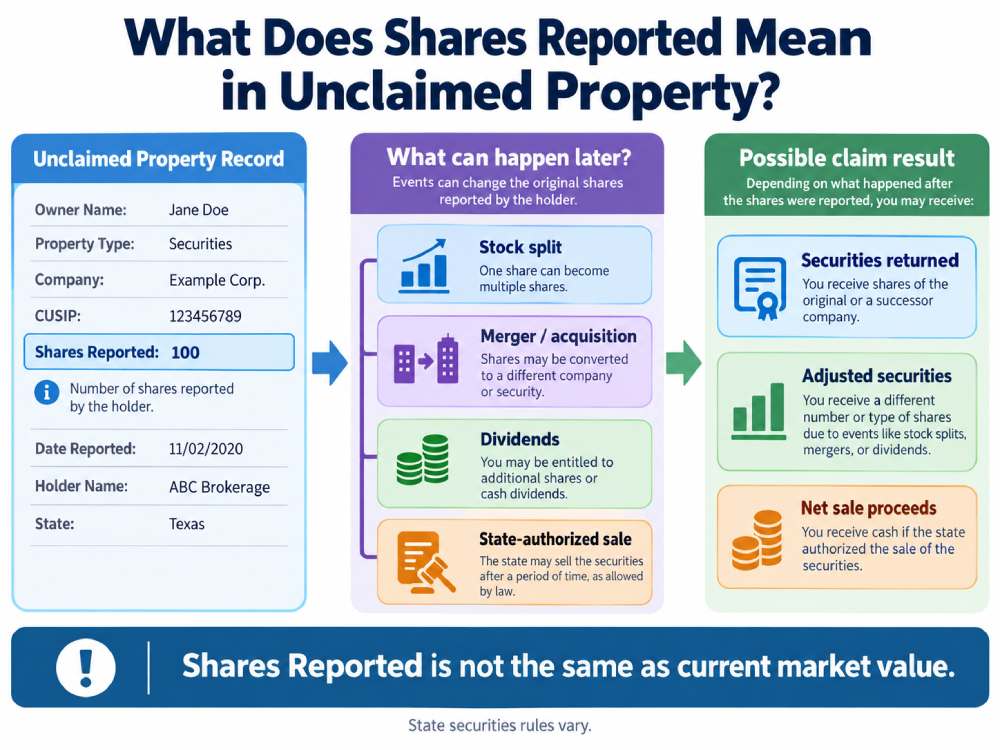
“Shares Reported” generally means the number of shares of stock, a mutual fund or another security that the holder reported as unclaimed property.
For example, an unclaimed property record might show:
- Property Type: Securities
- Cash Reported: $0.00
- Shares Reported: 125.0000
- Name of Security Reported: Example Corporation
In that situation, 125.0000 is a quantity of shares—not a dollar value.
However, the number originally reported should not automatically be treated as the exact number of shares you will receive today. Stock splits, mergers, acquisitions, dividends, liquidations and sales by the state can affect what ultimately becomes payable to the rightful owner.
When a business reports securities as unclaimed property, it can provide information about the security separately from any cash associated with the account.
California’s official Claim Affirmation Form, for example, contains separate fields for:
- Cash Reported;
- Shares Reported; and
- Name of Security Reported.
California State Controller — Sample Claim Affirmation Form
This distinction is important because an investment-related property can contain something very different from an ordinary forgotten checking-account balance.
Shares Reported answers a quantity question:
How many shares did the holder report as part of this property?
The shares are initially reported by the holder—the organization that had the owner’s security or account before it became reportable as unclaimed property.
A holder could be:
- a brokerage;
- a transfer agent;
- a mutual fund company;
- a corporation;
- a bank or financial institution;
- a dividend reinvestment plan administrator; or
- another organization responsible for the security.
The holder reports information identifying the owner and the property and, under the applicable state’s procedures, may also transfer or re-register the security for the state.
Arizona, for example, has specific procedures requiring reportable securities to be transferred or registered according to its securities-remittance instructions.
Arizona Department of Revenue — Reporting Securities
No.
This is probably the most important distinction.
If a record says:
Shares Reported: 250
that does not mean:
- the property is worth $250;
- the stock price is $250;
- you will receive a $250 check; or
- the state values each share at $1.
It generally means that 250 shares were reported.
The economic value depends on what the security is and what happened to it afterward.
You first need to identify the security.
A record may include a field such as:
Name of Security Reported
which can identify the corporation, mutual fund or other security associated with the shares.
But even knowing the company name and original share count may not tell you the current value.
You need to consider whether:
- the security still exists;
- the company changed names;
- the company merged with another company;
- there was a stock split;
- the company was acquired;
- the shares were converted into another security;
- cash was paid during a merger;
- the company became private;
- the shares became worthless; or
- the state already sold the securities.
Shares Reported is therefore a historical reporting field, not a live stock quote.
These fields describe different components of the property.
| Field | What it generally tells you |
|---|---|
| Cash Reported | The cash amount or cash component reported for the property. |
| Shares Reported | The number of securities shares reported. |
For example:
| Cash Reported | Shares Reported | Possible interpretation |
|---|---|---|
| $500 | 0 | The record may contain cash but no separately reported securities shares. |
| $0 | 100 | The reported property may primarily consist of securities. |
| $250 | 75 | The property may contain both cash and shares. |
This is why you should not evaluate an investment-related claim by looking at only one field.
For more detail, see What Does Cash Reported Mean in Unclaimed Property?.
Yes.
Securities accounts can generate both share-based and cash property.
For example, an account could involve:
- shares of stock;
- cash dividends;
- fractional-share proceeds;
- cash from a corporate transaction;
- capital-gain distributions;
- interest; or
- other cash associated with the security.
NAUPA’s reporting format reflects this distinction by maintaining separate data elements for monetary amounts and the number of security shares.
NAUPA — Reporting Software and Electronic File Format
As of 2026, NAUPA states that NAUPA II remains the reporting format in current production, while the newer NAUPA III XML format is being introduced through a phased rollout beginning in 2027.
This is relevant because the existing production standard separately identifies the number of shares associated with a security.
Yes, securities reporting can include fractional shares.
NAUPA’s current production reporting format provides decimal precision for the field used to report the number of shares.
That is why you may see a quantity such as:
42.3750 shares
rather than a whole number such as:
42 shares
Fractional shares can occur in situations involving:
- mutual funds;
- dividend reinvestment plans;
- stock splits;
- corporate reorganizations; or
- other investment-account activity.
Do not round the figure when trying to match a state record with your historical account records.
Not necessarily.
The reported quantity reflects information associated with the property when it was reported, but securities can change after that point.
California specifically explains that securities claims may require research into corporate actions that occurred while the security was held by the State Controller’s Office.
Examples include:
- mergers;
- acquisitions;
- stock splits; and
- dividends.
California State Controller — Securities Claim Processing
That research can affect what the claimant is ultimately entitled to receive.
What happens if the stock split after it was reported?
A stock split can change the number of shares associated with an owner’s interest.
For example, imagine that:
100 shares
were reported and the company later completed a:
2-for-1 stock split.
Conceptually, the ownership position could become:
200 shares
subject to the particular facts of the security and how the state handled the property.
California states that the rightful owner or heir is entitled to benefits arising from corporate actions such as stock splits, dividends and mergers while securities are held by the State Controller’s Office.
California State Controller — Securities and Corporate Actions
This means the original Shares Reported field may no longer tell the entire story.
What if the company merged with another company?
A merger can change:
- the security’s name;
- the ticker symbol;
- the number of shares;
- the company whose stock is ultimately held;
- the stock-to-stock exchange ratio; or
- whether part or all of the interest becomes cash.
That is another reason securities claims often require additional research after approval.
You might see an old company name on a historical record even though the investment was later converted into another company’s shares or into cash.
What if the company was acquired for cash?
If an acquisition converts stock into cash, the owner may ultimately have a cash entitlement instead of shares.
For example, a security originally reported as:
50 shares of Company A
could later be affected by an acquisition under which shareholders receive a specified amount of cash per share.
After such a corporate action, the original Shares Reported number may remain useful as historical information, but the eventual property may be cash rather than transferable stock.
What happens to dividends while the state holds the stock?
This depends on state law, but California provides a clear example.
California states that an owner or heir is entitled to benefits from certain corporate actions while the securities are being held, including:
- dividends;
- mergers; and
- stock splits.
If the state later sells the securities, California says the claimant is entitled to the applicable net sale proceeds and qualifying dividends, interest or other increments realized before the sale.
California — How Securities Claims Are Handled
Other states can use different holding and liquidation rules.
It depends on whether the state still holds the securities and on the law of that state.
California currently states that when securities remain in its custody, a person making a valid claim is entitled to receive the securities.
If those securities have already been sold, the claimant is instead entitled to the applicable net proceeds from the sale.
This principle is contained in California’s current Unclaimed Property Law.
California Unclaimed Property Law
What happens if the state already sold my stock?
You may receive cash rather than shares.
California law provides that if securities have been sold, a valid claimant may receive the net proceeds received by the Controller from the sale.
Arizona provides another example of why state rules matter. Arizona’s current owner FAQ states that securities are generally liquidated within three years of receipt, while the resulting proceeds remain available to the original owner subject to Arizona’s applicable custody rules.
Arizona Department of Revenue — Unclaimed Property Owner FAQ
Generally, you should not assume so.
If the state sold the securities under its applicable law, the claim may be for the proceeds generated by that sale rather than what those shares would theoretically be worth at today’s market price.
For example, if stock was sold several years ago and later increased dramatically in value, the current market price does not automatically determine the amount recoverable from the state.
The exact result depends on the state’s law and the history of the property.
If a record says:
Shares Reported: 0
it generally means that no securities shares are reflected in that particular reported-shares field.
But you should still examine the rest of the record.
A zero share count does not automatically mean:
- the property has no value;
- there is no cash;
- the property is invalid; or
- nothing can be claimed.
For example, a record could show:
Cash Reported: $500
Shares Reported: 0
In that case, the property may simply be cash rather than securities.
That can indicate that the property contains securities even though no cash component is shown in that field.
For example:
Cash Reported: $0.00
Shares Reported: 200.0000
Security: Example Corporation
The important item may be the 200 shares, not the zero-dollar cash field.
This is precisely why the fields should be read together.
See What Does Cash Reported Mean in Unclaimed Property?.
Yes.
The economic position associated with a security can change because of:
- stock splits;
- reverse stock splits;
- mergers;
- spin-offs;
- acquisitions;
- reorganizations;
- dividend reinvestment;
- fractional-share activity; or
- other corporate actions.
This is why California says additional research is required for many approved securities claims before payment or transfer can be completed.
California — Securities Claim Processing Information
Why do securities claims sometimes take longer?
A cash-only claim can be relatively straightforward once ownership is verified.
A securities claim can require an additional question:
What does the original security represent today?
California currently explains that after a securities claim is approved, additional time may be needed to research:
- corporate mergers;
- acquisitions;
- stock splits;
- dividends; and
- other activity affecting the security’s value.
California says most securities claims are paid within about 120 days after approval, although claims requiring extensive research can take longer.
California State Controller — Claim Processing Information
This is a California processing example, not a nationwide deadline.
For broader timing information, see How Long Do Unclaimed Property Claims Take?.
What does Name of Security Reported mean?
This field identifies the security associated with the reported shares.
It might identify:
- a corporation;
- a mutual fund;
- a bond;
- a dividend reinvestment plan;
- another equity interest; or
- another type of security.
The name is particularly important when interpreting the Shares Reported field.
Knowing:
Shares Reported: 100
is much more informative when you also know:
Name of Security Reported: XYZ Corporation
However, historical security names can become outdated following mergers, acquisitions or reorganizations.
Is the company listed as the holder the same as the stock issuer?
Not necessarily.
The holder is the entity responsible for reporting the unclaimed property.
The issuer is the company or organization whose security is represented by the shares.
For example, a brokerage or transfer agent might report property involving shares issued by a completely different corporation.
You could therefore see:
Reported By / Holder: Transfer Agent ABC
Name of Security: XYZ Corporation
Those names serve different purposes.
See What Does Holder Mean in Unclaimed Property?.
What if I do not recognize the security name?
Do not immediately assume the property is unrelated to you.
The security could be connected to:
- a former company name;
- a corporate merger;
- a brokerage account;
- an employee stock plan;
- a dividend reinvestment plan;
- an inherited investment;
- a mutual fund;
- a spin-off; or
- another historical financial relationship.
Compare the entire record:
- owner name;
- reported address;
- holder;
- security name;
- property type;
- cash reported; and
- shares reported.
The state may request supporting documentation if additional verification is necessary.
No.
The field describes the reported property. It does not independently establish that the person viewing the listing is the rightful owner.
The claim process may still require evidence such as:
- government-issued identification;
- Social Security Number or TIN information when requested;
- proof of the reported address;
- an old brokerage statement;
- a stock certificate;
- account documentation; or
- other evidence connecting the claimant to the security.
California’s business-claim instructions, for example, specifically identify an account statement or stock certificate as possible ownership evidence for property reported by an investment company.
California — Business Claim Documentation
What if I still have an old stock certificate?
Keep it.
An old stock certificate may be useful evidence of your relationship with the security, particularly if the state requests proof connecting you to the reported property.
But do not assume an old physical certificate necessarily represents today’s exact number of active shares.
The security may have undergone:
- splits;
- mergers;
- redemptions;
- acquisitions;
- cancellations; or
- other corporate events.
Submit documents only according to the state’s claim instructions, and do not surrender an original certificate unless the official program specifically requires it.
Can securities become worthless?
Yes.
Some securities can lose their economic value or become non-transferable.
The treatment of such securities can vary by jurisdiction.
For example, Arizona currently instructs holders not to report worthless or non-transferable securities and to report them later if they become transferable or regain value.
Arizona — Worthless or Non-Transferable Securities
California’s holder instructions use a different procedure for certain non-transferable securities, illustrating again why securities rules cannot safely be generalized across all states.
California — Securities Reporting and Remittance
No.
The presence of shares does not by itself answer a tax question.
Tax consequences can depend on:
- the type of security;
- how the property was originally acquired;
- whether securities were sold;
- the owner’s tax basis;
- dividends or other income involved; and
- the claimant’s individual tax circumstances.
Do not use the Shares Reported field alone to calculate taxable income, capital gains or cost basis.
How should I read a securities unclaimed property record?
Read all of the fields together.
| Field | What it helps explain |
|---|---|
| Owner | Whose property was reported? |
| Reported Address | What address was associated with the owner? |
| Holder / Reported By | Which organization reported the property? |
| Property Type | What category of property was reported? |
| Cash Reported | Was a cash component reported? |
| Shares Reported | How many securities shares were reported? |
| Name of Security | Which security was associated with the reported shares? |
| Property ID | Which specific state record should you reference? |
Suppose you find:
Reported Address: 125 Oak Street
Reported By: ABC Transfer Company
Property Type: Securities
Cash Reported: $0.00
Shares Reported: 150.0000
Name of Security Reported: XYZ Corporation
You could reasonably interpret that record as saying:
- Sarah Johnson was reported as the owner.
- The holder had 125 Oak Street associated with her.
- ABC Transfer Company reported the property.
- The reported property involved securities.
- No cash is shown in the cash field.
- 150 shares were reported.
- The security was XYZ Corporation.
What you cannot conclude from the listing alone is:
- what those shares are worth today;
- whether XYZ Corporation still exists under that name;
- whether the shares underwent a split;
- whether the state still holds the securities;
- whether they have already been sold; or
- what the final claim payment will be.
If the record appears to match you:
- Check the owner name.
- Compare the reported address with your history.
- Identify the holder.
- Review the security name.
- Write down the Shares Reported quantity.
- Check whether Cash Reported is also present.
- Save the Property ID.
- File through the official state claim process.
- Provide investment or ownership records if requested.
You generally do not need to determine the entire corporate history yourself before filing the claim. The state may perform securities research as part of processing an approved claim.
Use our How to Find and Claim Unclaimed Property for Free guide for the complete filing process.
Frequently asked questions
Shares Reported generally means the number of shares of a stock, mutual fund or other security that the holder reported as part of the unclaimed property record.
No. It represents a quantity of shares, not a dollar value. The value depends on the security and what happened to it after it was reported.
Not necessarily. Stock splits, mergers, acquisitions, sales and other corporate actions may affect the claimant’s current entitlement.
It generally means that 100 shares were reported for the property. It does not mean the property is worth $100.
Yes. Fractional shares can be reported, so a securities record may show values such as 25.5000 or 100.1250 rather than only whole shares.
It generally means no shares are reflected in that field. The property can still contain cash or another asset, so check the entire record before concluding that it has no value.
The property may primarily consist of securities rather than cash. Check the security name and other record details.
Will the state return my actual stock?
It depends on the state and whether the securities are still being held. California, for example, can return securities that remain in custody. If they have been sold under applicable law, a claimant may instead receive the net sale proceeds.
What happens if my stock split while the state held it?
State law may protect benefits arising from corporate actions. California specifically recognizes stock splits, dividends and mergers when determining a claimant’s entitlement to securities held by the state.
What if the company was acquired?
The original security may have been converted into shares of another company, cash, or a combination of both. Securities claims may require corporate-action research to determine the current entitlement.
The claim may be paid in cash based on the applicable proceeds from the sale rather than in securities. The precise rule depends on the state handling the property.
Why does a securities claim take longer than a cash claim?
The state may need to research stock splits, mergers, acquisitions, dividends and other corporate activity before determining what securities or proceeds are due.
No. You still need to establish ownership through the official claim process using the identifying information and documentation requested by the state.
Bottom line
“Shares Reported” generally means the number of securities shares that the holder reported as unclaimed property.
But the number is only part of the story.
Remember:
- Shares Reported = number of shares reported.
- Cash Reported = separate cash component.
- Name of Security Reported = identifies the reported investment.
- Shares Reported is not a dollar value.
- The original share count may be affected by stock splits, mergers and other corporate actions.
- If the state still holds the securities, they may potentially be transferred to an approved claimant under that state’s rules.
- If the securities were sold, the claimant may receive cash proceeds instead.
Most importantly, do not multiply the Shares Reported figure by today’s stock price and assume that is exactly what your claim is worth. The security’s history and the state’s treatment of it matter.
For the related monetary field, read What Does Cash Reported Mean in Unclaimed Property?.
You can also learn how to interpret the asset category in What Does Property Type Mean in Unclaimed Property?.
Important information: UnclaimedPropertyGuide.net is an independent informational website and is not affiliated with any state or federal government agency. Securities custody, liquidation periods, corporate-action treatment and claim procedures vary by jurisdiction. Always verify the property and current claim rules with the official state program.