In unclaimed property, the “holder” is generally the business, organization or other entity that has possession of property belonging to someone else or owes money to that person. In a state unclaimed property search result, the holder name usually identifies the organization that reported the property—such as a bank, employer, insurance company, utility or government agency.
The holder is usually not the person entitled to claim the money. The person or entity entitled to the property is the owner. And if the property has already been transferred to a state Unclaimed Property Program, the holder may no longer have the money at all.
What does “holder” mean in unclaimed property?
NAUPA’s current unclaimed property glossary defines a holder broadly as a person or entity that is in possession of property belonging to another, acts as a trustee, or owes another person an obligation.
NAUPA — Unclaimed Property Glossary
In practical terms, a holder might be:
- A bank holding money in an old deposit account.
- An employer that issued wages or a payroll check that was never collected.
- An insurance company owing benefits or proceeds.
- A utility owing a deposit or customer refund.
- A retailer or other business owing a refund, credit or payment.
- A brokerage or financial institution holding securities or investment-related property.
- A government entity that owes an uncollected payment.
Texas, for example, tells businesses and government entities that have unclaimed property reporting obligations that they are holders.
Texas Comptroller — Are you an unclaimed property holder?
What is the difference between the holder, owner and state?
These three roles are easy to confuse, but they are not the same.
| Role | What it means | Example |
|---|---|---|
| Holder | The organization that originally possesses or owes the property. | An employer has an uncashed payroll check. |
| Owner | The person or entity entitled to the property. | The employee is owed the wages. |
| State program | The government program that administers qualifying property after it is reported and transferred. | The state receives the reported funds and later evaluates the employee’s claim. |
| Claimant | The person or entity asking the state to return the property. | The employee files a claim—or, in some cases, an authorized estate representative files for a deceased owner. |
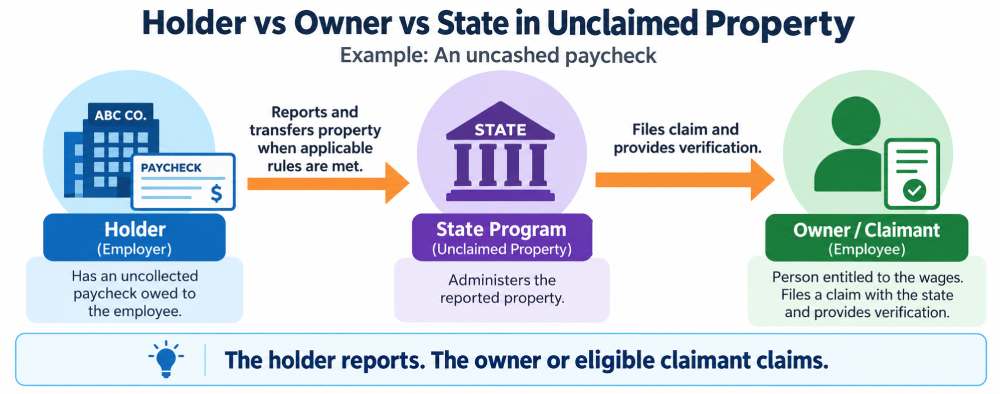
A single person can be both the owner and claimant, but the holder is a different role.
For example:
Employer = Holder → Employee = Owner → State = Administrator → Employee files claim as Claimant
Holder: Who had or owed the money?
Owner: Who does the property belong to?
State: Who administers it after transfer?
Claimant: Who is asking for it now?
Why does a holder appear in my unclaimed property search result?
The holder name helps identify where the property came from.
For example, imagine a search result showing:
| Field | Example |
|---|---|
| Owner | John A. Smith |
| Holder | ABC Payroll Services LLC |
| Property Type | Wages / Payroll |
| Reported Address | Dallas, Texas |
The holder name does not prove that this property belongs to you, but it gives you another clue.
You might ask:
- Did I work for a company that used this payroll provider?
- Did I have an account with this bank?
- Did I use this utility?
- Did this insurer cover me or a family member?
- Does the reported city match an old address?
The more details that match your history, the stronger the indication that the listing may be connected to you.
Does the holder still have my money?
It depends on whether the property has already been transferred to the state.
If the property has not been reported yet
The business or organization may still control the account or payment.
In that situation, contacting the holder directly may allow you to:
- Confirm your identity.
- Update your address.
- Cash or replace a payment.
- Restore contact with the institution.
- Resolve the property before it is transferred.
If the property has already been transferred
The original holder may no longer have the funds.
For example, Washington’s required holder notice tells owners that property may be transferred to the custody of the Department of Revenue and states that, after the transfer, an owner seeking its return must file a claim with the administrator.
Washington RCW 63.30.290 — Contents of notice by holder
That is a useful state-specific example of the distinction:
Before transfer → the holder may still be the place to resolve the property.
After transfer → the state claim process usually becomes the important route.
Why would a holder report property as unclaimed?
A holder may have money or property that it has not been able to successfully return to its owner.
Common examples include:
- An employee never cashing a paycheck.
- A refund being sent to an outdated address.
- A customer forgetting about a bank account.
- An insurance payment remaining uncollected.
- A utility deposit never being returned.
- A dividend or other payment never reaching the investor.
After the applicable abandonment requirements are met, the holder may be required to report the property and transfer it to the appropriate state program.
Texas provides a straightforward official example: it instructs holders to determine whether property has reached the applicable abandonment period, conduct required owner outreach and then report the owner’s money or financial assets to the Comptroller when required.
Texas Comptroller — How holders report unclaimed property
The exact dormancy period and reporting process are not universal, so a Texas deadline or property period should not be applied automatically to another state.
What if I do not recognize the holder name?
An unfamiliar holder name does not automatically mean the property is not yours.
This is a very common source of confusion.
The company shown in an unclaimed property database may be:
- A legal corporate name different from the consumer brand you remember.
- A parent company.
- A former company name.
- A company that acquired another business.
- A successor to the original holder.
- A payroll processor.
- A financial institution you used indirectly.
- An insurer or administrator connected with an employer benefit.
Washington’s current reporting statute, for example, requires a holder that changed its name—or is a successor to a previous holder—to include former or previous holder information in its unclaimed property report when applicable.
Washington RCW 63.30.230 — Content of holder reports
This illustrates why the name displayed in a search result may not always be the brand name you immediately recognize.
How can the holder name help me verify a possible match?
Treat the holder as one piece of evidence, not as proof by itself.
When evaluating a result, compare as many details as the state database makes available.
- Check the owner name.
Does it match your current or former legal name? - Check the reported address or city.
Does it match somewhere you previously lived or worked? - Check the holder.
Did you have any relationship with that company or organization? - Check the property type.
Does the type make sense for that relationship? - Check your records.
Look at old bank statements, pay stubs, insurance paperwork, utility bills or emails.
For example:
| Holder shown | Property type | Possible connection to investigate |
|---|---|---|
| Former employer | Wages | Uncashed paycheck or payroll payment |
| Bank | Deposit account | Old checking or savings account |
| Insurance company | Insurance proceeds | Policy benefit, refund or other payment |
| Utility company | Customer refund | Deposit or overpayment |
| Government agency | Check / warrant | Government-issued payment that was never collected |
If your result uses the term “Warrants”, read What Are Warrants in Unclaimed Property? for that separate property-type explanation.
What if the holder name changed?
Companies merge, rebrand, reorganize and acquire other businesses.
That means an old property can sometimes appear under:
- A company’s former legal name.
- The name of an acquired company.
- A parent or successor organization.
- A name you never encountered as a customer.
Before rejecting a possible match simply because the name looks unfamiliar, search the company name independently and compare it with your old records.
If you still cannot establish a connection, use the property ID when contacting the official state program and ask whether additional holder information is available.
Should I contact the holder or the state?
The answer depends mainly on whether the property has already been transferred.
| Situation | Best starting point |
|---|---|
| You received a notice that property may soon be transferred | Contact the holder through verified contact information. |
| The company says it still has the property | Ask the company how to recover or reactivate it. |
| The company says it already reported and transferred the property | Ask which state received it, then use that state’s official program. |
| You found the property in an official state database | Use the state’s claim process. |
| You do not recognize the holder | Investigate the holder and compare the owner name, address and property type before filing. |
If the property is already in a state database, you can use our Unclaimed Property by State directory to reach the correct official program.
Then follow our complete guide to finding and claiming unclaimed property.
Does the holder decide whether my claim is approved?
Usually not once the property has been transferred into the state program.
At that point, the state administrator evaluates the claim under its procedures.
The former holder may still be useful because it can sometimes help establish:
- Where the property came from.
- The name associated with the account.
- An old account number.
- The address used at the time.
- Whether the property was actually reported.
- Which state received the property.
But finding the holder’s name on a record does not mean the company itself now approves or pays every claim.
Does “holder” mean I owe that company money?
No. The term holder does not mean creditor or debt collector.
In unclaimed property terminology, it describes the party that held property belonging to someone else or owed an obligation that became subject to unclaimed property reporting.
For example:
Employer owes you an uncashed paycheck → employer is the holder → you are the owner.
That is very different from:
You owe the employer money.
Separate rules can sometimes allow certain debts to affect an unclaimed property payment, but that is a different question from the meaning of the holder field.
See Can Unclaimed Property Be Debt? for that distinction.
Can a government agency be the holder?
Yes.
A holder does not have to be a private business. Texas, for example, expressly describes both businesses and government entities with reportable unclaimed property as holders.
A government agency might have issued a payment that was never successfully delivered or collected.
This is one reason terms such as “warrant” may appear in some state unclaimed property records: in that context, the property can represent an uncashed government-issued payment rather than anything related to criminal law.
Is a holder the same as an unclaimed property finder?
No.
A holder is connected to the underlying property itself.
A private finder, locator or recovery company is a third party that may contact people about unclaimed property and offer assistance locating or claiming it, sometimes for a fee.
Those are completely different roles.
Read Is Unclaimed Property a Trap? if you received an unexpected message about missing money.
What should I do when I see a holder name?
Use this simple checklist:
- Read the holder name carefully.
- Compare it with your past employers, banks, insurers, utilities and other accounts.
- Check the reported owner name.
- Compare any city or address shown.
- Look at the property type.
- Search unfamiliar corporate names before rejecting the match.
- Use the property ID when asking the state for clarification.
- If the match appears legitimate, follow the official claim process.
Do not file simply because the name matches yours. The holder, reported address, property type and other available details can help distinguish your property from someone else’s.
Frequently asked questions
What is a holder in unclaimed property?
A holder is generally the business, organization or other entity that possesses property belonging to another person or owes that person an obligation before the property is transferred into a state unclaimed property system.
Is the holder the same as the owner?
No. The holder has or owes the property, while the owner is the person or entity entitled to it.
Does the holder still have my money?
Possibly, if the property has not yet been transferred. If it has already been reported and delivered to the state, the state program generally becomes the place to pursue the claim.
Why don’t I recognize the holder?
The listing may show a legal company name, former name, parent company, successor organization, payroll processor or other entity you did not recognize as the customer-facing brand. Compare the record with your old addresses, employment and account history.
Can the holder be my former employer?
Yes. An employer can be a holder when it has wages or another payment belonging to an employee that ultimately becomes reportable as unclaimed property.
Can a government agency be a holder?
Yes. Government entities can also have unclaimed payments or other property that must be reported under applicable law.
Should I contact the holder before filing a claim?
If the property has already appeared in an official state database, generally start with the state’s claim instructions. If you received a pre-transfer notice or the property is still with the company, contacting the holder may be appropriate.
Does the holder name prove the property belongs to me?
No. It is one clue. Compare it with the owner name, reported address, property type and your own records before concluding that a listing is yours.
What if the holder says it transferred my money but I cannot find it?
Ask which state received the property, when it was reported, the name and address used in the report and any available property reference. Then contact the receiving state’s official Unclaimed Property Program if necessary.
Bottom line
In an unclaimed property record, the holder is usually the organization that originally had or owed the property before it was transferred to the state.
The holder may be a:
- Bank.
- Employer.
- Insurance company.
- Utility.
- Brokerage.
- Government agency.
- Other business or organization.
The most important distinction is:
Holder = who had or owed the property.
Owner = who is entitled to it.
State = who administers it after transfer.
Claimant = who is asking for it now.
If you found a holder name in a state search result, treat it as a clue to the origin of the property. Compare it with your old employers, accounts, addresses and the property type before submitting a claim.
If the property appears connected to you, use our Unclaimed Property by State directory to access the appropriate official program, then follow our claim guide for the next steps.
Important information: UnclaimedPropertyGuide.net is an independent informational website and is not affiliated with any state or federal government agency. Unclaimed property terminology, reporting requirements and claim procedures can vary by jurisdiction and property type. Always verify your specific record through the official state program.