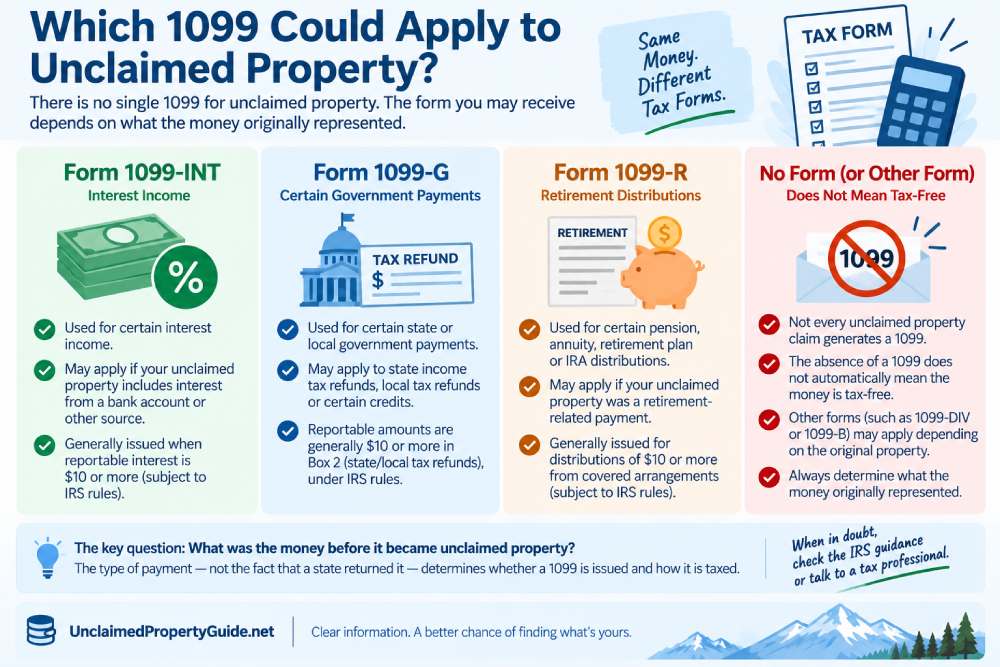
You may receive a Form 1099 after claiming unclaimed property, but not every claim generates one.
Whether a tax form is issued generally depends on what the property originally represented.
For example, taxable interest, a state tax refund or a retirement distribution can have different reporting rules from simply recovering the principal from an old bank account.
Does every unclaimed property claim come with a 1099?
No.
The fact that a state returned unclaimed property to you does not automatically mean the state must issue a Form 1099.
The IRS uses different information returns for different kinds of payments.
For example:
- Interest can be reported on Form 1099-INT.
- Certain state or local tax refunds can be reported on Form 1099-G.
- Certain pension, annuity or retirement distributions can be reported on Form 1099-R.
- Other types of income can have different reporting forms.
The correct form depends on what the money was before it became unclaimed.
What kind of 1099 can you receive for unclaimed property?
There is no single Form 1099 designed specifically for unclaimed property.
Possible forms include:
| Possible form | When it may be relevant |
|---|---|
| 1099-INT | Interest income associated with the recovered property. |
| 1099-G | Certain government payments, including qualifying state or local income tax refunds. |
| 1099-R | Certain retirement plan, pension, annuity or IRA distributions. |
| 1099-DIV | Certain dividend distributions related to investments. |
| 1099-B | Certain proceeds from securities transactions when applicable. |
| Other forms | Depending on the original nature of the property and applicable reporting rules. |
When might you receive Form 1099-INT?
Form 1099-INT is used for certain interest income.
The IRS states that Form 1099-INT generally applies when reportable interest in specified boxes reaches at least $10, subject to the detailed filing rules. :contentReference[oaicite:0]{index=0}
This can matter if an unclaimed property payment includes:
- Interest from an old bank account.
- Interest associated with recovered funds.
- Other reportable interest income.
For example, suppose you receive:
$3,000 of account principal + $100 of interest.
The tax and reporting treatment of the $100 interest may differ from the $3,000 that was already your money.
For the broader tax treatment, read Is Unclaimed Property Taxable?.
When might you receive Form 1099-G?
Form 1099-G is used for certain government payments.
The current IRS instructions state that state or local income tax refunds, credits or offsets of $10 or more can be reportable in Box 2 under the applicable rules. :contentReference[oaicite:1]{index=1}
This can be relevant if the unclaimed property you recover was originally a:
- State income tax refund.
- Local income tax refund.
- Credit or offset treated under the Form 1099-G rules.
Not every government payment belongs on Form 1099-G.
The IRS specifically distinguishes state income tax refunds from other types of state payments. :contentReference[oaicite:2]{index=2}
When might you receive Form 1099-R?
Form 1099-R is used for certain distributions from:
- Pensions.
- Annuities.
- Retirement plans.
- IRAs.
- Insurance contracts.
- Other qualifying arrangements.
The IRS states that a Form 1099-R is generally filed for designated distributions of $10 or more from covered arrangements. :contentReference[oaicite:3]{index=3}
This can matter if a retirement-related payment became unclaimed and was later recovered through a state program.
Can you receive more than one tax form?
Potentially, yes.
A complicated unclaimed property claim can involve more than one component.
For example, you might recover:
- Principal.
- Interest.
- Investment proceeds.
- A retirement-related distribution.
Different components can have different tax reporting rules.
That does not mean every claim will generate several forms, but you should not assume that one large payment necessarily has only one tax character.
Who sends the 1099?
This can vary.
Depending on the property, the tax form could potentially come from:
- The original holder.
- A financial institution.
- A retirement plan administrator.
- A government agency.
- Another payer responsible for the reportable payment.
Do not assume that the state Unclaimed Property Program itself will always be the entity shown as payer.
The state may simply be returning property that originated elsewhere.
When will the 1099 arrive?
Information returns generally follow IRS filing and recipient-statement deadlines applicable to the particular form.
You should therefore monitor your mail and online tax documents after the end of the year in which you receive the relevant payment.
If you claimed property late in the year, the tax document may arrive during the following filing season.
Keep your address updated with any payer involved in the claim.
What if I claimed property but never received a 1099?
The absence of a Form 1099 does not automatically mean the payment is tax-free.
Federal tax rules generally depend on the nature of the income, not only on whether a payer sent you an information return.
For example, the IRS requires taxpayers to report taxable interest even in situations where no Form 1099-INT was received.
So if you receive unclaimed property and no form arrives:
- Identify the original property type.
- Identify the original holder or payer.
- Review the claim paperwork.
- Check whether the payment included interest or another income component.
- Look for tax documents in any online account associated with the payer.
- Contact the payer if you believe a required form is missing.
Does no 1099 mean I owe no tax?
No.
These are two separate questions:
| Question | What determines the answer? |
|---|---|
| Will I receive a 1099? | Federal information-reporting rules for the payer and payment type. |
| Is the money taxable? | The tax rules that apply to what the payment originally represented. |
An amount can sometimes be taxable even if you do not receive a form.
Conversely, receiving an information return does not necessarily mean every dollar shown is taxed in exactly the way you might initially assume.
What if my 1099 shows the wrong amount?
Do not simply ignore an incorrect tax form.
If a Form 1099 contains information you believe is wrong:
- Compare it with your claim paperwork.
- Confirm the amount you actually received.
- Identify whether the form reports only one component of the payment.
- Contact the issuer shown on the form.
- Ask whether a corrected information return is appropriate.
Keep copies of all correspondence.
The IRS receives information returns too, so discrepancies between a form and your tax return can create questions later.
What if the 1099 uses an old address?
An old mailing address does not necessarily make the tax form invalid.
This can happen frequently with unclaimed property because an outdated address is often the reason the property became unclaimed in the first place.
Check that the important information is correct, including:
- Your name.
- Taxpayer identification information.
- The payer.
- The payment amount.
- The type of form.
Update your address with the relevant payer when appropriate.
What if the unclaimed property was only my old bank balance?
Suppose you recover $5,000 from an old savings account.
If the $5,000 represents money that was already yours, the simple fact that a state returned it does not automatically mean the entire $5,000 becomes newly taxable income.
However, if the payment includes separately reportable interest, a Form 1099-INT may be relevant.
This is why you should determine whether the state returned:
- Only principal.
- Principal plus interest.
- Another type of income.
What if the unclaimed property was a state tax refund?
A state or local income tax refund can be reported on Form 1099-G under the applicable rules. :contentReference[oaicite:4]{index=4}
Whether that refund is actually taxable on your federal return is a separate question and can depend on whether you previously received a federal tax benefit from deducting the tax.
See our complete tax guide to unclaimed property for more detail.
What if the property came from a retirement account?
Retirement-related unclaimed property deserves extra care.
Depending on the circumstances, the payment may involve Form 1099-R and specific rules regarding:
- Gross distributions.
- Taxable amounts.
- Distribution codes.
- Federal income tax withholding.
- IRA or retirement plan status.
The current 2026 Form 1099-R contains separate fields for gross distribution, taxable amount, withholding and distribution codes. :contentReference[oaicite:5]{index=5}
If the amount is significant, consider professional tax advice rather than treating it like an ordinary cash claim.
What if the unclaimed property belongs to a deceased person?
Tax reporting can become more complicated when property belonged to someone who died.
Questions can include:
- Whether the income belongs to the deceased person, estate or beneficiary.
- Whether the property is inherited principal or taxable income.
- Whether interest accrued after death.
- Whose taxpayer identification number appears on the form.
If you are claiming property from an estate, keep all paperwork showing:
- The original owner.
- Your authority to claim.
- The date and amount paid.
- Any tax forms received.
See who can claim unclaimed money from a deceased relative.
Can a warrant generate a 1099?
Potentially, but the word warrant does not determine the tax form.
A government payment warrant often functions similarly to a check.
You need to know what the warrant originally represented.
For example:
- A state tax refund may involve Form 1099-G.
- Taxable interest may involve Form 1099-INT.
- Another payment may follow different reporting rules.
Read what warrants mean in unclaimed property.
What records should I keep?
Keep:
- The original unclaimed property listing.
- The reporting holder’s name.
- The property type.
- The claim number.
- The approval letter.
- The payment amount.
- Any breakdown between principal and interest.
- Forms 1099 or other tax documents.
- Estate documents if the owner was deceased.
- Investment records if securities were involved.
What should I do if I receive a 1099 after filing my tax return?
First, determine whether the form affects the return you already filed.
Do not assume that every late form automatically requires the same action.
Depending on the circumstances, you may need to review:
- The type of form.
- The tax year shown.
- The amount.
- Whether the income was already reported.
- Whether the form is correct.
If the form changes your tax liability, an amended return may be relevant.
For a significant amount or complicated situation, consult a qualified tax professional.
Frequently asked questions about Form 1099 and unclaimed property
Will I get a 1099 after claiming unclaimed property?
Maybe. It depends on what the recovered property originally represented and whether that payment is subject to information-reporting rules.
Is there a special unclaimed property 1099?
No. There is no single federal Form 1099 specifically for all unclaimed property claims.
What 1099 is used for interest?
Certain reportable interest is generally reported on Form 1099-INT.
What 1099 is used for a state tax refund?
Certain state or local income tax refunds are generally reported on Form 1099-G.
What form is used for an old retirement distribution?
Certain retirement, pension, annuity and IRA distributions are generally reported on Form 1099-R.
If I receive no 1099, is the unclaimed property tax-free?
Not necessarily. Whether the payment is taxable and whether a payer must issue a Form 1099 are related but separate questions.
Who sends the 1099?
It depends on the property. The issuer may be the original payer, financial institution, government agency, retirement administrator or another entity responsible for the reportable payment.
What if my 1099 is wrong?
Contact the issuer shown on the form and request clarification or a correction if appropriate. Keep copies of your claim documents and correspondence.
Can I get more than one tax form from one claim?
Potentially, especially if a claim involves multiple types of property or income. The facts of the payment determine which reporting rules apply.
Bottom line
You will not automatically receive a Form 1099 simply because you claimed unclaimed property.
The tax form, if any, depends on what the property originally represented.
Interest may involve Form 1099-INT. Certain state tax refunds may involve Form 1099-G. Certain retirement-related distributions may involve Form 1099-R. Other property types can follow different rules. The IRS’s current information-return guidance lists different forms according to the underlying payment category rather than creating one universal form for unclaimed property. :contentReference[oaicite:6]{index=6}
Also remember that not receiving a 1099 does not automatically mean a payment is tax-free.
Keep the claim documentation, identify the original property type and review any tax forms that arrive before filing your return.
Next, read Is Unclaimed Property Taxable? or continue with our guide to finding and claiming unclaimed property.
Important information: UnclaimedPropertyGuide.net is an independent informational website and does not provide individualized tax, legal or accounting advice. Tax and reporting requirements depend on the facts of each payment. Consult current IRS guidance or a qualified tax professional for your own situation.