Unclaimed property itself is not a trap. Official state Unclaimed Property Programs are legitimate government programs that hold money and other assets until they can be returned to the rightful owner.
However, scammers frequently use the idea of “unclaimed money” to steal personal information or collect fake fees.
That means you should distinguish between a legitimate state program and an unexpected phone call, text message, email or letter claiming that money is waiting for you.
Is unclaimed property legitimate?
Yes.
Every U.S. state operates an Unclaimed Property Program.
These programs receive qualifying property from businesses and organizations that were unable to return it to the owner.
Examples can include:
- Old bank account balances.
- Uncashed checks.
- Insurance proceeds.
- Utility deposits.
- Refunds.
- Wages.
- Stocks and other securities.
- Dividends.
- Certain safe deposit box contents.
The state acts as a custodian while attempting to return the property to its rightful owner or another eligible claimant.
The National Association of Unclaimed Property Administrators, or NAUPA, provides links to official state programs.
Find your official state Unclaimed Property Program
Why does unclaimed property sound suspicious?
The idea can sound strange because someone may tell you:
“The government is holding money in your name.”
That naturally resembles language used in scams.
But legitimate unclaimed property exists because businesses can lose contact with owners.
For example:
- You moved without updating your address.
- You forgot about an old bank account.
- A check was mailed to an old address.
- An insurer could not locate a beneficiary.
- A business owed you a refund.
- A relative died and left property family members did not know existed.
Eventually, qualifying property may be transferred to the appropriate state under its unclaimed property laws.
What is the difference between real unclaimed property and a scam?
The biggest difference is how you reach the program and what you are asked to do.
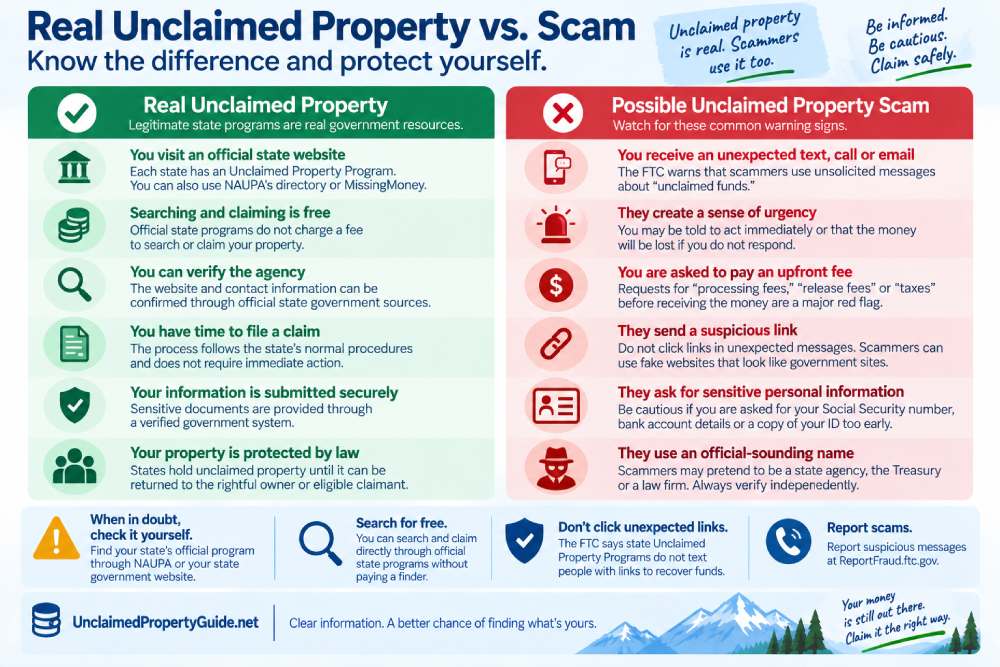
| Official Unclaimed Property Program | Possible scam |
|---|---|
| You independently visit an official state website. | You receive an unexpected text, call or email. |
| Searching the state database is free. | You are asked to pay an upfront “processing” or “release” fee. |
| You can verify the government agency independently. | The organization uses an official-sounding but unfamiliar name. |
| You are given time to follow the normal claim process. | You are told you must act immediately or lose the money. |
| Sensitive documents are submitted through verified official channels. | You are asked to send personal information through an unexpected link. |
Does the government text you about unclaimed property?
Be very cautious with unexpected text messages.
In a 2026 consumer alert, the Federal Trade Commission warned about texts and calls telling people that they were entitled to thousands of dollars in unclaimed property.
The FTC specifically advises consumers:
Do not click links in unexpected texts about unclaimed property.
The FTC states that state Unclaimed Property Programs do not send text alerts asking people to click links to recover property.
FTC warning about unclaimed funds scams
What does an unclaimed property text scam look like?
A scam message might say something like:
- “You have $8,450 in unclaimed funds.”
- “Your claim expires today.”
- “Final notice: claim your state funds.”
- “Your claim period has been extended.”
- “Click here to receive your unclaimed property.”
The message may include a link that resembles a government website.
The goal can be to obtain:
- Your Social Security number.
- Bank account information.
- Credit card information.
- A copy of your ID.
- Your login credentials.
- An upfront payment.
What about unexpected phone calls?
Unexpected calls deserve the same caution.
A caller may claim to represent:
- Your state government.
- A national unclaimed property office.
- A Treasury department.
- A recovery agency.
- An “asset locator.”
An official-sounding name does not prove that the organization exists.
According to the FTC, scammers may even mention a specific amount of money to make the call sound convincing.
Warning signs include:
- Pressure to act immediately.
- A demand for payment before receiving the funds.
- A request for banking information.
- A request for a Social Security number before you independently verify the agency.
- Threats that the money will disappear if you hang up.
Will the government ask for a fee to release unclaimed property?
You do not need to pay a fee to search for and claim your own property through an official state Unclaimed Property Program.
NAUPA specifically states that searching for and claiming missing money through official state programs is free.
NAUPA — Is it really free to search?
A request for an upfront government “processing fee,” “release fee” or “activation fee” is therefore a major warning sign.
Do legitimate claims require personal information?
Yes, sometimes.
This is why scams can be convincing.
A legitimate state may need information to verify that you are the owner.
Depending on the claim, legitimate verification can involve:
- Your legal name.
- Your address.
- A previous address.
- Identity documentation.
- Taxpayer identification information.
- Estate documents.
The issue is not simply whether personal information is requested.
The important question is:
Are you submitting it through a verified official state system that you independently located?
Never send sensitive documents simply because an unexpected caller or text tells you to.
How can I verify an unclaimed property website?
Before submitting sensitive information:
- Do not rely on the link in an unexpected message.
- Search for the state’s official Unclaimed Property Program independently.
- Use NAUPA’s official state directory when in doubt.
- Confirm the agency responsible for the program.
- Check that the website matches the official program listed by the state.
- Use the contact details published on the official government site.
You can also use our Unclaimed Property by State directory as a starting point for finding the correct government program.
Is MissingMoney.com legitimate?
Yes.
MissingMoney.com is a free search resource sponsored by NAUPA.
It allows users to search unclaimed property records from participating states.
NAUPA explains that most states participate in MissingMoney and that the service can show matches and provide links to official state programs.
However, no single website contains every type of unclaimed money in the United States.
For some searches, you may still need to use an individual state website or a specialized federal database.
Are private unclaimed property finders scams?
Not necessarily.
This distinction is important.
NAUPA notes that third-party finders may offer to locate or claim property on behalf of owners and that these services are often legal.
However:
- You generally do not need a finder to search your official state database.
- You can normally file your own state claim for free.
- A finder may charge a fee or percentage of the recovered property.
- Some states regulate finder agreements or fees.
Therefore, a company charging for a service is not automatically a scam.
But you should understand what you are paying for before signing anything.
What should I check before hiring a finder?
Before signing an agreement:
- Search your name through the official state program first.
- Confirm that the property actually exists.
- Check the fee or percentage the company charges.
- Read the cancellation terms.
- Look for state limits on finder fees.
- Do not give unnecessary financial information.
- Keep a copy of the agreement.
For many ordinary claims, a finder is unnecessary.
What is a government impersonation scam?
A scammer may pretend to represent a real or fake government department.
They can use:
- Official-looking logos.
- Government terminology.
- Fake badge or case numbers.
- Spoofed phone numbers.
- Websites designed to resemble government pages.
The FTC warns that government impersonators frequently use urgency and fear to pressure consumers.
For unclaimed property, the message may instead use excitement:
“You have thousands waiting — claim it now.”
The emotional tactic is different, but the objective is the same: get you to act before verifying the claim.
What if someone says the claim expires today?
Treat extreme urgency as a warning sign.
The FTC specifically warns about scammers telling people that:
- Time is running out.
- The claim period is about to expire.
- A special extension has been granted.
Do not let an arbitrary deadline stop you from verifying the information.
Close the message or end the call and find the official state program yourself.
What if a caller already knows my name and address?
That does not prove the call is legitimate.
Names, addresses, phone numbers and other information can come from:
- Public records.
- Data breaches.
- Commercial databases.
- Social media.
- Previously leaked information.
A scammer knowing basic information about you does not mean the person represents the government.
Is a letter about unclaimed money always a scam?
No.
Legitimate state programs can use mail as part of their outreach or claims process.
For example, some states operate automatic matching programs that notify owners by mail.
But scammers also send physical letters.
The FTC issued a separate 2026 warning about fake letters claiming that a person with the recipient’s surname had died and left millions in unclaimed life insurance.
The supposed “law firm” then proposed sharing the nonexistent proceeds.
FTC — Unclaimed life insurance money scam
How do I verify a letter?
Do not rely only on:
- The phone number printed on the letter.
- The website listed in the letter.
- The email address provided.
Instead:
- Search independently for the supposed agency.
- Find the agency’s official website.
- Use the phone number published there.
- Ask whether the letter is genuine.
If the letter references a specific unclaimed property listing, search for that property independently.
Can scammers fake a .gov-looking website?
Scammers can build websites that visually imitate government pages.
Look carefully at the actual domain.
Do not trust:
- A government logo by itself.
- A padlock icon by itself.
- A professional-looking design.
- A domain that merely contains words like “state,” “treasury” or “government.”
Use a trusted directory or navigate from the state’s main government website when unsure.
What if I already clicked an unclaimed property scam link?
If you clicked a suspicious link but did not provide information, close the page and avoid further interaction.
If you entered sensitive information, the next steps depend on what you provided.
Consider:
- Changing compromised passwords.
- Enabling multi-factor authentication.
- Contacting your bank or card issuer if financial information was shared.
- Monitoring financial accounts.
- Reviewing your credit reports if identity information was exposed.
- Reporting the scam to the FTC.
The FTC accepts fraud reports at:
What if I paid an unclaimed property scammer?
Act quickly.
Contact the company you used to make the payment.
Depending on how you paid, this may include:
- Your bank.
- Credit card issuer.
- Debit card issuer.
- Wire transfer company.
- Payment app.
Explain that the transaction was connected to a scam and ask whether it can be reversed or disputed.
Also report the fraud to the FTC.
Can I verify whether I actually have unclaimed property?
Yes.
You do not need to trust the caller, text or letter.
Search independently.
The safest process is:
- Go to NAUPA’s state directory.
- Select the state.
- Open the official state Unclaimed Property website.
- Search your name.
- Review any matching properties.
If you find the property independently, follow the official claim process.
Read our guide to finding and claiming unclaimed property for the full process.
What if the message mentions a real property listing?
Even if the property is real, you do not necessarily need to work with the person who contacted you.
A finder may have discovered a publicly searchable record.
Instead:
- Locate the state database yourself.
- Find the same record.
- Determine whether you can claim it directly.
- Compare that free option with whatever service the finder is offering.
In many cases, the owner can claim directly without paying a recovery percentage.
Does claiming unclaimed property require paying taxes first?
Be suspicious if someone tells you that you must send them a tax payment before your money can be released.
Tax treatment and claim processing are separate issues.
Some recovered property can have tax consequences, but that does not mean an unknown caller should collect “taxes” from you before releasing state property.
Read Is Unclaimed Property Taxable? for information about legitimate tax issues.
What are the biggest red flags?
Be especially cautious when several of these appear together:
- Unexpected contact.
- A large amount of supposedly waiting money.
- A link sent by text.
- A fake or unfamiliar government agency name.
- Pressure to act immediately.
- An upfront processing fee.
- A request for gift cards, crypto or unusual payment methods.
- A request for banking details before verification.
- A request to keep the transaction secret.
- A promise that you cannot verify through an official database.
How to safely search for unclaimed property
Follow this process:
- Ignore unsolicited links.
- Use NAUPA to locate your official state program.
- Search every state where you have lived or done business.
- Check possible matches carefully.
- File through the official state system.
- Provide sensitive information only through verified channels.
- Keep your claim number and documentation.
- Use the official claim-status system after filing.
You can also browse our Unclaimed Property by State directory.
How long should a legitimate claim take?
Processing time varies.
Certain automated claims can move in days, while complicated claims involving:
- Heirs.
- Businesses.
- Multiple owners.
- Securities.
- Additional documentation.
can take weeks or months.
A slow claim does not mean it is a scam.
Read how long unclaimed property claims take.
What if the property belongs to a deceased relative?
Be particularly careful with unsolicited inheritance offers.
Real unclaimed property belonging to a deceased owner can often be claimed, but you usually need to establish legal entitlement through the state holding the property.
Read who can claim unclaimed money from a deceased relative.
That is very different from a stranger contacting you and proposing to split a mysterious multimillion-dollar inheritance.
Frequently asked questions about unclaimed property scams
Is unclaimed property real?
Yes. Official state Unclaimed Property Programs hold money and other assets for rightful owners and eligible claimants.
Is claiming unclaimed property free?
Searching and claiming directly through an official state Unclaimed Property Program is free.
Does the government text people about unclaimed property?
The FTC warns not to click unexpected unclaimed property text links and states that state programs do not text alerts asking people to click links to recover property.
Is an upfront processing fee normal?
Not when claiming directly through an official state program. An unexpected demand for an upfront release or processing fee is a major scam warning.
Are all unclaimed property finders scams?
No. Some third-party finders operate legally and charge for their services. However, they are not required to search or file a normal claim directly with the state.
Is MissingMoney.com legitimate?
Yes. MissingMoney is sponsored by NAUPA and provides free searches across participating state databases.
A legitimate state program may request identifying information when necessary to verify ownership. Submit sensitive information only after independently verifying that you are using the official state system.
What if someone says my unclaimed money expires today?
Do not let the deadline pressure you into acting. The FTC identifies artificial urgency as a common scam tactic. Verify the property independently.
Are letters about unclaimed property legitimate?
Some can be legitimate, but scammers also use physical mail. Independently verify the sender and property before responding.
What should I do if I receive a suspicious unclaimed property message?
Do not click the link or send money. Search your state’s official database independently and report suspected fraud to the FTC when appropriate.
Bottom line
Unclaimed property is legitimate, but scams surrounding unclaimed money are real.
The safest rule is simple:
Do not let someone else choose the website for you.
Instead:
- Find your official state Unclaimed Property Program independently.
- Search your name yourself.
- Remember that official state searches and claims are free.
- Ignore pressure to act immediately.
- Do not pay unexpected “release” or “processing” fees.
- Never submit identity or banking information through an unverified link.
If the property is real, you should be able to verify it independently through the government program holding it.
Start with our complete guide to finding and claiming unclaimed property or browse our Unclaimed Property by State directory.
Important information: UnclaimedPropertyGuide.net is an independent informational website. We are not affiliated with NAUPA, MissingMoney, the FTC, any state Unclaimed Property Program or any U.S. government agency. We do not hold property, process claims or contact users offering recovery services. Always verify claims independently through official government channels.