Yes, unclaimed property can be connected to debt, but the word “debt” can mean two very different things in this context.
First, unclaimed property can represent money that a business, employer, government agency or other holder owed to you. An unpaid refund, uncashed check or unpaid wage is essentially an obligation to the owner that can eventually become unclaimed property.
Second, if you owe money to a government agency, child-support program or another creditor, that debt may affect what happens when you claim unclaimed property — but the rules vary by state and by type of debt.
How can unclaimed property be a debt?
Many forms of unclaimed property begin with one person or organization owing money to another.
For example, imagine that:
- An employer owes you wages.
- A utility company owes you a deposit refund.
- A business owes you a customer refund.
- A bank owes you the balance of an old account.
- A government agency issued you a payment that you never cashed.
In these situations, the organization holding the money has an obligation to pay the owner.
If the organization loses contact with the owner and the property remains unclaimed long enough, state law can require the holder to report and transfer the property to the state.
USA.gov describes unclaimed money as money that a business, financial institution or government owes you but that you did not collect.
USA.gov — Find unclaimed money
Does “debt” mean I owe the unclaimed property company money?
Usually, no.
If an official Unclaimed Property database shows property in your name, the listing generally indicates that money or another asset may be owed to you.
It does not normally mean:
- You owe the state that amount.
- You have a collection account.
- You have been sued.
- You have a tax debt.
- You have an unpaid loan.
The state is normally holding the property as custodian while waiting for the rightful owner or eligible claimant to establish ownership.
What kinds of debt can become unclaimed property?
Examples of obligations that can eventually result in unclaimed property include:
| Original obligation | Possible unclaimed property |
|---|---|
| Employer owes employee money | Uncashed payroll check or wages |
| Business owes customer money | Refund or customer credit |
| Utility owes former customer money | Deposit refund |
| Bank owes account holder money | Checking or savings account balance |
| Insurance company owes beneficiary money | Insurance proceeds |
| Government agency owes payment | Uncashed warrant or government check |
| Company owes shareholder money | Dividend or securities-related payment |
This is one reason the legal relationship surrounding unclaimed property is sometimes described using terms such as debtor, creditor, holder and owner.
Who is the debtor and who is the creditor?
In traditional debtor-creditor terminology:
- The holder can be the party that owes the money.
- The owner is the person entitled to receive it.
For example, if a company issues you a refund check that you never cash:
The company owes you the refund.
You are therefore the person entitled to the money.
Eventually, the company’s obligation may be transferred to the state’s Unclaimed Property Program under the applicable law.
Can an unpaid check become unclaimed property?
Yes.
Uncashed checks are one of the most common examples of unclaimed property.
They can include:
- Payroll checks.
- Refund checks.
- Vendor checks.
- Insurance checks.
- Dividend checks.
- Government warrants.
If you see the term “Warrants” in an Unclaimed Property database, read our guide explaining what warrants mean in unclaimed property.
Can my own debts affect an unclaimed property claim?
Yes, in some states and for certain debts.
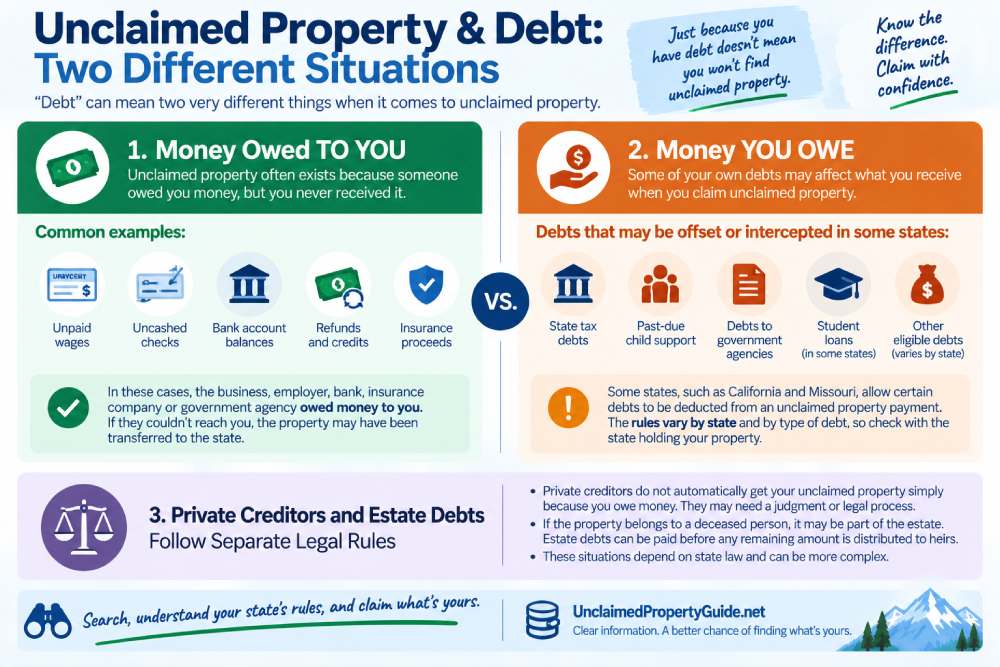
A state may be authorized by law to intercept or offset money that would otherwise be paid to you.
This does not mean every debt automatically reduces every unclaimed property claim.
The rules depend on:
- The state holding the property.
- The type of debt.
- The government agency involved.
- Whether an offset or intercept law applies.
Can the state take unclaimed property for debts you owe?
In some states, yes.
California provides a clear official example.
The California State Controller explains that state law allows payments from unclaimed property funds to be intercepted for debts owed to certain state, city or county agencies.
California says that only the amount owed is intercepted.
California State Controller — Unclaimed Property payment FAQ
This means that if California approves an unclaimed property claim for $2,000 and an applicable government intercept of $500 exists, the claimant may receive the remaining amount after the authorized intercept.
The exact outcome depends on the debt and applicable law.
Can unclaimed property be taken for child support?
Yes, in some states.
Past-due child support is one of the clearest examples of a debt that can affect unclaimed property.
Missouri, for example, developed a process that matches its Unclaimed Property database against past-due child support cases.
When a match is found, qualifying unclaimed property can be applied to the child-support obligation before the parent receives the money.
The Missouri State Treasurer reported that millions of dollars in unclaimed property have been redirected toward past-due child support through this process.
Missouri Treasurer — Unclaimed Property and past-due child support
Can tax debt reduce an unclaimed property payment?
Potentially, depending on the state.
Some states operate broader payment-offset systems that allow government payments to be intercepted for qualifying debts.
These can potentially include:
- State tax debts.
- Amounts owed to government agencies.
- Child support.
- Other debts specifically authorized by law.
But you should not assume that a tax debt automatically eliminates unclaimed property in every state.
Check the rules where the property is held.
Can the entire unclaimed property payment be taken?
That depends on:
- The amount of unclaimed property.
- The amount of the qualifying debt.
- The applicable state law.
Suppose you are entitled to:
$1,500 in unclaimed property.
If an authorized government offset is:
$400
the state might intercept $400 and pay you the remaining $1,100.
If the qualifying debt exceeds the property value, the result may be different.
Again, the exact process is state-specific.
Will I be notified if my payment is intercepted?
States that intercept payments generally have procedures for notifying the claimant.
For example, California says an intercept notice is mailed to the claimant and identifies the agency associated with the debt.
If the claimant disagrees with the debt, California directs the person to contact the agency listed on the notice rather than the Unclaimed Property Division.
California guidance on intercepted payments
What if I am already paying the debt in installments?
Do not assume that a payment plan prevents an offset.
California specifically states that its intercept can apply even when the claimant is in an installment agreement with the agency.
Other states can use different rules.
If you receive an intercept notice, contact the agency that claims you owe the debt.
Can private creditors take unclaimed property?
This is more complicated than a government offset.
A private creditor does not automatically gain ownership of your unclaimed property simply because you owe money.
Whether a private creditor can reach the funds can depend on:
- Whether the creditor has a judgment.
- State garnishment law.
- Court procedures.
- The type of property.
- Whether exemptions apply.
This is different from a statutory state offset for taxes, child support or another government debt.
Can debt collectors see that I have unclaimed property?
Some unclaimed property databases are publicly searchable.
Depending on the state, a search result may display:
- The owner’s name.
- A previous city.
- The reporting holder.
- The property type.
That means a third party may potentially discover that property is listed.
However, discovering the listing does not automatically give that person or company the right to claim the property.
The claimant still needs to establish ownership or legal authority.
Can unclaimed property be garnished?
Potentially, but garnishment is a legal process and the rules vary by state.
The presence of money in an Unclaimed Property Program does not mean that any creditor can simply call the state and collect it.
Whether funds can be reached can depend on:
- A court judgment.
- State garnishment procedures.
- The identity of the creditor.
- The type of debt.
- Any applicable exemptions.
For a significant debt or active judgment, legal advice may be appropriate before assuming how an unclaimed property payment will be treated.
What if the unclaimed property belongs to a deceased person who had debts?
This is another situation where the distinction matters.
If the owner died, the unclaimed property may belong to the deceased person’s estate rather than automatically becoming the personal property of whichever relative discovers it.
Estate debts and creditor claims are governed by probate and estate law.
Depending on the circumstances, estate assets may need to be used to pay valid estate obligations before remaining property is distributed to heirs.
That does not automatically make an heir personally responsible for all of the deceased person’s debts.
The correct treatment depends on the estate and state law.
Read who can claim unclaimed money from a deceased relative before filing a deceased-owner claim.
Do you inherit someone else’s debt when claiming their unclaimed property?
Claiming property as an heir does not automatically mean that you personally assume every debt owed by the deceased person.
But estate property can be subject to valid estate obligations before heirs receive distributions.
This distinction is important:
| Situation | General concept |
|---|---|
| Your personal debt | A debt you personally owe may affect your own payment if an applicable offset or legal collection process exists. |
| Deceased person’s debt | Valid debts may be obligations of the deceased person’s estate. |
| Being an heir | Does not by itself make you personally responsible for every debt of the deceased. |
Because probate law varies significantly, complicated estates may require professional legal advice.
What if the unclaimed property itself came from a debt collection?
Property can sometimes arise from money recovered or payable in connection with legal proceedings, refunds or other financial obligations.
The important question is still:
Who is legally entitled to the money?
The property type and original holder can help explain why it exists.
If you do not recognize the listing:
- Check the reporting holder.
- Review the property type.
- Compare the listed address with your history.
- Contact the official Unclaimed Property Program if more information is needed.
Does having debt prevent you from searching for unclaimed property?
No.
You can still search official databases.
You should not assume that because you:
- Owe taxes.
- Have a credit card balance.
- Have a loan.
- Owe child support.
- Have a judgment.
you should avoid checking for property.
First determine whether property actually exists.
Use our guide to finding and claiming unclaimed property to search safely.
Should I claim property if I know I owe the state money?
That is a personal decision, but an outstanding debt does not necessarily mean there is no value in filing the claim.
Depending on the state’s rules:
- No offset may apply.
- Only part of the payment may be intercepted.
- The full amount may be applied to an eligible debt.
If you know a state agency is owed money, review the state’s payment-offset rules so that you understand what may happen before expecting the full claim amount.
Does an offset mean the unclaimed property claim was denied?
No.
An approved claim and a debt offset are separate issues.
The state may determine:
You are the rightful owner of $2,000.
and separately determine:
$500 must be intercepted for an eligible debt.
Your ownership claim can therefore be valid even though you do not receive the full amount in cash.
Can an unclaimed property payment affect my taxes?
Debt offsets and taxes on the underlying property are also separate questions.
The fact that part of a payment was intercepted does not by itself determine whether the original property was taxable.
Tax treatment depends on what the money represented.
Read Is Unclaimed Property Taxable? for more information.
How can I know whether my state uses debt offsets?
Use the official Unclaimed Property Program for the state holding your property.
Look for terms such as:
- Offset.
- Intercept.
- Debt setoff.
- State payment offset.
- Child support intercept.
If the state’s Unclaimed Property FAQ does not explain the issue, contact the official agency before relying on information from another state’s website.
You can find the appropriate program through our Unclaimed Property by State directory.
Examples of how debt can interact with unclaimed property
Example 1: A company owes you a refund
A utility owes you a $250 deposit refund but cannot locate you.
Eventually, the $250 becomes unclaimed property.
Here, the obligation or “debt” was owed to you.
Example 2: You owe a state agency
You successfully claim $1,200 from a state Unclaimed Property Program.
The state identifies an authorized $300 debt offset.
The state may intercept $300 and issue the balance according to its law.
Example 3: Past-due child support
A state matches an owner’s unclaimed property against a qualifying past-due child-support obligation.
The funds may be redirected to satisfy the support obligation if state law authorizes it.
Example 4: Deceased relative had creditors
You discover unclaimed property belonging to a deceased parent.
The money may be an estate asset.
Whether creditors must be paid before heirs receive the remaining estate depends on probate and estate law.
Frequently asked questions about debt and unclaimed property
Can unclaimed property represent a debt?
Yes. Many forms of unclaimed property arise because a business, employer, bank, insurer or government agency owed money to the owner but could not deliver it.
Does unclaimed property mean I owe money?
Usually not. A property listing generally indicates that money or another asset may be owed to you rather than a debt you owe.
Can the state take my unclaimed property for debt?
Some states can intercept unclaimed property payments for certain qualifying government debts. The rules differ by state.
Can unclaimed property be used for past-due child support?
Yes, in some states. Missouri, for example, has used an automated process to match unclaimed property with past-due child-support obligations.
Can tax debt reduce my unclaimed property payment?
Potentially. Some states allow certain debts owed to government agencies to be deducted from state payments. Check the law in the state holding your property.
Can private creditors take unclaimed property?
A private creditor does not automatically own your unclaimed property simply because you owe money. Whether a creditor can reach the funds depends on applicable collection, judgment and garnishment laws.
Can unclaimed property be garnished?
Potentially, depending on the state’s law and legal process. This is different from automatic government debt-offset programs.
If the state intercepts money, was my claim denied?
No. A state can approve your ownership claim but intercept part of the payment for an eligible debt.
Do I become responsible for a deceased relative’s debt if I claim their unclaimed property?
Not automatically. The property may be an estate asset and valid estate debts can affect distribution, but an heir does not become personally liable for every debt merely by being an heir.
Should I still search if I owe money?
Yes. Whether a particular debt can affect the eventual payment is a separate question from whether unclaimed property exists in your name.
Bottom line
Unclaimed property can be related to debt in two opposite ways.
First, the property itself may exist because someone owed money to you and the payment was never completed.
That is common with:
- Uncashed checks.
- Refunds.
- Wages.
- Account balances.
- Insurance proceeds.
Second, a debt you owe may sometimes affect your unclaimed property payment.
Some states allow authorized offsets for debts such as government obligations or past-due child support. California, for example, allows certain state and local agency debts to be intercepted from unclaimed property payments, while Missouri has used unclaimed property to satisfy qualifying past-due child-support obligations.
Private creditors and deceased-owner debts are more complicated and depend on collection, garnishment and probate law.
If you find property in your name, start by filing through the official Unclaimed Property Program and check the rules in the state holding the funds.
Important information: UnclaimedPropertyGuide.net is an independent informational website and does not provide individualized legal, tax or debt advice. Debt offsets, garnishment, probate and creditor rights vary by state and circumstances. Verify current requirements with the official state agency and seek professional advice when necessary.