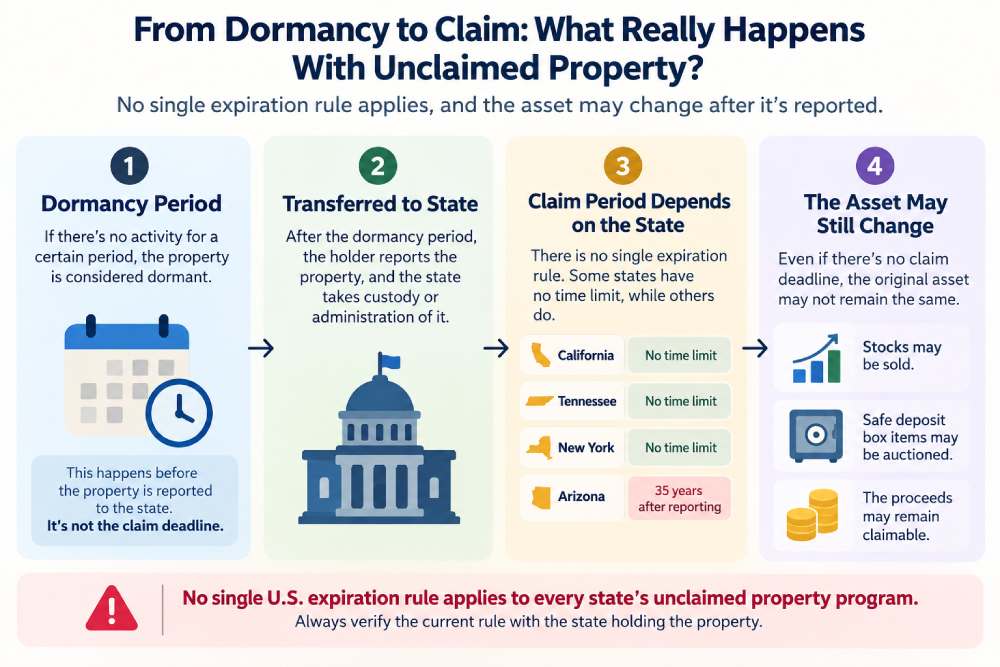
Unclaimed property does not have one nationwide expiration date. In several states, money held by the state can be claimed indefinitely. However, the rule is not identical everywhere, and some states impose much longer-term limits.
For example, California, Tennessee and New York currently state that there is no time limit for claiming state-held unclaimed property. Texas says there is generally no statute of limitations. Arizona, by contrast, currently gives owners 35 years from the date property was reported to the state before ownership reverts to the state.
Does unclaimed property ever expire?
It depends on the state holding the property.
There is no single federal rule establishing one expiration period for all state unclaimed property claims.
State programs currently provide very different answers.
| State | Current general rule |
|---|---|
| California | No time limit for filing a claim with the State Controller. |
| Tennessee | No time limit to claim property held by the Tennessee Treasury. |
| New York | Unclaimed funds do not expire and may be claimed at any time. |
| Texas | Generally no statute of limitations for unclaimed property held by the state. |
| Florida | No statute of limitations; owners or heirs can claim funds indefinitely. |
| Arizona | Claims may currently be filed for 35 years after the property is reported to the state. |
This is why the safest answer to “Does unclaimed property expire?” is:
Check the current rules of the state actually holding the property.
California: no time limit to claim unclaimed property
The California State Controller currently states:
There is no time limit for claiming property from the state.
That means an owner can potentially discover an old property record years after it was transferred and still begin the claim process.
California State Controller — How to Claim Property
This should not be confused with the time California has to evaluate a complete claim.
California law currently requires the Controller to consider a claim within 180 days after it is filed, although that relates to claim processing, not the deadline for initially filing the claim.
For that distinction, see How Long Do Unclaimed Property Claims Take?.
Tennessee: property can be claimed without a time limit
The Tennessee Department of Treasury also currently states that there is no time limit to claim property through its Unclaimed Property Division.
The property is available to the rightful owner or legal heirs after the Treasury receives it.
Tennessee Treasury — What Is Unclaimed Property?
Tennessee also says there is no fee to claim property through the state program.
New York: unclaimed funds do not expire
New York provides another clear example.
The New York State Comptroller’s Office of Unclaimed Funds currently says that money turned over to the office has no time limit for the owner to claim it.
New York State Comptroller — Unclaimed Funds
The Comptroller has also described accounts held by the Office of Unclaimed Funds as funds that never expire.
Texas: generally no statute of limitations
Texas uses slightly more cautious wording.
The Texas Comptroller states that there is generally no statute of limitations for unclaimed property the state holds, meaning owners can file a claim at any time.
Texas Comptroller — Unclaimed Property
The word generally is worth preserving. Unclaimed property can involve many property types and specialized rules, so it is better not to convert a state’s carefully worded guidance into an absolute nationwide statement.
Florida: owners and heirs can claim indefinitely
Florida’s Bureau of Unclaimed Property currently states that:
- there is no statute of limitations on unclaimed property in Florida; and
- owners or heirs can claim their funds indefinitely.
Florida Bureau of Unclaimed Property — Fact Sheet
Florida’s guidance also illustrates an important distinction: money can remain claimable even though the state may use or invest funds held within the program according to state law.
Arizona is different: the current rule is 35 years
Arizona demonstrates why you should not write off all state claim deadlines as unlimited.
The Arizona Department of Revenue currently says ownership of unclaimed property does not revert to the state until 35 years after the property was reported.
The owner can file a claim during that 35-year period.
After the period expires, Arizona says the property is no longer available to be returned.
Arizona Department of Revenue — Owners FAQ
Is the dormancy period the same as the claim deadline?
No. These are two completely different clocks.
This distinction causes a lot of confusion.
| Term | What it means |
|---|---|
| Dormancy period | The period of inactivity or other statutory conditions that generally must pass before property becomes reportable as unclaimed property. |
| Reporting / transfer | The holder reports and, when required, transfers the property to the appropriate state program. |
| Claim period | The period during which the rightful owner or another legally entitled claimant can seek the property from the state. |
| Claim processing time | How long the state takes to review a claim after it has been filed. |
For example, a bank account might first pass through an applicable dormancy period before the bank reports it.
That dormancy period is not a countdown telling the owner how long they have left to claim the property from the state.
For more detail, read What Is a Dormancy Period in Unclaimed Property?.
Example: dormancy period vs claim deadline
Stage 1 — Account is active
The owner still has an active relationship with the bank or other holder.
Stage 2 — Property becomes dormant
The applicable inactivity period or other statutory conditions are met.
Stage 3 — Holder reports the property
The bank, insurer, employer or other holder sends the property to the appropriate state program.
Stage 4 — Owner discovers the record years later
Now the relevant question is whether the state still allows a claim.
Stage 5 — Claim is filed
The state verifies the claimant’s identity and legal entitlement.
The clock in Stage 2 is not the same legal issue as the clock in Stage 4.
Does property become state property after the dormancy period?
Not simply because the dormancy period ends.
The dormancy period generally determines when property becomes subject to state unclaimed property reporting rules.
State unclaimed property programs often describe themselves as holding property for the rightful owner rather than treating the transfer like an ordinary purchase by the government.
Arizona, for example, says the state holds unclaimed property as a custodian for the rightful owner.
Tennessee similarly states that property received by its Unclaimed Property Division remains available to the owner or legal heirs.
However, the details of custody, eventual escheat and ownership differ by state.
For a deeper explanation of the terminology, see What Does Escheated Mean in Unclaimed Property?.
Can the right to claim continue even if the original property is gone?
Yes. This is one of the most important concepts in unclaimed property.
The original asset and the claimant’s remaining entitlement are not always the same thing.
For example:
- stocks may be sold;
- safe deposit box contents may be auctioned;
- fractional shares may be converted to cash;
- corporate mergers may convert shares into other securities or cash; or
- other tangible property may be disposed of according to state law.
The resulting proceeds can remain claimable even when the state no longer possesses the original asset.
Do unclaimed stocks expire?
The better question is:
Does my right to claim expire, and does the state still hold the actual shares?
Those are different issues.
California currently has no general time limit for filing an unclaimed property claim, but its law requires qualifying securities to be sold within a specific period.
Under California’s current February 2026 law, securities covered by Section 1563 are generally sold:
- no sooner than 18 months; and
- no later than 20 months
after the actual filing date of the applicable holder report.
If California still holds the securities when a valid claim is approved, the claimant can receive the securities.
If they have already been sold, the claimant is entitled to the net proceeds received from the sale.
California Unclaimed Property Law — §1563
So:
No filing deadline
does not mean:
The state must preserve your stock indefinitely.
Read What Happens to Unclaimed Stocks and Securities? for the full process.
Arizona securities can also be sold before the claim period expires
Arizona makes the same distinction especially clear.
The Arizona Department of Revenue currently says:
- owners generally have 35 years after reporting to claim property;
- securities are liquidated within three years of receipt; and
- the resulting proceeds remain the property of the original owner for the remainder of the 35-year period.
Arizona — Securities and the 35-Year Rule
This is a good example of why delaying a claim can matter even when the cash value remains recoverable.
Do safe deposit box contents expire?
Again, separate the claim right from the physical objects.
A state may not keep jewelry, coins, collectibles and other safe deposit box contents forever.
Arizona currently explains that safe deposit box contents are:
- transferred to state custody after the applicable abandonment rules;
- held for an additional period;
- potentially sold at public auction; and
- liquidated within three years of receipt.
The proceeds then remain associated with the original owner for the remainder of Arizona’s 35-year claim period.
Arizona — Safe Deposit Box Contents
That means waiting too long could change a claim from:
“Return my physical property.”
to:
“Pay me the proceeds generated when the property was sold.”
See What Is Safe Deposit Box Unclaimed Property?.
Why should I claim promptly if there is no deadline?
Even when a state allows claims indefinitely, there are practical reasons not to wait.
1. The original asset may change
Stocks can be sold. Physical property can be auctioned. Corporate actions can change securities.
2. Documents become harder to find
An old claim may require evidence connecting you to:
- a former address;
- an old employer;
- a closed bank account;
- a deceased relative;
- a former business; or
- another historical relationship.
The longer you wait, the harder those records may be to locate.
3. Estates become more complicated over time
If the original owner dies, the claim can require additional estate, probate or heirship documentation.
4. Businesses change names or disappear
A former holder may merge, close or change corporate identity, making historical research more difficult.
5. Your own records can disappear
Bank statements, tax returns, employment records and old correspondence are not always preserved indefinitely.
Can I claim property that is 10 years old?
Potentially, yes.
A 10-year-old record would still be within the current claim rules of states such as:
- California;
- Tennessee;
- New York;
- Texas; and
- Florida.
It would also still fall within Arizona’s current 35-year period if the property was reported only 10 years ago.
The age of the record by itself does not prove that the claim is invalid.
Can I claim property that is 20 years old?
Often, yes, depending on the jurisdiction and the record.
In states with no claim time limit, the age alone would not bar the claim.
Arizona’s current 35-year rule would also potentially allow a property reported 20 years ago to be claimed.
But older claims may require stronger historical documentation.
Can I claim property that is 30 years old?
Potentially.
Again, you must check the state.
California, Tennessee, New York and Florida currently allow claims without a general time limit.
An Arizona property reported 30 years ago could still fall within the state’s current 35-year period.
At this age, however, the underlying asset may have changed significantly.
For example:
- stock may have been sold;
- a company may have merged;
- safe deposit box contents may have been auctioned; or
- a deceased owner’s estate may now need to be documented.
Can I claim property that is more than 35 years old?
That depends entirely on the state.
The age itself is not a national cutoff.
For example:
- a California property can potentially remain claimable because the state currently imposes no claim filing deadline;
- New York says its unclaimed funds do not expire;
- Tennessee says there is no time limit;
- Florida says owners or heirs can claim indefinitely;
- but Arizona currently says ownership reverts to the state 35 years after reporting.
Therefore, never apply Arizona’s 35-year rule to another state—or another state’s unlimited period to Arizona.
Does the 35-year Arizona period start when I lost the money?
No. Arizona describes its current period as 35 years after the property was reported to the state.
That can be much later than:
- the date you moved;
- the date you stopped using an account;
- the date a check was issued;
- the date the holder lost contact with you; or
- the beginning of the dormancy period.
This distinction matters when evaluating a very old property record.
Does “escheated” mean it is too late to claim?
Not necessarily.
The word escheated is often used in state unclaimed property materials for property that has been transferred into state custody.
For example, California’s Unclaimed Property Law repeatedly refers to property delivered to the Controller as escheated property, while California simultaneously says owners have no time limit to file a claim.
So you should not read the word:
EScheated
and automatically conclude:
“The state permanently owns it and I can no longer claim it.”
The specific state’s law controls.
See What Does Escheated Mean in Unclaimed Property?.
What if the original owner has died?
The death of the owner does not automatically make unclaimed property disappear.
Depending on state law and the estate situation, a claim may potentially be filed by:
- an executor;
- an administrator;
- a personal representative;
- a trustee;
- an eligible heir; or
- another legally authorized claimant.
Tennessee, for example, expressly says property may be claimed by the owner or legal heirs.
Florida likewise says owners or their heirs can claim funds indefinitely under its current rules.
The claimant will usually need to prove:
- the deceased person’s connection to the property; and
- the claimant’s authority or entitlement to act for the estate.
See Who Can Claim Unclaimed Money From Deceased Relatives?.
What if the property no longer appears in the online database?
Do not assume that disappearing from search results automatically means the property expired.
Possible explanations can include:
- the property was already claimed;
- an automatic or expedited payment was issued;
- the record was consolidated;
- the searchable database changed;
- the property was transferred to another jurisdiction;
- the public record is no longer displayed in the same way; or
- the state needs the Property ID to locate it.
If you previously saved a:
- Property ID;
- claim number;
- state notice;
- holder name; or
- screenshot of the listing,
contact the official state unclaimed property office and ask about the specific record.
Can a claim itself expire after I start it?
A claim filing can have its own procedural deadlines even when the underlying property does not have a general expiration date.
For example, a state may request additional documentation and give you instructions or a deadline for responding.
If you fail to complete the claim, it may be:
- closed;
- returned;
- denied;
- marked incomplete; or
- require a new submission.
That does not necessarily mean the underlying property itself has permanently expired.
Always distinguish:
deadline to respond to a pending claim
from:
deadline to claim the underlying property at all.
Does a denied claim mean the property has expired?
No.
A denial normally concerns whether the claimant provided sufficient evidence or qualifies under the applicable rules.
It is not the same thing as an expiration of the property.
Possible issues include:
- identity could not be verified;
- old-address evidence was insufficient;
- the claimant could not establish a relationship with the holder;
- estate documentation was incomplete;
- business authority was not proven; or
- the claim was filed by the wrong person.
See Unclaimed Property Claim Denied? What to Do Next if this happens.
What documents should I preserve for an old claim?
If you discover an old record, keep anything that could connect you to:
- the reported owner name;
- the last known address;
- the reporting holder;
- the account;
- the property type; or
- the deceased owner or business.
Useful documents may include:
- old IDs;
- bank statements;
- tax forms;
- W-2s or 1099s;
- utility bills;
- insurance documents;
- brokerage statements;
- employment records;
- estate records; and
- correspondence from the original holder.
See What Documents Do I Need to Claim Unclaimed Property?.
Why does my old address matter?
A property that has been unclaimed for many years may still show the address the original holder had for you decades ago.
That address can help:
- identify you as the correct owner;
- distinguish you from another person with the same name;
- connect you to the reporting holder; and
- explain why the property was reported to a particular state.
Read What Does Last Known Address Mean in Unclaimed Property? if the record shows an old location.
How do I check whether my state’s property expires?
Use this process:
- Identify the state holding the property.
- Go to the official state unclaimed property program.
- Look for an owner FAQ, claim instructions or current state statute.
- Search for terms such as “time limit,” “claim deadline,” “statute of limitations” or “escheat.”
- Check whether special rules apply to the property type.
- Contact the program directly if the property is unusually old.
NAUPA maintains links to official state unclaimed property programs and recommends searching every state where you have lived or done business.
NAUPA — Find Your State’s Official Unclaimed Property Program
You can also use our Unclaimed Property by State directory.
Should I search again if I found nothing years ago?
Yes.
A previous search is not permanent.
Businesses continue reporting newly abandoned property, so money that was not in a state database five years ago could appear later.
A practical approach is to search periodically, particularly after major life changes or when you remember an old account, address or employer.
See How Often Should You Search for Unclaimed Property?.
Does federal unclaimed money follow the same rules?
Not necessarily.
This guide focuses primarily on state unclaimed property programs.
Certain federal assets or payments can be administered separately by agencies with their own:
- claim procedures;
- record-retention rules;
- eligibility requirements; and
- deadlines.
Do not assume a state unclaimed property rule automatically applies to:
- federal tax refunds;
- federal pensions;
- Treasury securities;
- FDIC-related funds;
- bankruptcy funds; or
- other federal programs.
Example: why “no expiration” does not mean nothing changes
Year 1:
A brokerage loses contact with the owner.
Later:
The applicable dormancy requirements are met and the securities are reported to the state.
State receives the shares:
The claimant may still have the right to recover the property.
State later sells the securities under its law:
The actual shares no longer remain in state custody.
Owner discovers the property years later:
If the state’s claim rules still allow the claim, the owner may be entitled to the applicable sale proceeds rather than the original shares.
Frequently asked questions
Does unclaimed property have an expiration date?
There is no single nationwide expiration date. California, Tennessee and New York currently state that there is no time limit to claim state-held property, while Arizona currently applies a 35-year period after the property is reported.
Does unclaimed money expire after five years?
Not as a general U.S. rule. A five-year dormancy period or another reporting period should not be confused with the deadline for an owner to claim property after it reaches the state.
Does unclaimed property expire after 10 years?
Not automatically. Many state-held properties can still be claimed after 10 years. The applicable state program determines the actual rule.
Does unclaimed property expire after 20 years?
Not necessarily. States such as California, Tennessee, New York and Florida currently allow claims without a general time limit. Arizona currently allows claims for 35 years after reporting.
What happens after 35 years?
There is no nationwide 35-year rule. Arizona currently states that ownership reverts to the state 35 years after the property was reported and that the property is no longer available to return after that period.
Is the dormancy period the deadline to claim my money?
No. The dormancy period generally occurs before the holder reports the property to the state. The owner’s claim period after state custody is a separate issue.
Can a state sell my property before my right to claim expires?
Yes, depending on the state and property type. Securities and safe deposit box contents are common examples. A later claim may be for sale proceeds rather than the original asset.
Do unclaimed stocks remain as stocks forever?
No. States may liquidate securities under their laws. California currently requires qualifying securities to be sold within a statutory window, while Arizona currently says securities are liquidated within three years of receipt.
Can safe deposit box contents be sold?
Yes. State law may authorize the sale of unclaimed safe deposit box contents. The proceeds may then remain associated with the rightful owner according to that state’s claim rules.
Can heirs claim very old unclaimed property?
Potentially. If the property remains claimable under the state’s rules, an eligible heir or estate representative may be able to claim it after establishing both the deceased owner’s ownership and the claimant’s legal entitlement.
Can I claim property if the original company no longer exists?
Potentially, yes. Once property has been properly transferred to a state program, the claim is generally handled through that state rather than the former holder. You will still need to establish ownership.
Does a rejected claim mean the money expired?
No. A denied or incomplete claim usually means the state could not verify entitlement based on the evidence submitted. It is different from the underlying property reaching a legal claim deadline.
Why should I claim now if my state has no deadline?
Because the original asset may be sold or transformed, records become harder to obtain over time, and estate or ownership questions can become more complicated.
Bottom line
Unclaimed property does not have one universal U.S. expiration rule.
Several state programs currently allow property to be claimed without a general time limit:
- California;
- Tennessee;
- New York;
- Florida; and
- generally, Texas.
But that does not justify saying that all unclaimed property remains claimable forever.
Arizona currently provides a clear exception: owners generally have 35 years after the property is reported to submit a claim.
And regardless of the ultimate claim deadline, the original form of the property may change.
A state can potentially:
- sell securities;
- auction tangible property;
- convert fractional shares to cash; or
- hold sale proceeds instead of the original asset.
So the best approach is:
Do not panic because a property record is old—but do not postpone a legitimate claim unnecessarily.
Check the current rules of the state holding the property, gather your ownership evidence and file through the official program.
Start with our guide to finding and claiming unclaimed property for free, or use the Unclaimed Property by State directory to find the correct jurisdiction.
Important information: UnclaimedPropertyGuide.net is an independent informational website and is not affiliated with any state or federal government agency. Unclaimed property claim periods, custody rules and asset-disposition procedures vary by state and can change. Always verify the current rules with the official program holding the property.
[…] Does Unclaimed Property Expire? before assuming that an old record is either permanently available or already […]