In the unclaimed property context, “escheated” generally means that money or another asset was reported and transferred to a state after the holder determined that it met the applicable unclaimed property rules. If you see that an old bank account, check or investment was “escheated,” it does not automatically mean the money is permanently gone.
In many modern unclaimed property programs, the state holds the property or its proceeds so the rightful owner can later make a claim. The exact rules depend on the state and the type of property.
What does “escheated” mean?
Escheatment is the process by which property that has been considered abandoned or unclaimed under applicable law is transferred from the organization holding it to a state authority.
The SEC’s Investor.gov describes escheatment in the financial-account context as turning custody of abandoned assets or accounts over to a state.
Investor.gov — The Escheatment Process
This can happen to different kinds of property, including:
- Bank account balances.
- Uncashed checks.
- Refunds.
- Unpaid wages.
- Insurance proceeds.
- Stocks and other securities.
- Dividends.
- Other money a business or organization owes to an owner.
The organization that originally has the property is generally referred to as the holder. When the conditions under state law are met, that holder reports the property and may have to transfer the property or its value to the appropriate state program.
What happens when property is escheated?
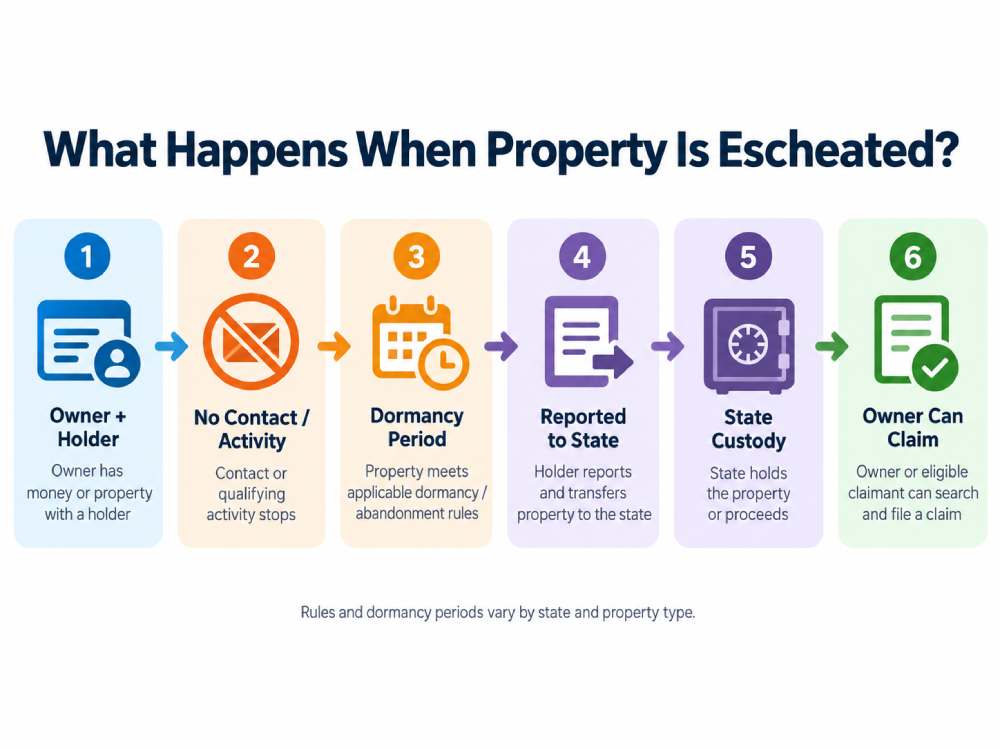
The details vary by state and property type, but the process usually follows this general pattern:
- You have money or property with a business or organization. This could be a bank, employer, insurer, brokerage, utility or government agency.
- There is a long period without the activity or owner contact required under applicable rules.
- The property becomes subject to the state’s unclaimed property law.
- The holder attempts any required owner outreach or due diligence.
- The holder reports the property to the appropriate state.
- The property, cash or proceeds are transferred to the state’s unclaimed property program.
- The owner or another eligible claimant can later attempt to recover it.
Does escheated mean I lost ownership of the money?
Not necessarily.
In the ordinary consumer unclaimed property context, escheatment frequently means that the property moved from the original holder into a state-administered system where an owner can seek recovery.
For example, Washington law is unusually explicit on this point. Its Revised Uniform Unclaimed Property Act states that property received by the administrator is held “in custody for the benefit of the owner” and is not owned by the state.
Washington RCW 63.30.500 — Administrator holds property as custodian for owner
Washington also allows a person claiming to be the owner of property held under the law to file a claim for it.
Washington RCW 63.30.530 — Claim for property by person claiming to be owner
That is a useful illustration of how modern custodial unclaimed property systems operate, but do not assume that every state’s statute uses identical wording or rules.
Is “escheated” the same as “abandoned”?
They are related, but they describe different parts of the process.
| Term | What it generally means |
|---|---|
| Dormant | The account or property has gone without qualifying owner activity or contact for a period relevant under the applicable rules. |
| Presumed abandoned | The property has met the legal conditions that make it reportable under the applicable state’s unclaimed property law. |
| Escheated / transferred | The holder has reported and transferred the property, cash or other required asset to the state. |
| Claimed | An owner or other eligible claimant establishes entitlement and the state approves return of the property or payment. |
People and even financial institutions sometimes use these words loosely, so the most useful question is not simply which label appears on the account. Find out whether the property has actually been transferred and, if so, which state received it.
Why would my bank account be escheated?
A common situation is that a financial institution loses meaningful contact with an account owner for long enough that the account becomes subject to the state’s unclaimed property rules.
This can happen after events such as:
- Moving and failing to update your address.
- Leaving an old savings account untouched.
- Mail repeatedly being returned as undeliverable.
- Failing to respond to communications from the institution.
- Forgetting about an account opened years earlier.
- An owner dying without the institution being successfully contacted by an estate representative.
However, an account being labeled “inactive” or “dormant” by a bank does not necessarily mean it has already been transferred to the state.
If the account is still with the financial institution, the correct next step may be to deal with the institution rather than filing a state unclaimed property claim.
What should I do if my bank says my account was escheated?
If a bank, brokerage or other company tells you that your property was escheated, first determine whether the transfer is planned or has already occurred.
If the property has not been transferred yet
Contact the institution using a verified phone number, website or branch and ask what it needs from you to reestablish contact or recover the funds.
Do this promptly. Once the institution completes the transfer, the claim normally has to be handled through the receiving state’s process instead.
If the property has already been transferred
Ask the institution for as many of these details as it can provide:
- The state that received the property.
- The date or approximate reporting period.
- The owner name used in the report.
- The address associated with the old account.
- The name of the reporting holder.
- The property type.
- Any property or reporting reference number available.
Then search that state’s official unclaimed property database.
You can use our Unclaimed Property by State directory to locate the appropriate official program.
Can I still claim money after it has been escheated?
In ordinary state unclaimed property programs, an owner can generally still attempt to claim property after it has been transferred to the state.
You normally begin by:
- Identifying the state holding the property.
- Searching the state’s official unclaimed property database.
- Confirming that the record appears connected to you.
- Submitting the state’s claim.
- Providing any requested proof of identity or ownership.
NAUPA states that searching for and claiming your property through an official state program is free.
NAUPA — Is it really free to search?
For the complete process, see our guide to finding and claiming unclaimed property.
What if the escheated property does not appear in the state database?
This is one of the most important situations to understand.
If the original holder tells you that property was transferred but you cannot find it online, check:
- Whether you are searching the correct state.
- Whether you searched the exact name used on the old account.
- Previous last names or legal names.
- Old addresses and cities.
- The reporting institution’s name.
- Whether the transfer happened only recently.
A recently reported property may not appear in the public database immediately.
For example, New York’s Office of Unclaimed Funds currently tells claimants that if the original holder says the property was turned over to New York, it may take three months to appear in the state’s search database.
New York Office of Unclaimed Funds — How to Search & Claim Property
If the holder has confirmed the receiving state and enough time has passed, contact that state’s unclaimed property office directly and provide the transfer details.
Which state receives escheated property?
It is not necessarily the state where you live today.
The state entitled to receive unclaimed property depends on legal reporting rules and the information the holder has about the owner. For a consumer trying to recover money, however, you usually do not need to solve those legal priority rules yourself.
Ask the original holder which state received the property.
If you do not know, search:
- Your current state.
- States where you previously lived.
- States connected to the old account or employer.
- Other states where you maintained financial relationships.
Our state-by-state search directory explains how to locate the official program for each state.
What happens if the escheated property was stock or another investment?
Investment property requires additional caution because the state may not still hold the original security.
The SEC warns investors that states can sell securities after they are escheated. Depending on the applicable law, a successful claimant may therefore receive cash or proceeds rather than the original shares.
Investor.gov — Escheatment by Financial Institutions
Washington provides one state-specific example: its unclaimed property statute authorizes the administrator to dispose of certain securities under specified conditions.
Washington RCW 63.30.430 — Disposal of securities
Therefore, if an old brokerage account shows as escheated, do not assume:
- The original shares are still being held.
- The account will simply be reopened.
- You will receive today’s market value.
- Every state handles securities the same way.
Check the state’s current rules and the specific property record before estimating what an approved claim might return.
Does escheatment mean the government seized my money?
That is generally not the best way to understand ordinary unclaimed property escheatment.
Unclaimed property programs are designed to receive property that a holder can no longer successfully return through its normal relationship with the owner.
For example, Washington expressly describes its administrator as a custodian for the owner, while Investor.gov describes state escheatment of financial accounts as a transfer of custody.
That is different from assuming that the government confiscated money because the owner did something wrong.
However, the term “escheat” can have other legal uses outside ordinary unclaimed property administration. If you encountered it in a probate case, court order, real-estate matter or another legal proceeding, do not automatically apply this consumer unclaimed-property explanation to that situation.
Is escheatment the same as an uncashed check?
No. An uncashed check is a type of property; escheatment describes what can eventually happen to property after it meets the applicable state’s unclaimed property requirements.
For example:
Company issues payment → check is never cashed → owner cannot be reached → applicable abandonment requirements are met → property is reported to the state.
A state search may use a more specific property label for the original payment. One term you may encounter is “warrant,” particularly for certain government-issued payments.
See What Are Warrants in Unclaimed Property? if that appears in your search result.
What if the owner of the escheated property has died?
Property does not necessarily disappear simply because the listed owner died.
Depending on the circumstances and the state’s rules, a claim may need to be filed by someone such as:
- An executor.
- An administrator.
- A personal representative.
- A trustee.
- An eligible heir.
The state may require additional documents establishing both the owner’s death and the claimant’s authority or entitlement.
If this applies to you, read Who Can Claim Unclaimed Money From Deceased Relatives?.
Do I have to pay someone to recover escheated property?
No third-party finder is necessary simply to search an official state database or file an ordinary claim yourself.
NAUPA states that it is free to search for and claim missing money through official state programs.
Private recovery businesses do exist, and some operate legally for a fee. Their involvement does not automatically mean a claim is fraudulent, but you should know that you can usually start by checking the official state program yourself.
See our guide Is Unclaimed Property a Trap? for common warning signs.
What should I do after seeing “escheated” on an account?
If you only remember one part of this guide, use this checklist:
- Confirm whether the property was actually transferred.
- Ask which state received it.
- Get the owner name, old address and reporting holder information if available.
- Search the state’s official unclaimed property database.
- Try previous names and addresses if necessary.
- File directly through the official program if you find a match.
- Keep the original institution’s transfer notice or correspondence.
- Contact the state directly if the holder confirms a transfer but the property cannot be located.
The word “escheated” sounds more final than it often is. For someone dealing with ordinary unclaimed property, the useful question is usually not “Is my money gone?” but rather:
“Which state has it, and what do I need to prove that it belongs to me?”
Frequently asked questions
Can I get escheated money back?
Often, yes. State unclaimed property programs provide processes through which owners and other eligible claimants can seek property that has already been reported and transferred. The exact requirements depend on the state and the property.
Does escheated mean abandoned?
The terms are related but not identical. Property is generally considered or presumed abandoned under applicable rules before it is reported and transferred. Escheatment refers to the transfer into the state process.
Does escheated mean the state owns my money?
Do not assume that. Modern unclaimed property programs often operate as custodial systems. Washington law, for example, expressly states that property received by its administrator is held for the benefit of the owner and is not owned by the state. Other states may use different statutory language.
How many years before money is escheated?
There is no single nationwide period. The applicable period varies by state and property type, and additional rules can affect when property is presumed abandoned.
Why can’t I find recently escheated money online?
There can be a delay between the holder transferring or reporting the property and the record becoming searchable. New York, for example, currently warns that recently transferred property may take three months to appear in its database. That timeframe should not be treated as a rule for other states.
Can a bank reverse escheatment?
If the bank has not yet completed the transfer, it may be able to resolve the matter directly after confirming your ownership or contact information. Once the property has actually been delivered to the state, recovery is normally handled through the state’s unclaimed property program. Ask the bank which stage the account is in.
What happens to escheated stocks?
States may sell securities after receiving them, depending on applicable law. An approved claim therefore does not always result in the original shares being returned. Verify the specific state’s rules and the disposition of the property.
Is claiming escheated property free?
Searching and claiming through an official state Unclaimed Property Program is free, according to NAUPA. Optional third-party recovery services may charge fees.
Bottom line
In the unclaimed property context, “escheated” generally means that an asset moved from the original holder into a state’s unclaimed property system after meeting the applicable reporting requirements.
It does not automatically mean that you permanently lost the property.
If you discover that an old account or payment was escheated:
- Confirm that the transfer actually occurred.
- Identify the state that received it.
- Search the official state database.
- File a claim if you find a matching property.
Start with our Unclaimed Property by State directory, or read the complete How to Find and Claim Unclaimed Property guide if you are ready to begin the recovery process.
Important information: UnclaimedPropertyGuide.net is an independent informational website and is not affiliated with any state or federal government agency. Unclaimed property laws, terminology and claim procedures vary by jurisdiction and property type. Always verify your situation through the official state program handling the property.