Safe deposit box unclaimed property generally refers to the contents of a safe deposit box or other safekeeping repository that were not claimed by the owner and eventually became subject to a state’s unclaimed property laws.
Unlike most unclaimed property—which is usually money or another financial asset—a safe deposit box can contain physical objects such as coins, jewelry, collectible currency, documents or other personal property.
Depending on the state and how much time has passed, the government may:
- still hold the physical contents;
- have sold items with commercial value;
- hold the proceeds of that sale for the owner; or
- have disposed of items handled differently under that state’s law.
How does a safe deposit box become unclaimed property?
A safe deposit box does not usually become state-held unclaimed property simply because the owner has not opened it recently.
The process generally involves circumstances such as:
- the lease or rental agreement expiring;
- the financial institution losing contact with the owner;
- rent remaining unpaid;
- the owner dying without heirs or representatives knowing about the box; or
- the contents otherwise remaining unclaimed for the period required by state law.
The applicable dormancy period varies by jurisdiction.
Arizona, for example, currently states that safe deposit box contents are presumed abandoned when they remain unclaimed for more than three years after the lease or rental period expires.
Arizona Department of Revenue — Safe Deposit Box Remittance
California law similarly provides a three-year period for certain safe deposit box or safekeeping repository contents after the applicable lease or rental period has expired, subject to additional statutory conditions.
California State Controller — Safe Deposit Box Unclaimed Property Law
Do not assume three years applies nationwide. Dormancy and reporting requirements are determined by the applicable state law.
What can be inside unclaimed safe deposit boxes?
The contents can vary dramatically.
Arizona’s Unclaimed Property Unit says items offered through its safe deposit box auctions commonly include:
- collectible coins;
- currency;
- jewelry;
- pocket watches;
- stamps;
- silver bars;
- sports cards; and
- other collectibles.
Arizona Department of Revenue — Safe Deposit Box Auction Information
Other boxes can contain documents or personal records rather than valuable collectibles.
For example, possible contents can include:
- wills;
- deeds;
- letters;
- certificates;
- account records;
- photographs;
- personal papers; or
- other tangible items.
The existence of a safe deposit box record therefore does not tell you what was inside or how valuable it was.
Does the state actually receive the physical contents?
It can.
This is one of the major differences between safe deposit boxes and most other types of unclaimed property.
Arizona currently requires holders to report safe deposit box contents separately from cash and securities. After the report is submitted, the state’s Unclaimed Property Vault Supervisor provides instructions for transferring the physical contents.
The financial institution must package each owner’s contents separately and provide an inventory identifying the items being transferred.
Arizona — How Safe Deposit Box Contents Are Transferred
California likewise uses dedicated inventory and detail forms when financial institutions remit safe deposit box contents to the State Controller.
California State Controller — Safe Deposit Box Reporting Forms
Does the state keep safe deposit box contents forever?
Not necessarily.
States can have procedures allowing valuable contents to be sold after a specified custody period.
Arizona provides a particularly clear example.
The Arizona Department of Revenue currently explains that:
- safe deposit box contents are transferred to the state after becoming abandoned;
- the state initially holds the contents;
- after the applicable waiting period, valuable items can be sold through public auction; and
- the sale proceeds are credited to the original owner’s property.
Arizona — What Happens to Safe Deposit Box Contents?
Arizona also states that safe deposit box contents are liquidated within three years after receipt, while proceeds remain associated with the original owner under Arizona’s applicable unclaimed property rules.
Those timing rules are Arizona-specific.
Can the state auction my safe deposit box contents?
Yes, in some states and under the conditions established by state law.
Arizona holds public auctions for qualifying safe deposit box contents that remain unclaimed.
Its auction page explains that items can include:
- coins;
- currency;
- jewelry;
- silver;
- collectibles; and
- other valuable property.
The state then places the proceeds into accounts associated with the owners whose property was sold.
Arizona — Unclaimed Property Auctions
California also authorizes the State Controller to sell certain safe deposit box contents with monetary value under its Unclaimed Property Law.
California — Guidelines for Claiming Safe Deposit Box Property
The exact:
- holding period;
- auction process;
- type of property sold;
- handling of documents;
- fees; and
- claim rights after sale
can differ from one state to another.
What happens to the money if the contents are sold?
The owner’s claim can shift from the physical object to the proceeds generated by the sale.
For example, suppose a box contained:
A collectible gold coin
and the state later sold that coin at an authorized public auction.
The original owner would no longer necessarily be claiming:
the physical coin
but instead may be claiming:
the proceeds credited to the owner’s unclaimed property account
under that state’s rules.
Arizona explicitly states that proceeds from its safe deposit box auctions are placed into accounts for the owners of the sold property.
California similarly provides for sale proceeds to be credited to the owner’s account after applicable deductions.
Will I receive what the item would be worth today?
Do not assume so.
If the state already sold an item according to applicable law, the claim will generally concern the resulting proceeds rather than whatever the physical object might be worth on today’s collector market.
For example, suppose a rare coin was sold years ago for:
$500
and a similar coin might now sell for:
$1,200.
You should not automatically assume that the state owes the current $1,200 market value.
The applicable state’s law and actual sale proceeds matter.
Can the bank take unpaid rent or drilling fees from the contents?
State law can allow certain safe deposit box charges or liens to affect the property or sale proceeds.
California’s current claiming guidelines state that proceeds from the sale of safe deposit box contents can be used to satisfy applicable bank liens before the remaining amount is credited to the owner’s account.
California also explains that if physical contents are still available to be returned, an applicable safe deposit box lien may have to be paid before the property is released.
California — Safe Deposit Box Claims and Liens
Arizona’s holder-reporting instructions likewise require financial institutions to include past-due rent or drilling fees in safe deposit box reports.
This does not establish one nationwide rule about fees. Check the state handling your property.
What happens to documents with little or no commercial value?
This is another area where state-specific rules matter.
California’s published claim guidelines state that safe deposit box contents appearing to have monetary value are sold as required by its law, while certain other materials—such as wills, statements, letters and deeds—are handled differently and may be destroyed under the state’s procedures.
California State Controller — Safe Deposit Box Contents
Arizona similarly states that items it considers to have inconsequential value may be disposed of appropriately after the applicable holding process.
Do not assume every state preserves every document indefinitely.
How can I tell whether the state still has the physical contents?
A public search result may not answer that question by itself.
Depending on the state’s system, the record could represent:
- physical safe deposit box contents currently held by the state;
- contents awaiting sale;
- property that has already been auctioned;
- sale proceeds; or
- a record for which only limited information is publicly displayed.
If the listing appears to belong to you:
- Save the Property ID.
- Identify the official state program.
- Review the property type.
- Start the official claim process or contact the agency.
- Ask whether the physical contents remain in custody or whether the record now represents proceeds.
Do not rely on a generic dollar amount shown in a public search result to determine whether physical contents still exist.
Why won’t the state tell me what is inside before I prove ownership?
Security and fraud prevention can limit what states disclose publicly.
California, for example, states that it will not disclose the contents of a safe deposit box for security reasons, although it may indicate whether the contents have commercial value.
California — Safe Deposit Box Information and Claims
This makes sense from a verification standpoint.
If a state publicly revealed that a particular box contained:
- a rare coin collection;
- specific jewelry;
- gold bars; or
- valuable historical items,
that information could help a fraudulent claimant construct a more convincing story.
The state can therefore require ownership verification before releasing detailed information.
What does a safe deposit box property type mean in a search result?
If a record lists a property type such as:
- Safe Deposit Box Contents;
- Safe Deposit Box;
- Safekeeping Property;
- Tangible Property; or
- Proceeds From Safe Deposit Box Contents,
the label is describing the source or form of the unclaimed property.
It does not necessarily tell you:
- exactly what was inside;
- whether the physical items still exist;
- their current value;
- whether items have already been sold; or
- how much you will receive.
See What Does Property Type Mean in Unclaimed Property? for more information about interpreting property categories.
What if Cash Reported shows $0?
Do not automatically assume the safe deposit box was empty or worthless.
A cash field and physical contents are two different things.
A record could potentially involve:
Cash Reported: $0.00
while the unclaimed asset itself consists of:
- coins;
- jewelry;
- collectibles;
- documents; or
- other tangible property.
Likewise, if the physical contents were later sold, a separate cash value or proceeds record may become relevant.
For more detail about monetary fields, see What Does Cash Reported Mean in Unclaimed Property?.
How do I claim unclaimed safe deposit box contents?
The basic process is similar to other unclaimed property claims:
- Find the property in the official state database.
- Confirm that the owner information matches your history.
- Start the claim through the state program.
- Prove your identity.
- Prove your connection to the safe deposit box or reporting institution.
- Provide additional authority documents if you are claiming for another owner.
- Wait for the state to determine whether physical contents or sale proceeds remain available.
Use our How to Find and Claim Unclaimed Property for Free guide for the overall process.
What documents might I need?
Requirements vary by state and claim, but evidence can potentially include:
- government-issued identification;
- proof of Social Security Number or TIN when requested;
- proof of the reported address;
- a safe deposit box account statement;
- the safe deposit box key;
- bank correspondence;
- documents proving a relationship with the financial institution;
- name-change records;
- estate documents; or
- legal authority to act for another owner.
California’s current claiming guideline specifically identifies either an account statement or the safe deposit box key as potential ownership evidence.
If those are unavailable, California says proof of residence or occupancy at the address associated with the account may be used, and if that is unavailable, evidence establishing an association with the reporting institution can become relevant.
California — Documentation for Safe Deposit Box Claims
For a broader document checklist, see What Documents Do I Need to Claim Unclaimed Property?.
What if I no longer have the safe deposit box key?
That does not necessarily prevent you from filing a claim.
The key is one possible form of evidence, not necessarily the only one.
California’s current instructions explicitly provide alternatives when an account statement or key is unavailable.
Potential evidence can include:
- proof that you lived at the address associated with the box;
- bank records;
- historical correspondence;
- account information; or
- other records showing your relationship with the financial institution.
Follow the evidence request from the state handling your claim rather than assuming the missing key makes recovery impossible.
What if I cannot prove the old address?
The state may have other ways to evaluate the ownership connection.
For example, you may be able to establish that you had a relationship with the bank through:
- old bank statements;
- account records;
- tax documents;
- loan records;
- correspondence; or
- other historical financial documents.
See How to Prove an Old Address for Unclaimed Property for a detailed strategy.
What if the safe deposit box had multiple owners?
Multiple ownership can affect how physical contents are released.
California currently states that unclaimed safe deposit box contents can only be mailed to one owner or heir when there are multiple owners or heirs.
The other owners or heirs must submit the state’s Property Release Form authorizing the contents to be sent to the designated recipient.
California — Safe Deposit Box Property Release Form
This is a California procedure, not a nationwide rule.
If multiple names appear on your record, check how the state handling the property requires co-owners to proceed.
What if the safe deposit box owner died?
A deceased-owner safe deposit box claim can involve two distinct issues:
- Was the deceased person the owner of the box or contents?
- Who is now legally entitled or authorized to claim that property?
The state may request:
- a death certificate;
- Letters Testamentary;
- Letters of Administration;
- a will;
- small-estate documentation;
- trust documentation;
- heirship evidence;
- birth or marriage records; and
- proof connecting the deceased person to the box.
If the safe deposit box belonged to a deceased relative, read Who Can Claim Unclaimed Money From Deceased Relatives? before filing.
What if valuable family items were inside?
If you believe the box contained jewelry, collectible coins, family heirlooms or another valuable item, contact the official state program as soon as you identify a possible match.
Ask whether:
- the physical contents remain in state custody;
- the property has been scheduled for sale;
- the contents have already been sold; or
- the record now represents sale proceeds.
Do not assume that filing a claim many years later guarantees recovery of the same physical object.
Can I stop an auction after finding my property?
This depends on the state, the status of the property and the timing of the claim.
If you discover property that appears scheduled for auction, contact the official unclaimed property agency immediately and follow its instructions.
Do not rely on a general online article for an auction deadline.
Each jurisdiction can have specific:
- notice procedures;
- claim cutoffs;
- auction dates;
- verification requirements; and
- rules governing withdrawal of items from sale.
Can I buy unclaimed safe deposit box contents at auction?
Some states conduct public auctions of qualifying unclaimed property.
Arizona, for example, operates an Unclaimed Property Safe Deposit Box Auction Notification Service and publishes information about upcoming sales.
Arizona — Safe Deposit Box Auctions
Buying an item at an authorized state auction is different from claiming property as the original owner.
The buyer receives property through the auction process; the former owner may instead retain a claim to the applicable sale proceeds under state law.
Can someone else claim my safe deposit box?
Finding a safe deposit box record does not automatically give another person the right to its contents.
The claimant generally needs to establish:
- ownership; or
- legal authority to act for the owner.
An authorized claimant might include, depending on state rules:
- the owner;
- a co-owner;
- an executor or administrator;
- an eligible heir;
- a trustee;
- a guardian;
- another legally recognized representative.
See Can Someone Else Claim My Unclaimed Property? for the broader rules.
How do I know whether a safe deposit box record is mine?
Look at the entire listing rather than only the name.
| Field | What to check |
|---|---|
| Owner | Does the reported name match you or someone you represent? |
| Address | Do you recognize the historical address? |
| Holder | Did you or the owner have a relationship with that bank or financial institution? |
| Property Type | Does it indicate a safe deposit box, safekeeping property or sale proceeds? |
| Property ID | Save this identifier for the claim or inquiry. |
| Displayed Value | Remember that the displayed cash amount may not describe physical contents. |
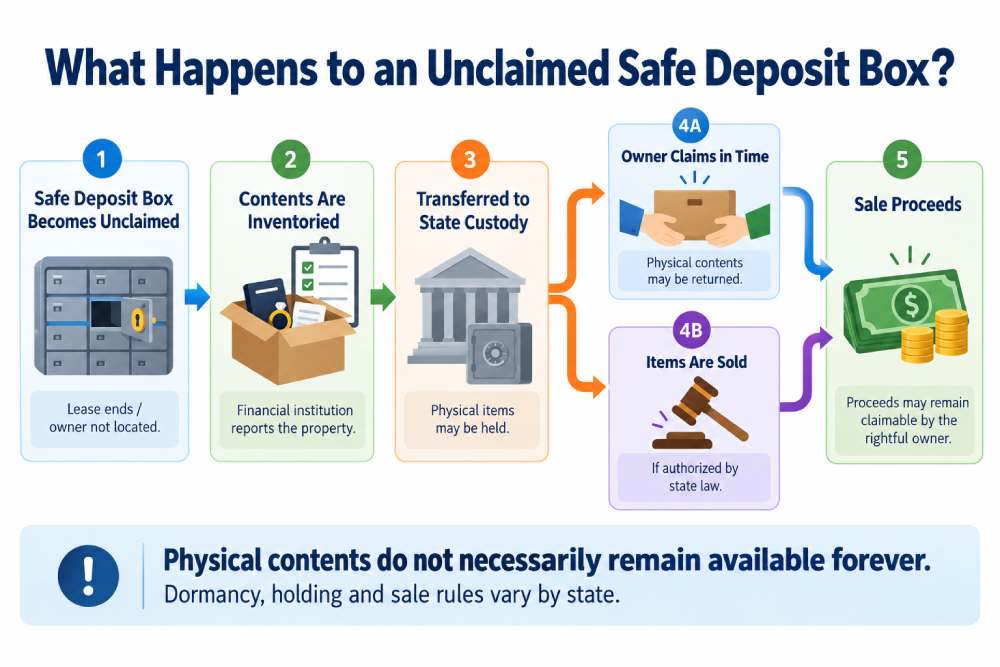
Example: what may happen to an unclaimed safe deposit box
A simplified example might look like this:
The safe deposit box lease expires and the owner does not retrieve the contents.
2. Applicable dormancy period passes
The property becomes reportable under state law.
3. Bank inventories the contents
The bank reports the owner and items according to the state’s procedure.
4. Contents are transferred to the state
The state safeguards the tangible property.
5A. Owner claims before sale
If the state still holds the property and the claim is approved, physical items may be returned under the state’s rules.
OR
5B. State sells qualifying items
If authorized by state law, commercially valuable contents may eventually be auctioned.
6. Sale proceeds remain associated with the owner
The rightful owner may later claim the applicable proceeds under that state’s law.
What should I do if I find a safe deposit box record?
Use this checklist:
- Make sure you are using an official state unclaimed property program.
- Save the Property ID.
- Check the owner name and reported address.
- Identify the financial institution that reported the property.
- Look for old records, statements or a safe deposit box key.
- Start the official claim.
- Ask whether the state still holds physical contents or only proceeds.
- Submit only the documents requested through the official claim process.
Use our Unclaimed Property by State directory to locate the correct government program.
Frequently asked questions
What is safe deposit box unclaimed property?
It generally refers to safe deposit box or safekeeping contents that were left unclaimed long enough to become reportable under state unclaimed property law. Depending on the state and timing, the government may hold the physical contents or proceeds from their sale.
What happens to an abandoned safe deposit box?
The financial institution may eventually inventory the contents and report or transfer them under applicable state law. The process and dormancy period vary by jurisdiction.
Does the state actually keep items from safe deposit boxes?
Some states do physically receive and safeguard tangible contents. Arizona and California both have formal procedures for financial institutions to transfer safe deposit box property.
Can the state sell safe deposit box contents?
Yes, some states authorize the sale of certain commercially valuable contents after applicable custody periods. The timing and procedures vary by state.
What happens to the money after an auction?
States can credit the applicable sale proceeds to the original owner’s unclaimed property account, allowing an eligible owner or claimant to later seek those proceeds under state law.
Can I get the original jewelry or coins back?
Possibly, if the state still holds the physical contents when an approved claim is processed. If the items were already sold under applicable law, the claim may instead concern the sale proceeds.
What if Cash Reported says $0?
A zero cash field does not necessarily mean the safe deposit box had no contents or value. Tangible property can be separate from the cash amount displayed in a search record.
Do I need the original safe deposit box key?
Not necessarily. California lists a safe deposit box key as one possible form of ownership evidence but provides alternative evidence routes when the key or account statement is unavailable.
What if the owner of the safe deposit box died?
An executor, administrator, trustee, heir or another eligible claimant may potentially claim the property depending on the state’s estate rules. Additional death, probate or relationship documents may be required.
Can multiple owners claim the same safe deposit box?
Multiple-owner procedures vary. California, for example, requires authorization from the other owners or heirs before physical contents are mailed to one designated recipient.
How do I find out what was inside the box?
The state may limit disclosure until ownership is verified. California specifically says it does not disclose safe deposit box contents for security reasons, although it may indicate whether the property has commercial value.
Can I search unclaimed safe deposit boxes for free?
Yes. Search through official state unclaimed property programs. You generally do not need to pay a company merely to search the state’s database.
Bottom line
Safe deposit box unclaimed property can represent actual tangible items—not just money.
When a safe deposit box or similar repository remains unclaimed long enough, the financial institution may eventually report and transfer its contents under state law.
What happens afterward depends on the jurisdiction and timing:
- the state may still hold the physical contents;
- valuable property may eventually be sold;
- sale proceeds may remain associated with the rightful owner;
- certain fees or liens may affect the proceeds; and
- some non-commercial items may be handled differently.
Most importantly, finding a safe deposit box record does not tell you whether the physical items still exist.
File through the official state program and determine whether your claim involves:
physical contents → sale proceeds → or both.
If you need to begin the recovery process, use our complete guide to finding and claiming unclaimed property.
Important information: UnclaimedPropertyGuide.net is an independent informational website and is not affiliated with any state or federal government agency. Safe deposit box dormancy periods, custody rules, auctions, liens, disposal policies and claim procedures vary by jurisdiction. Always verify the current rules with the official state program handling the property.
[…] See What Is Safe Deposit Box Unclaimed Property?. […]