“Cash Reported” generally means the amount of cash that a business or other holder reported for a particular unclaimed property record.
For example, a state record may show:
- Property Type: Savings Account
- Reported By: ABC Bank
- Cash Reported: $100 or Over
In that example, the property type tells you what kind of property was reported, while “Cash Reported” describes the cash component associated with the record.
However, you should not automatically interpret Cash Reported as the exact amount you are guaranteed to receive. The way the value is displayed, the status of the property, securities activity, offsets and other claim-specific factors can affect what ultimately happens.
What does Cash Reported mean?
Unclaimed property normally begins with a holder—a company, bank, insurer, employer, government entity or other organization that owes or possesses property belonging to someone else.
When the property becomes reportable under applicable unclaimed property law, the holder submits information to the state.
That information can include:
- the owner’s name;
- the owner’s last known address;
- the type of property;
- the holder’s name;
- the cash amount;
- shares of securities, if applicable; and
- other identifying information.
Some state systems expose part of this information publicly using a label such as “Cash Reported.”
California’s public unclaimed property records, for example, currently use that exact wording.
California State Controller — Unclaimed Property Search
It is best understood as:
The cash value reported for that property record.
Who reports the cash amount?
The amount originates with the holder that reports the unclaimed property.
Examples of holders include:
- banks;
- credit unions;
- insurance companies;
- employers;
- utilities;
- brokerages;
- retail companies;
- escrow companies;
- government agencies; and
- other businesses or organizations holding money for an owner.
New Jersey’s holder-reporting instructions, for example, distinguish between total Cash Reported and Shares Reported when holders submit unclaimed property reports.
New Jersey Unclaimed Property — Holder Reporting Instructions
NAUPA’s electronic reporting standard similarly contains fields for the amount being remitted for an owner and separate fields for securities and shares.
NAUPA Standard Electronic File Format
Is Cash Reported the exact amount I will receive?
Not necessarily.
The safest interpretation is that the field describes the cash associated with the reported property—not a guaranteed final payment quote.
Several things can make the amount ultimately recovered different from what you expect when first viewing a record.
These can include:
- the public website displaying only an amount range;
- multiple owners or ownership interests;
- securities associated with the property;
- corporate actions affecting stock;
- sale of securities before the claim;
- certain legally authorized payment offsets; or
- other state-specific adjustments.
California’s Claim Affirmation Form, for example, separately displays:
- Cash Reported;
- Shares Reported; and
- Name of Security Reported.
The same form also explains that a claimant may receive the property or, where property was sold as permitted by law, the net proceeds of the sale.
California — Sample Unclaimed Property Claim Affirmation Form
Does Cash Reported mean the state already has the money?
Not always.
This is one of the most important distinctions.
California currently publishes some records before the transfer process is complete. Those pages are labeled:
“Notice of Unclaimed Property Being Transferred to the State.”
The state explains that the business has reported the property and is in the process of transferring it to the State Controller’s Office.
Those records can already display a value under Cash Reported.
For example, California public records currently show properties with labels such as:
- Cash Reported: Under $100
- Cash Reported: $100 or Over
even while the page explains that the property is still being transferred.
California Example — Cash Reported Under $100
California Example — Cash Reported $100 or Over
So:
Reported does not always mean already fully received and processed by the state.
Cash Reported vs Property Type
These two fields answer different questions.
| Field | What it tells you |
|---|---|
| Property Type | What kind of asset or obligation generated the unclaimed property. |
| Cash Reported | The cash amount or cash range reported for that property record. |
For example:
| Property Type | Cash Reported |
|---|---|
| Savings Account | Under $100 |
| Customer Overpayment | $100 or Over |
| Premium Refund | $100 or Over |
| Certified Check | Under $100 |
California’s current public database contains examples of each of these combinations.
So if you see:
Property Type: Customer Overpayment
Cash Reported: $100 or Over
the first line tells you why or from what type of obligation the property arose. The second tells you something about the amount.
For a detailed explanation, read What Does Property Type Mean in Unclaimed Property?.
Cash Reported vs Holder
The holder is the company or organization that originally reported the property.
The cash reported is the amount connected to the property record.
For example:
Holder: Capital One
Property Type: Customer Overpayment
Cash Reported: $100 or Over
Those three fields mean different things:
- Capital One = who reported the property;
- Customer Overpayment = what type of property it was;
- $100 or Over = the cash range shown for the record.
If the company name is unfamiliar, see What Does Holder Mean in Unclaimed Property?.
What does “Cash Reported: Under $100” mean?
If a state record says:
Cash Reported: Under $100
it generally means the public record is displaying an amount range rather than the exact dollar amount.
California currently uses this wording on public property-detail pages.
For example, one California record for a certified check currently displays:
Cash Reported: Under $100
California State Controller — Example Record
This does not mean:
- the property is exactly $99;
- the property has no value;
- the claimant will automatically receive $99; or
- every state uses the same threshold.
It only tells you the range displayed by that particular system.
What does “Cash Reported: $100 or Over” mean?
Similarly:
Cash Reported: $100 or Over
means the public page is identifying the reported cash as being in that displayed range rather than revealing an exact figure.
California currently shows this language for many different property types, including:
- checking accounts;
- customer overpayments;
- premium refunds;
- escrow funds; and
- miscellaneous intangible property.
For example:
California Example — Checking Account, $100 or Over
California Example — Premium Refund, $100 or Over
Do not interpret “$100 or Over” as meaning the property is worth only slightly more than $100. The displayed range does not tell you the precise value.
Why doesn’t the website show the exact amount?
Public search systems do not all display property data in the same way.
A state may display:
- an exact amount;
- an amount range;
- a general value category;
- limited property information; or
- different details after the claimant begins the verification process.
The reason can depend on the state’s database design, privacy practices, reporting format and claim system.
For that reason, avoid assuming that the absence of an exact amount means:
- the state does not know the amount;
- the property has little value; or
- the listing is incomplete.
Use the official claim process to obtain the information the state makes available to verified claimants.
What does Cash Reported $0.00 mean?
A $0.00 cash field should be interpreted in the context of the entire property record.
It does not automatically prove that the entire property has no value.
This is especially important when securities are involved.
California’s official Claim Affirmation Form has separate fields for:
- Cash Reported;
- Shares Reported; and
- Name of Security Reported.
That means a record can conceptually contain a securities component separate from its cash component.
Before concluding that a property showing $0.00 cash is worthless, check whether the record also contains:
- shares;
- a security name;
- stock or mutual-fund information;
- safe-deposit property; or
- another non-cash component.
These fields become especially important for securities.
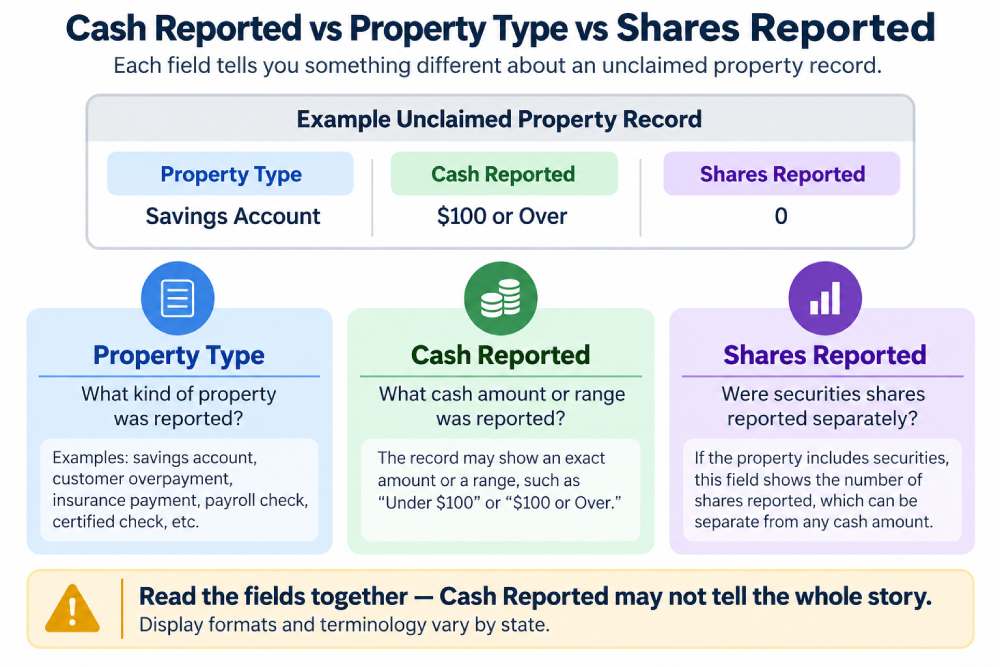
| Field | Meaning |
|---|---|
| Cash Reported | The cash component reported for the property. |
| Shares Reported | The number of shares associated with a reported security. |
| Name of Security Reported | The stock, mutual fund or other security identified in the record. |
A securities-related claim therefore should not be evaluated only by looking at Cash Reported.
If shares were reported, the value of those securities may be a separate issue.
California states that when securities remain in state custody, a valid claimant may receive the securities. If they have already been sold as permitted by law, the claimant may instead be entitled to the net proceeds received from the sale.
California Unclaimed Property Law
This is one reason the cash field alone may not tell you the full economic value of a securities claim.
Can the value of stocks change after they are reported?
Yes.
A share count and a cash amount are fundamentally different.
If a record involves stock, the value of the security can change with market prices and corporate events.
California explains that securities claims can require additional research because corporate activity may affect the security’s value.
Corporate events can include:
- stock splits;
- mergers;
- dividends;
- acquisitions;
- cash mergers; and
- other issuer actions.
California State Controller — Unclaimed Property Payments
So a securities record cannot always be understood by looking only at the original cash field.
Can Cash Reported change before the property reaches the state?
Unclaimed property reporting systems can distinguish between amounts originally reported and amounts ultimately remitted.
NAUPA’s electronic reporting standard, for example, defines a field called PROP-AMOUNT-REMITTED.
The standard describes this as the net amount due to the owner after applicable additions or deletions are calculated, and states that this is the amount being paid to the state.
NAUPA Standard Electronic File Format — Amount Remitted
This is another reason not to treat every displayed “reported” amount as interchangeable with every later accounting value.
What is the difference between reported and remitted?
The words sound similar but can describe different stages.
| Term | General meaning |
|---|---|
| Reported | The holder included the property and its information in an unclaimed property report. |
| Remitted | The property or money is transferred to the state as required by the applicable reporting process. |
In many cases, reporting and remittance are part of the same overall compliance cycle.
But they are not always instantaneous.
California’s public “being transferred” pages are a clear example: a property may already have been reported while the business is still in the process of transferring it to the State Controller.
What should I do if the property is still being transferred?
Follow the instructions shown by the official state program.
California’s current transfer-notice pages explain that properties in this stage may take several months to be processed and that a claimant may temporarily be unable to generate a claim form.
The state specifically tells users not to assume the normal claim process is already available while the transfer is being completed.
If your record has a similar status:
- Save the Property ID.
- Read the status message carefully.
- Do not create unnecessary duplicate claims.
- Follow the state’s instructions about when to check again.
If the property has already moved into the normal claim system, use our How to Find and Claim Unclaimed Property for Free guide.
Can the final payment be lower than Cash Reported?
It can be in some circumstances.
One example is a legally authorized payment offset.
California currently states that an unclaimed property payment may be intercepted for certain debts owed to state, city or county agencies.
California State Controller — Payment and Offset Information
That does not mean every state uses the same offset rules, and it does not mean most claims are reduced.
It simply demonstrates why the reported cash figure should not always be interpreted as an unconditional promise of the exact payment that will arrive.
Can the final value be higher than the Cash Reported field?
Potentially, depending on what else is included in the property.
For example, a securities record can involve:
- reported shares;
- dividends;
- corporate actions;
- sale proceeds; or
- other security-related adjustments.
California states that an owner or heir can be entitled to benefits from certain corporate actions while stock is held by the State Controller, and if securities have been sold, the claimant may receive the applicable net proceeds and qualifying increments realized before the sale.
California — Securities and Corporate Actions
Again, these are California rules and should not automatically be applied nationwide.
Does Cash Reported tell me whether the property is really mine?
No.
The amount does not establish ownership.
To determine whether a search result is likely yours, examine:
- owner name;
- reported address;
- holder name;
- property type;
- co-owner information, if any;
- property ID; and
- any other information the state displays.
A record showing $1,000 does not become yours simply because your name resembles the reported owner’s name.
The claim process is where the state verifies ownership.
For more detail, see What Does “Owner” Mean in Unclaimed Property?.
Should I claim property even if the amount is small?
If the record appears to belong to you, a small displayed amount does not make the property illegitimate.
Whether filing is worthwhile is a personal decision, but official state claim programs generally exist precisely to return property regardless of whether the amount is large or small.
Also remember that a range such as:
Under $100
does not tell you the exact amount.
If the claim process is free and straightforward, you can review the official record and decide whether to proceed.
Does Cash Reported include taxes?
Do not use the Cash Reported field to determine whether the payment is taxable.
Tax treatment generally depends on the underlying nature of the money rather than the label shown in the unclaimed property database.
For example, recovered:
- wages;
- interest;
- dividends;
- insurance proceeds;
- refunds; and
- other property
can have different tax consequences.
The fact that the state labels a value as “Cash Reported” does not itself determine its federal or state tax treatment.
How should I read an unclaimed property record?
Do not focus on a single field.
Read the record as a group of clues:
| Field | Question it helps answer |
|---|---|
| Owner | Whose property was reported? |
| Reported Address | What address did the holder have for the owner? |
| Holder / Reported By | Which company or organization reported it? |
| Property Type | What kind of property was it? |
| Cash Reported | What cash amount or range was reported/displayed? |
| Shares Reported | Were securities shares reported separately? |
| Property ID | Which specific record should you reference when claiming or contacting the state? |
Reading the fields together gives you a much better idea of whether the record matches your history.
What should I check before filing the claim?
Before you submit anything, verify:
- The owner name.
Does it match you or someone you are legally authorized to represent? - The reported address.
Do you recognize it? - The holder.
Did you ever have an account, job, policy or other relationship with that organization? - The property type.
Does it make sense based on your relationship with the holder? - The Cash Reported field.
Is it an exact amount, a range or zero? - Any shares or securities information.
- The current property status.
Is it claimable now or still being transferred?
If the record looks like a legitimate match, follow the state’s official claim process.
Frequently asked questions
What does Cash Reported mean in unclaimed property?
It generally refers to the cash amount reported for the unclaimed property record. Some states, including California, use “Cash Reported” as a field on public records and claim forms.
Is Cash Reported how much I will get?
Not necessarily. It describes the reported cash component, but the final amount can depend on the property, securities activity, ownership interests, state procedures and legally authorized adjustments.
Does Cash Reported mean the state already has the money?
No. California, for example, displays Cash Reported on some properties that have been reported by a business but are still being transferred to the State Controller.
What does Cash Reported: Under $100 mean?
It means the public system is displaying the property’s reported cash within that range rather than giving you the exact amount.
What does Cash Reported: $100 or Over mean?
It means the reported cash falls within the displayed category. It does not tell you the exact value or establish that the payment will be exactly $100.
What does Cash Reported $0.00 mean?
It means the cash field is zero. Check the entire record before concluding that the property has no value, particularly if shares, securities or another type of non-cash property may be involved.
Cash Reported describes the cash component. Shares Reported refers to the number of shares associated with a security. A property record can contain information about one or both.
What is the difference between Cash Reported and Property Type?
Property Type tells you what kind of property was reported, such as a savings account, payroll check or insurance payment. Cash Reported describes the cash amount associated with the record.
Can Cash Reported change?
The amount ultimately handled by a state may not always be identical to an earlier reported figure. Holder-reporting systems can distinguish amounts reported from amounts ultimately remitted, and securities can involve separate adjustments or corporate actions.
Why won’t the state show me the exact amount?
Public unclaimed property systems vary. Some display exact amounts while others show ranges or limited information. Follow the official claim process for the state handling the property.
Does a large Cash Reported amount prove the property belongs to me?
No. Ownership still must be verified using identifying information such as the owner name, address, holder relationship and other evidence requested by the state.
Bottom line
“Cash Reported” generally tells you how much cash was reported for an unclaimed property record.
But it should be read together with the rest of the listing.
Remember:
- Cash Reported = the cash component reported or displayed.
- Property Type = what kind of property generated the claim.
- Holder = the organization that reported the property.
- Shares Reported = securities shares reported separately, where applicable.
- Reported does not always mean the state has already completed the transfer.
- Cash Reported is not automatically a guaranteed final payment amount.
If the record appears to belong to you, do not focus only on the dollar figure. Compare the owner, address, holder and property type first, then use the official state claim process.
For help interpreting another field, read What Does Property Type Mean in Unclaimed Property? or What Does Holder Mean in Unclaimed Property?.
When you are ready to claim, follow our complete guide to finding and claiming unclaimed property.
Important information: UnclaimedPropertyGuide.net is an independent informational website and is not affiliated with any state or federal government agency. Terminology, public database fields, displayed amounts, reporting procedures and claim-payment rules vary by jurisdiction. Always verify your property through the official state program.
[…] For more detail, see What Does Cash Reported Mean in Unclaimed Property?. […]