In unclaimed property, the “owner” is generally the person or entity identified as having a right to the reported money or asset. In a public search result, that owner name usually comes from the reporting holder’s records—such as a bank, employer, insurer, utility or other organization that transferred the property to the state.
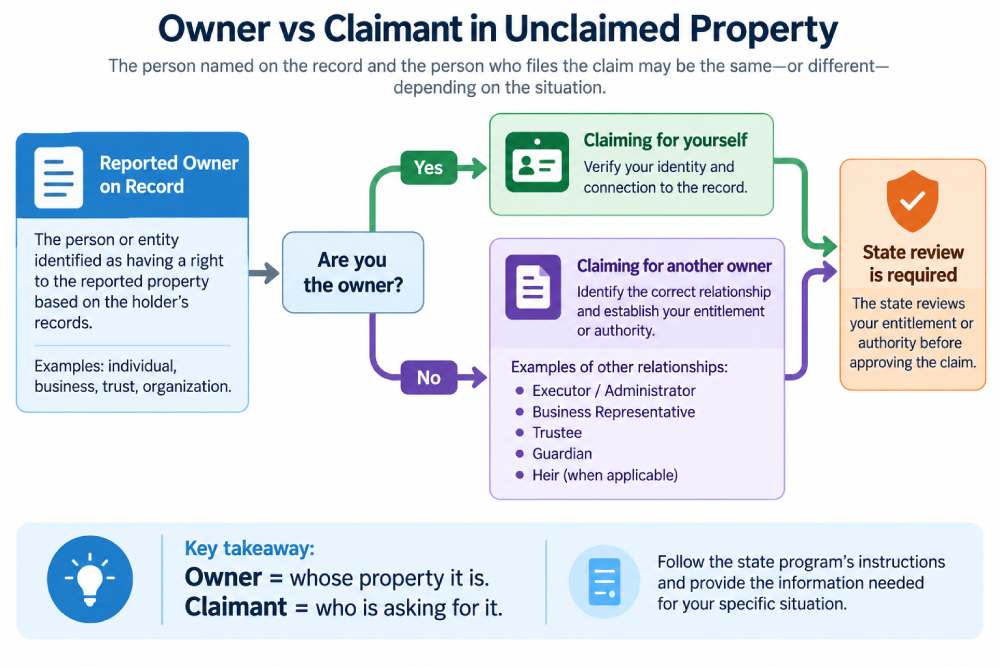
That does not automatically mean the person submitting the claim is the same person as the named owner. In many cases, the claimant is the owner. But in others, the claimant may be an executor, administrator, trustee, guardian, business representative or another person who must prove a legal right to act.
What does “owner” mean in unclaimed property?
In practical terms, the owner is the person or entity that the reported property is associated with and for whose benefit it was originally held or owed.
Examples:
- A former employee whose paycheck was never collected.
- A bank customer whose old account became dormant and was reported.
- An insured person or beneficiary connected to unpaid insurance proceeds.
- A customer owed a refund or utility deposit.
- A business entity associated with funds belonging to that company rather than to an individual person.
That is why the owner field matters so much: it identifies whose property the record is supposed to represent.
What does “apparent owner” mean?
You may also see the term apparent owner.
In unclaimed property law, this generally refers to the person or entity that appears in the holder’s records as having an interest in the property.
Washington’s current statutory definitions are a good illustration. Its law distinguishes the apparent owner shown in the records from the broader concept of an owner, which can include a person with a legal, beneficial or equitable interest and, in some contexts, a legal representative acting for that person.
Washington RCW 63.30.010 — Definitions
That does not mean every person with the same name is entitled to the property. It means the state is starting from the reporting information it received.
So if the owner field shows a common name like “Michael Johnson,” you should not treat that name alone as proof. Look at the address, holder, property type and any other available details before deciding it is really your property.
Is the owner always the same person as the claimant?
No.
This is one of the most important distinctions in unclaimed property.
| Term | What it means |
|---|---|
| Owner | The person or entity the property belongs to in the reported record. |
| Claimant | The person or entity submitting the request for the property. |
| Holder | The organization that originally held or owed the property before reporting it. |
| Heir | A person who may have inheritance rights in certain circumstances, subject to proof and applicable law. |
| Executor / Administrator / Personal Representative | A person authorized to act for a deceased owner’s estate. |
Example: an unclaimed property record names your deceased father as the owner. If you are filing the claim, you are the claimant, but the named owner on the record may still be your father. You may need to prove both:
- that the property really belonged to him; and
- that you have the right or authority to claim it.
Owner = who the property belongs to.
Claimant = who is asking for it now.
Does a matching name prove that I am the owner?
No. A matching name is a useful clue, but it is not enough by itself.
States normally need to verify that the record is genuinely connected to you. That is especially important when:
- The name is common.
- The address is old or incomplete.
- More than one person shares a name.
- The owner is deceased.
- The property appears under a business name.
- The claimant is acting in a representative capacity.
That is why the best practice is to compare:
- the full owner name;
- the holder name;
- the reported address or city;
- the property type; and
- your own records and history.
What should I select as my relationship to the owner?
When a state form asks for your relationship to the owner, choose the option that truthfully explains why you are the person submitting the claim.
Examples might include:
- Self / Owner — if the property is your own.
- Executor / Administrator / Personal Representative — if you are acting for a deceased owner’s estate.
- Business Representative — if you are claiming for a company.
- Trustee — if the property belongs to a trust and you have authority to act.
- Guardian / Conservator — if you have legal authority for another person.
- Heir / Beneficiary — only where the program permits and the facts support that route.
New York’s current claim instructions are a good example of this approach. They direct claimants to identify their relationship to the owner and make clear that a person claiming on behalf of someone else should provide claimant information in that capacity rather than pretending to be the owner personally.
New York Office of Unclaimed Funds — How to Search & Claim Property
What if the named owner has died?
A deceased person can still remain the reported owner in an unclaimed property record.
That does not automatically mean a relative can simply collect the funds. Usually, the state needs to know two things:
- Did the property belong to the deceased owner?
- Does the claimant have the legal right or authority to claim it?
New York’s current deceased-owner guidance makes this distinction clearly. It separates proof connecting the deceased owner to the funds from proof showing the claimant’s right to act—such as court appointment, estate documentation or other evidence, depending on the situation.
New York — Claims for Deceased Owners and Estates
Do not assume that being the closest relative is enough by itself. Probate, estate and inheritance rules can vary significantly.
For the full discussion, read Who Can Claim Unclaimed Money From Deceased Relatives?.
What if several names appear as owners?
Multiple names on a record require extra care.
For example, the record may relate to:
- joint owners on a bank account;
- multiple payees on a payment;
- co-owners of a business or asset; or
- a situation where the state database simply displays several names associated with one record.
The listing alone does not necessarily tell you the exact ownership rights of each person.
Do not assume:
- each person automatically gets an equal share;
- one person can always claim the whole amount alone; or
- survivorship rules automatically apply in the same way everywhere.
If several names are involved, follow the state program’s specific instructions and ask what documentation is needed.
What if the owner is a business name?
Sometimes the owner is not an individual person at all. The owner may be:
- a corporation;
- an LLC;
- a partnership;
- a nonprofit organization; or
- another business entity.
In that situation, the business is the owner, not the employee, shareholder or former contractor who happens to know about the company.
If you are submitting the claim for a company, the key question becomes:
Do you have authority to act for that entity?
The state may require proof such as current business authority, formation documents, dissolution records, tax records or another form of representative evidence, depending on the circumstances.
Can an executor or administrator personally become the owner?
Not simply by being appointed.
An executor, administrator or personal representative may have authority to act for the estate, but that does not mean estate property becomes that person’s personal money.
This distinction matters because people often confuse:
- ownership of the property, and
- authority to recover the property.
A court-appointed representative may submit the claim on behalf of the estate, but the property still belongs to the estate or the rightful beneficiaries under applicable law—not automatically to the representative personally.
How can I check whether I am really the right owner or claimant?
Use a careful verification approach before filing:
- Compare the full owner name.
Look at middle initials, former names, suffixes and any variation you actually used. - Compare the address or city.
Does it connect to a place where you lived, worked or maintained the relevant account? - Look at the holder and property type.
Do they fit your history? - Gather supporting records.
Examples may include statements, tax forms, pay stubs, insurance documents, letters or business records—depending on the type of property and the program’s requirements. - Keep the owner identity separate from your current claimant details.
If you are acting in another capacity, do not blur the distinction.
If you are still uncertain, use the property ID and contact the official state program directly through its verified website or phone route.
What if I am not the owner but think I can help someone else recover the money?
You should not simply file as though the property were yours.
If you are helping another person, the correct route depends on the situation. You may need:
- that person to file directly;
- a valid power of attorney;
- guardianship or conservatorship documents;
- estate authority; or
- some other recognized form of authority.
And if someone unexpectedly contacts you claiming they can help you recover money for a fee, be cautious. The safer route is usually to verify the property through the official state program yourself.
See Is Unclaimed Property a Trap? for scam and safety guidance.
What should I do after identifying the correct owner relationship?
Once you understand who the owner is and what your relationship is to that owner, the next steps are usually:
- Find the correct state program.
- Review the claim route that matches your role.
- Gather the evidence relevant to that role.
- Submit the claim accurately.
- Respond to any follow-up verification request from the state.
Use our Unclaimed Property by State directory to find the official program, then continue with How to Find and Claim Unclaimed Property.
Frequently asked questions
Who is the owner in an unclaimed property record?
The owner is generally the person or entity identified as entitled to the reported property based on the reporting holder’s records.
Is the owner always the person filing the claim?
No. The claimant may be the owner, but could also be an executor, administrator, trustee, guardian, business representative or another person acting in a different capacity.
What does “apparent owner” mean?
It generally refers to the owner shown in the holder’s records. It does not mean that anyone with the same name is automatically entitled to the property.
If my name matches, does that prove the property is mine?
No. A matching name is only one clue. The state may also look at the address, holder, property type and supporting records.
Can I claim property for a deceased relative?
Possibly, but you may need to prove both the deceased owner’s connection to the property and your authority or entitlement to claim it. That depends on the facts and the applicable rules.
Can a business be the owner?
Yes. Some unclaimed property records belong to companies or other entities rather than to individuals.
Does being an executor make me the owner of estate funds?
No. It usually means you may have authority to act for the estate. It does not automatically make the property your personal money.
What if there are multiple owners listed?
Do not assume equal shares or automatic authority for one person to claim everything. Follow the state program’s instructions for multi-owner records.
Bottom line
In unclaimed property, the owner is the person or entity the reported property belongs to. But the person filing the claim may or may not be that same person.
The key distinctions are:
- Owner = who the property belongs to.
- Claimant = who is asking for it.
- Heir / representative = someone who may need to prove a right or authority to act.
If you find a record, do not rely on the name alone. Check the address, holder, property type and your relationship to the owner before filing.
Then use our state-by-state unclaimed property directory and claim guide to follow the correct next step.
Important information: UnclaimedPropertyGuide.net is an independent informational website and is not affiliated with any state or federal government agency. Unclaimed property ownership, estate rights and claim procedures vary by jurisdiction and by the type of property involved. Always verify your situation through the official state program handling the record.