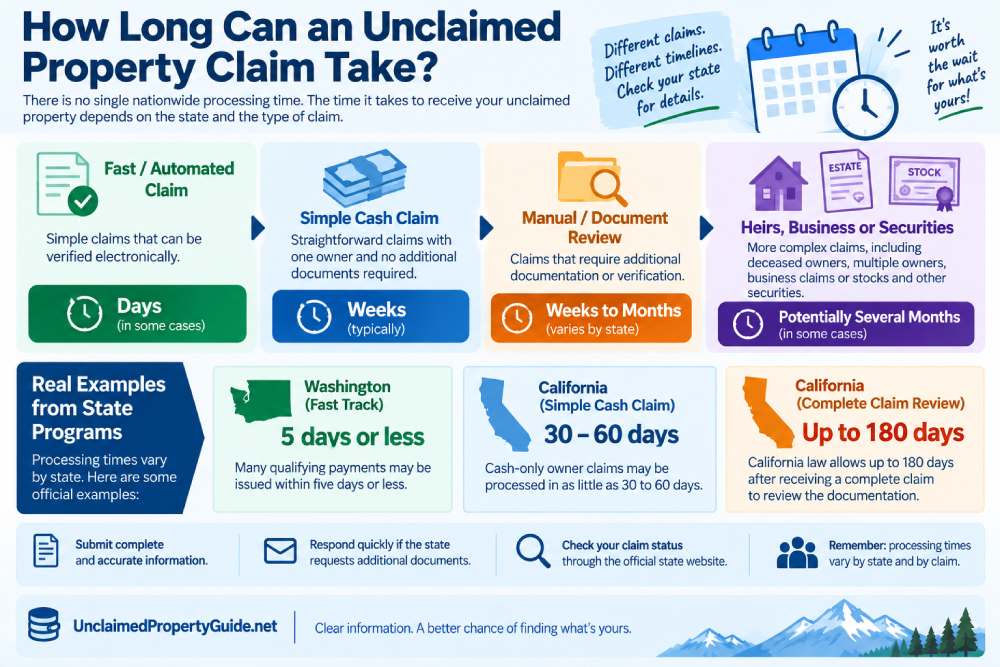
Unclaimed property claims can take anywhere from a few days to several months, depending on the state, the type of property and how much verification is required.
There is no single nationwide processing time for unclaimed property claims.
A straightforward cash claim that can be verified electronically may be processed quickly. A claim involving a deceased owner, multiple owners, a business, missing documentation or securities can take substantially longer.
Is there a standard processing time for unclaimed property claims?
No.
Unclaimed property programs are generally administered by individual states, and each state has its own:
- Claim system.
- Identity verification process.
- Documentation requirements.
- Staffing levels.
- Review procedures.
- Payment methods.
That means a claim filed in Washington can move very differently from one filed in California, Connecticut, Texas or another state.
This is why claims promising that you will always receive your money within a fixed number of days should be treated cautiously.
How long can a simple unclaimed property claim take?
A simple claim can sometimes move quickly when:
- There is only one owner.
- The property is cash.
- Your current information matches state records.
- Your identity can be verified electronically.
- No additional ownership documents are required.
Some states now use automated or expedited systems for these claims.
For example, Washington’s Fast Track process allows many qualifying payments to be issued within five days or less.
Washington Department of Revenue FY2025 Annual Report
Connecticut also operates CT FastTrack, which uses matching technology to process certain qualifying claims more efficiently.
The exact eligibility rules differ by state.
How long can a regular claim take?
Traditional claims commonly take longer because a state employee or claims system may need to review supporting information.
California provides a useful example.
The California State Controller currently says that cash-only owner claims may be processed in as little as 30 to 60 days.
However, California law allows the Controller up to 180 days after receiving a complete claim to review the documentation and make a decision.
California State Controller — Unclaimed Property claim processing
That does not mean every state uses 30, 60 or 180 days.
It simply demonstrates how much the timeline can vary even within one state depending on the claim.
Examples of current state processing times
There is no national standard, but official state programs provide useful examples.
| State / process | Current guidance |
|---|---|
| Washington Fast Track | Many qualifying payments may be issued within 5 days or less. |
| California simple cash claim | May be processed in approximately 30–60 days. |
| California complex claim | California law allows up to 180 days to review a complete claim. |
| Connecticut FastTrack | Qualifying claims can be processed much faster using automated matching technology. |
| Connecticut Big Match | This is not a traditional claim; qualifying recipients may receive a check about 6–8 weeks after notification. |
What makes an unclaimed property claim take longer?
Several factors can turn a straightforward claim into a more complicated review.
Common causes include:
- Missing documents.
- Documents that are difficult to read.
- An old address that you cannot easily prove.
- A name change.
- Multiple owners.
- A deceased owner.
- An estate claim.
- A business claim.
- Conflicting ownership information.
- Stocks or other securities.
- A claim submitted by a legal representative.
- High claim volume at the state agency.
The more evidence the state needs to confirm ownership, the longer the review can take.
Why do deceased-owner claims often take longer?
Claims for property belonging to a deceased person are often more complex than claims filed by a living owner.
The state may need to determine:
- Whether the listed owner is deceased.
- Who has authority to represent the estate.
- Whether probate occurred.
- Who the heirs or beneficiaries are.
- Whether multiple people have a legal interest in the property.
- Whether additional estate documents are required.
California specifically identifies claims filed by heirs among the types of more complex claims that are generally processed within its longer review period.
If you are dealing with inherited property, read who can claim unclaimed money from a deceased relative.
Why do securities claims take longer?
Stocks and other securities can require additional work even after the state determines that you are the rightful owner.
The state may have to research corporate events such as:
- Stock splits.
- Mergers.
- Acquisitions.
- Dividends.
- Company name changes.
- Conversions or reorganizations.
California currently states that most security claims require additional processing after approval and that some can take significantly longer because of this research.
California Unclaimed Property Division — securities claims
So an approved claim involving securities may still not result in an immediate payment.
Does the clock start when I submit the claim?
Not always in the way people expect.
A state may distinguish between:
- The date you started the online claim.
- The date the claim was submitted.
- The date supporting documents were received.
- The date the claim became complete.
This distinction can be important.
For example, California’s official timeline refers to the state receiving a complete claim package.
If the state later asks you for missing documents, the claim may not have been ready for final review when you originally submitted it.
What does “pending” mean on an unclaimed property claim?
A claim marked pending does not necessarily indicate a problem.
Depending on the state’s system, it can mean that:
- Your claim was received.
- Your identity is being verified.
- Documents are being reviewed.
- The state is waiting for additional information.
- Ownership research is underway.
- The claim is waiting in a processing queue.
Do not file the same claim again simply because the status has not changed for several days.
Duplicate submissions can create additional confusion.
What does “under review” mean?
Under review generally means the state is evaluating the claim and the evidence associated with it.
The reviewer may be checking:
- Your identity.
- Your connection to the reported address.
- The original holder’s records.
- Ownership documents.
- Estate documentation.
- Business records.
The exact meaning of each status label depends on the state’s system.
If your state’s website provides a claim-status guide, use that definition rather than assuming every state uses the same terminology.
How can I avoid delays?
You cannot control the state’s workload, but you can reduce avoidable problems.
Before submitting:
- Use the official state Unclaimed Property website.
- Enter your information accurately.
- Read the claim instructions carefully.
- Provide every document specifically requested.
- Make sure uploaded documents are clear and complete.
- Use your current contact information.
- Keep your claim number.
- Save copies of everything you submit.
Should I submit extra documents just in case?
Usually, no.
Sending unnecessary documents does not guarantee that your claim will move faster.
It can make the file larger and more complicated to review.
Instead:
- Read the state’s requirements.
- Submit what is requested.
- Wait for additional instructions.
- Respond promptly if the reviewer asks for more evidence.
Some claims can now be verified without traditional documentation at all.
When should I check my claim status?
Use the official claim-status tool provided by the state whenever possible.
Do not expect the claim to appear instantly in every system.
For example, California currently advises people who mail a claim package to allow approximately 60 days for the package to be received and entered into its system before checking the status.
California claim status guidance
Online claims may behave differently.
Always follow the instructions for the state holding your property.
How often should I check the status?
Checking several times per day will not accelerate the claim.
A more useful approach is to:
- Save your confirmation number.
- Check after the state’s suggested waiting period.
- Monitor your email and physical mail.
- Respond promptly to requests for documentation.
- Check again periodically if no update appears.
If the state publishes a specific processing estimate, wait until that period has passed before escalating unless there is an urgent problem.
When should I contact the Unclaimed Property office?
Consider contacting the state when:
- The published processing period has passed.
- The system says additional information is needed but does not explain what.
- You cannot access your claim status.
- Your mailing or contact information changed.
- You received conflicting instructions.
- The state specifically asks you to contact the office.
Use contact information from the official state website, not from an unsolicited email or third-party site.
You can find official state resources through our Unclaimed Property by State directory.
What if the state asks for more documents?
This is common and does not automatically mean your claim will be denied.
The reviewer may simply need additional evidence.
For example, the state could need proof of:
- An old address.
- A previous name.
- Business ownership.
- Your relationship to a deceased person.
- Your authority to act for an estate.
Respond using the official claim system or other method specified by the state.
Avoid sending sensitive documents through an unverified email address.
Does requesting more information restart the process?
It can delay the final decision because the reviewer may be unable to finish evaluating the claim until the missing information arrives.
Whether a formal processing clock resets depends on the state’s rules.
The safest approach is to provide requested information as quickly and accurately as possible.
How long after approval does payment take?
Approval and payment are not always the same step.
After approval, a state may still need to:
- Authorize the payment.
- Issue a check or electronic payment.
- Research securities.
- Apply permitted offsets or other legal requirements.
A simple cash payment may move relatively quickly.
Securities and other complex property can require substantially more time.
Will the state send a check or direct deposit?
This depends on the state.
Some programs issue paper checks, while other systems may support different payment methods.
Do not assume that a message asking for your bank account information is legitimate simply because you have a pending claim.
Verify payment instructions through the official state website.
Can a claim be approved automatically?
In some states, yes.
Modern matching systems allow certain straightforward claims to be verified much more quickly.
Washington’s Fast Track process, for example, can issue many qualifying payments within five days or less.
Connecticut also uses CT FastTrack and CT Big Match to streamline qualifying property returns.
These programs do not mean every claim in those states receives expedited treatment.
Why is my claim taking months?
A long processing period does not necessarily mean something is wrong.
Possible explanations include:
- Your claim requires manual review.
- You are claiming on behalf of someone else.
- The owner is deceased.
- There are multiple owners.
- Property ownership is difficult to verify.
- The claim involves a business.
- The property includes securities.
- Additional documentation is needed.
- The state has a large backlog of claims.
California, for example, currently warns that its Unclaimed Property Division is experiencing higher-than-expected claim volume, which can add time to acknowledgement, evaluation and payment. :contentReference[oaicite:1]{index=1}
Can a claim be denied after waiting several months?
Yes.
Waiting a long time does not guarantee approval.
A state can deny a claim if the evidence does not sufficiently establish ownership or legal entitlement.
If a claim is denied:
- Read the reason carefully.
- Determine whether documents are missing.
- Check whether there is a reconsideration or appeal process.
- Follow the state’s official instructions.
Do not immediately submit an identical new claim without addressing the reason for denial.
Can I speed up my unclaimed property claim?
There is usually no legitimate way to pay the state for priority processing.
The most effective things you can do are:
- File correctly the first time.
- Submit complete documentation.
- Respond quickly to requests.
- Use electronic submission when the state offers it.
- Keep your contact details current.
Be cautious with companies that claim they can guarantee significantly faster government processing simply because you pay them.
Read our guide to unclaimed property scams and suspicious offers if you receive an unexpected solicitation.
Should I file the same claim twice if nothing happens?
Generally, no.
If you already have:
- A claim number.
- A confirmation email.
- A pending claim in the state’s system.
use the claim-status process instead.
Submitting duplicate claims can make it harder to understand which submission is active.
Frequently asked questions about unclaimed property claim processing times
How long does it take to get unclaimed property?
It can range from a few days for certain automated claims to several months for claims that require manual review or extensive documentation.
Why is my unclaimed property claim taking so long?
Common reasons include missing documents, identity verification, deceased-owner claims, multiple owners, business claims, securities and high claim volume at the state agency.
Can an unclaimed property claim take 180 days?
Yes. California, for example, currently allows up to 180 days to review a complete claim. That does not mean every state uses the same deadline.
Can an unclaimed property claim be paid in a few days?
Yes. Washington says many qualifying Fast Track payments can be issued within five days or less, and other states have similar expedited systems for certain claims.
How long do deceased-owner claims take?
There is no universal timeframe. They often take longer because the state may need to verify heirs, estate authority and additional legal documentation.
How do I know whether my claim is being processed?
Use the official claim-status system provided by the state. Some states need time to enter mailed claims into their systems before a status appears.
Should I call the state after a week?
Usually not unless the state specifically tells you to do so. Check the state’s published processing guidance first.
Does “pending” mean my claim will be denied?
No. Pending generally means the claim has not yet reached a final decision.
Does approval mean I will receive payment immediately?
Not necessarily. Payment processing can take additional time, especially when the property involves securities or other complex assets.
Can I pay to have my claim processed faster?
Government Unclaimed Property Programs generally do not require you to pay a fee simply to process your own claim. Be cautious with anyone guaranteeing priority government processing for a fee.
Bottom line
There is no single answer to how long an unclaimed property claim takes.
A straightforward claim that can be verified automatically may be completed in days. A traditional cash claim may take weeks, while a claim involving heirs, businesses, multiple owners or securities can take several months.
Current official examples show just how different the timelines can be:
- Washington: many qualifying Fast Track payments within five days or less.
- California: simple cash claims can sometimes take 30–60 days, while the state can use up to 180 days to review a complete claim.
- Connecticut: qualifying claims can use FastTrack, while certain CT Big Match payments can be returned automatically.
The best way to avoid unnecessary delays is to submit an accurate claim, provide the requested documentation and monitor the official state claim-status system.
If you have not filed yet, start with our complete guide to finding and claiming unclaimed property.
Important information: UnclaimedPropertyGuide.net is an independent informational website. We are not affiliated with any state Unclaimed Property Program or U.S. government agency. Processing times vary by state and claim, and official timelines can change. Always check the state agency currently holding your property for the latest processing information.
[…] how long unclaimed property claims take for more […]
[…] Read our dedicated guide on how long unclaimed property claims take. […]
[…] Read how long unclaimed property claims take. […]