Unclaimed money belonging to a deceased relative can often still be claimed, but being a family member does not automatically mean you are the person legally entitled to receive it.
Depending on the state and the estate, the claimant may need to be an executor, administrator, personal representative, trustee or eligible heir.
The rules can also change depending on whether the deceased person left a will, whether probate occurred, whether an estate representative was appointed and how much property is involved.
Can you claim unclaimed money from a deceased relative?
Yes, in many cases.
Unclaimed property does not normally disappear simply because the owner dies.
State Unclaimed Property Programs can return money or property to:
- The deceased owner’s estate.
- A court-appointed executor or administrator.
- A personal representative.
- A trustee, when appropriate.
- An eligible heir under applicable state rules.
However, the state must verify both:
- That the property actually belonged to the deceased person.
- That the person filing the claim has the legal right to receive or administer it.
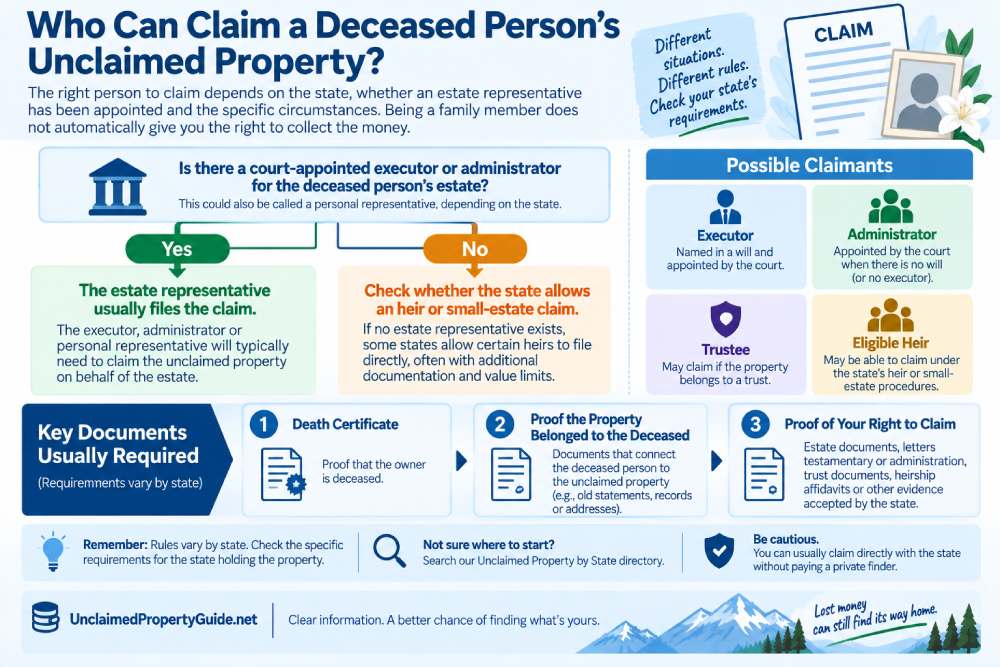
Who usually has the right to file the claim?
The answer depends on how the estate is being handled.
A useful way to think about it is:
| Situation | Who may be able to claim |
|---|---|
| Court appointed an executor or administrator | The appointed estate representative will usually need to file the claim. |
| Property belongs to a trust | The trustee may be the appropriate claimant, depending on the trust and property. |
| No formal estate representative exists | An heir may sometimes qualify under a state’s small-estate or heir procedure. |
| Estate has already been closed | The state may require the former representative, heirs or a reopened estate, depending on local rules. |
| Multiple heirs exist | The state may require information about all heirs or may pay through the estate representative. |
Can an executor claim unclaimed property?
Yes, usually.
An executor is a person appointed to administer an estate when there is a valid will and the court formally recognizes that authority.
If an executor has been appointed, the Unclaimed Property Program may ask for documents showing that the appointment is still valid.
Depending on the state, those documents can include:
- Letters Testamentary.
- A court certificate of appointment.
- The death certificate.
- Estate identification information.
- Additional proof linking the deceased owner to the property.
For example, New York states that when a court-appointed representative exists, that representative must submit the claim. :contentReference[oaicite:1]{index=1}
Can an administrator claim the money?
Yes.
An administrator generally serves a similar function to an executor when someone dies without a will or when no executor is available.
The exact title varies by state.
You may see terms such as:
- Administrator.
- Personal representative.
- Estate representative.
- Executor.
What matters is whether the claimant has valid legal authority over the estate.
Can an heir claim unclaimed property directly?
Sometimes.
Some states allow heirs to claim unclaimed property without opening a full probate estate when certain requirements are met.
This can be especially relevant for:
- Small estates.
- Low-value unclaimed property.
- Cases where no executor or administrator was appointed.
But the limits and required forms vary significantly by state.
California, for example, has specific filing instructions for an heir, trustee or personal representative/executor/administrator claiming property belonging to a deceased owner. :contentReference[oaicite:2]{index=2}
New York also provides limited procedures for heirs when there is no court-appointed representative, but its rules depend on the value of the funds and family relationship. :contentReference[oaicite:3]{index=3}
Which relatives can qualify as heirs?
There is no universal national list that applies to every estate.
When someone dies without a will, state intestacy law determines who inherits.
Depending on the family situation, potential heirs can include:
- A surviving spouse.
- Children.
- Parents.
- Siblings.
- More distant relatives.
The order of priority changes according to state law and whether other relatives are alive.
For example, New York’s simplified deceased-owner process can recognize certain relatives in an order that includes spouse, children, parents and siblings when there is no court-appointed representative. :contentReference[oaicite:4]{index=4}
That does not mean the same order or thresholds apply in every state.
Can a child claim a deceased parent’s unclaimed money?
Potentially, yes.
A son or daughter may be entitled to property belonging to a deceased parent.
However, the child may still need to prove:
- The parent’s identity.
- The parent’s death.
- The parent actually owned the property.
- The child’s relationship to the parent.
- Whether a surviving spouse exists.
- Whether other heirs exist.
- Whether an executor or administrator has already been appointed.
If an estate representative already exists, the child may need to work through that representative rather than filing independently.
Can a surviving spouse claim unclaimed property?
Often, but not automatically in every case.
A surviving spouse may have inheritance rights, but whether the spouse can file directly depends on:
- The state’s inheritance laws.
- The size of the estate.
- Whether probate occurred.
- Whether there is a will.
- Whether an estate representative was appointed.
- The type and value of the unclaimed property.
Some states provide simplified procedures for surviving spouses in smaller estates.
Can a sibling claim unclaimed money?
Possibly.
A sibling may become an heir when closer-priority relatives such as a spouse, children or parents do not exist.
But being the deceased person’s sibling alone does not guarantee that the Unclaimed Property Program can release the money directly to you.
You may need:
- A Table of Heirs or heirship affidavit.
- Death certificates for certain relatives.
- Probate documents.
- A small-estate affidavit.
- Other evidence required by the state.
What if there are several heirs?
Multiple heirs can make a claim more complicated.
The state may need to understand:
- Who all of the heirs are.
- Whether any heirs have died.
- Each person’s legal share.
- Whether one person is authorized to act for the estate.
California, for example, uses a Table of Heirship in certain deceased-owner claims to identify relatives of the deceased owner. :contentReference[oaicite:5]{index=5}
Do not omit other known heirs simply because you are the person who discovered the property.
Do you need probate to claim unclaimed property?
Not always.
Some states have procedures that allow qualifying small estates or heirs to claim property without going through a full probate proceeding.
However, probate may be necessary when:
- The property value exceeds a state’s small-estate threshold.
- There is a dispute among heirs.
- A representative must be formally appointed.
- The Unclaimed Property Program requires court authority.
- The estate contains other assets that require probate.
New York provides a good example of why the answer depends on the amount and circumstances.
If a court-appointed representative already exists, that person must generally claim the funds. When no representative exists, limited small-estate procedures can apply in some cases. :contentReference[oaicite:6]{index=6}
What if probate was already completed?
Finding unclaimed property after an estate has already been settled is common.
A company may report an asset years after the owner’s death, or heirs may simply discover it later.
What happens next depends on state law.
Possible routes can include:
- The former executor or administrator filing the claim.
- Obtaining updated or recertified court authority.
- Reopening the estate.
- Using a small-estate or heirship procedure.
Do not assume that a closed probate case means the money can no longer be claimed.
What if there was never a probate case?
You may still be able to claim the property.
Many estates never go through formal probate, especially when:
- The deceased person had few assets.
- Property passed outside probate.
- The estate qualified for a simplified procedure.
States often have alternative procedures for these situations.
California, for example, provides an heir claim process that can involve a Declaration Under Probate Code Section 13101 and a Table of Heirship in appropriate cases. :contentReference[oaicite:7]{index=7}
The requirements in another state can be completely different.
What documents are usually needed?
There is no universal checklist, but deceased-owner claims commonly require documents that establish three things:
1. The owner died.
This often means providing a certified death certificate.
2. The property belonged to that owner.
The state may ask for evidence connecting the deceased person to:
- The address shown in the record.
- The company that reported the property.
- The account involved.
3. You have the right to claim it.
Possible evidence includes:
- Letters Testamentary.
- Letters of Administration.
- A court appointment.
- A will.
- A trust.
- A small-estate affidavit.
- A Table of Heirs.
- Documents proving your family relationship.
New York explicitly requires proof that the deceased owned the funds, proof that the claimant is entitled to them and a death certificate. :contentReference[oaicite:8]{index=8}
How do you prove the deceased person owned the property?
A matching name is not always enough.
This is especially important with common names.
The state may ask for evidence connecting the deceased person to the property.
Possible evidence can include:
- Old bank statements.
- Tax records.
- Utility bills.
- Employment records.
- Documents showing the reported address.
- Correspondence from the company that reported the property.
New York, for example, asks claimants to establish the deceased owner’s connection to the reported address or the organization that reported the funds. :contentReference[oaicite:9]{index=9}
What if you cannot prove the old address?
Do not automatically abandon the claim.
States may accept other evidence showing a relationship between the deceased owner and the company that reported the property.
The available alternatives vary.
If the state asks for proof you do not have:
- Read the request carefully.
- Check old family records.
- Look for tax, bank, insurance or employment documents.
- Contact the original holder if appropriate.
- Ask the state’s Unclaimed Property office what alternatives it accepts.
Can a trustee claim unclaimed property?
Potentially.
If the property legally belongs to a trust, the current trustee may have authority to claim it.
The state may request:
- The trust agreement.
- Documentation showing the trustee’s authority.
- Evidence linking the trust or deceased owner to the property.
California specifically includes trustees among people who can file certain deceased-owner claims. :contentReference[oaicite:10]{index=10}
Can someone with power of attorney claim after the owner dies?
Be careful here.
A power of attorney generally derives authority from the living principal and commonly terminates when that person dies.
After death, authority usually shifts to the estate representative or another person authorized under estate law.
Do not assume that a power of attorney signed before death gives you permanent authority over the deceased person’s property.
Check the rules in the relevant state.
What if the deceased relative lived in a different state?
The property may be held by a state other than where you currently live.
Unclaimed property can be reported based on the deceased owner’s last known address.
If your relative:
- Lived in several states.
- Worked elsewhere.
- Had accounts in another state.
- Owned a business elsewhere.
search multiple state databases.
Use our Unclaimed Property by State directory to locate the correct official programs.
Can you claim property in more than one state?
Yes.
A deceased person may have unclaimed property in several states.
Each state claim is separate.
You may need to submit similar estate documentation more than once because one state’s approval does not automatically prove entitlement to property held elsewhere.
How long do deceased-owner claims take?
They often take longer than simple owner claims because additional legal documentation may need to be reviewed.
New York currently warns that claims filed for a deceased owner can require additional documents and take longer than ordinary claims. When additional documentation is requested, it says to allow up to 90 days after submission for review. :contentReference[oaicite:11]{index=11}
Other states have different timelines.
Read how long unclaimed property claims take for more detail.
Do heirs have to pay a fee to claim unclaimed property?
State Unclaimed Property Programs generally allow owners and heirs to claim directly without paying a private finder.
California, for example, explicitly states that owners or heirs can file directly with the State Controller without a service charge. :contentReference[oaicite:12]{index=12}
Private heir finders or asset locators may offer services for a fee, but hiring one is not automatically necessary.
Start with the official state program.
Is inherited unclaimed property taxable?
Tax treatment depends on what the property represents.
An inheritance is generally treated differently from:
- Taxable interest.
- Wages.
- Retirement distributions.
- Investment gains.
The fact that the asset came through an Unclaimed Property Program does not itself determine federal tax treatment.
Read Is Unclaimed Property Taxable? for a full explanation.
Some state databases do not display the exact value until ownership or entitlement is verified.
This is not necessarily unusual.
New York, for example, does not reveal the value of certain deceased-owner funds until the claim has been reviewed. :contentReference[oaicite:13]{index=13}
You should not need to pay a private company simply to learn whether a state is holding property.
How to claim unclaimed money from a deceased relative
The general process is:
- Search the official state Unclaimed Property database.
- Confirm that the listing appears connected to your deceased relative.
- Determine whether an executor, administrator or other estate representative exists.
- Choose the correct claimant relationship in the state’s claim system.
- Obtain the death certificate.
- Gather documents proving the deceased owner’s connection to the property.
- Gather documents proving your legal authority or heirship.
- Submit the claim using the state’s official process.
- Provide additional documentation if requested.
- Monitor the claim until a decision is issued.
For the general filing process, see how to find and claim unclaimed property.
What if you do not know whether there was a will?
Start by checking family records and the probate court in the county where the deceased person lived.
A will can affect:
- Who is named executor.
- Who inherits property.
- Whether a trust receives the property.
But remember that a will does not necessarily eliminate the need for court authority.
The Unclaimed Property Program may still require evidence that the person submitting the claim is legally authorized.
What if there is a dispute between heirs?
An Unclaimed Property office generally is not the place to resolve a family inheritance dispute.
If two or more people claim conflicting rights, the state may require:
- Probate proceedings.
- A court order.
- Formal appointment of an estate representative.
If ownership is disputed, legal advice may be appropriate before filing competing claims.
Frequently asked questions about deceased relatives and unclaimed property
Can I claim unclaimed money belonging to my deceased parent?
Possibly. A child can be an heir, but you may need to prove your relationship and legal right to the property. If an executor or administrator exists, that representative may need to file.
Can a surviving spouse claim the money?
Often, but the procedure depends on state law, whether an estate representative exists and whether other heirs have rights.
Can an executor claim unclaimed property?
Yes. A valid court-appointed executor is commonly authorized to file claims on behalf of the deceased owner’s estate.
Can an heir claim without probate?
Sometimes. Some states offer small-estate or heir procedures when no formal estate representative exists. Eligibility and value limits vary by state.
Do I need the death certificate?
Deceased-owner claims commonly require a certified death certificate or other officially accepted proof of death.
It can help states verify ownership, but the exact requirement varies. Some old property records may not include an SSN at all.
What if the estate was already closed?
The property may still be claimable. Depending on the state, the former representative may be able to act, updated court documents may be required or the estate may need to be reopened.
Can multiple heirs claim the same property?
There can be multiple people with inheritance rights. The state may require information about all heirs or may return the property through the estate representative.
Does unclaimed property expire when the owner dies?
Death alone generally does not eliminate the property’s value. Eligible heirs or estate representatives can often pursue the claim later, subject to the state’s rules.
Do I have to hire an heir finder?
No. You can generally start by searching and filing directly with the official state Unclaimed Property Program.
Bottom line
Unclaimed money belonging to a deceased relative can often still be recovered, but the claimant must establish a legal right to it.
If an executor, administrator or personal representative has been appointed, that person will often be the appropriate claimant.
If no representative exists, some states allow eligible heirs to claim smaller amounts through simplified estate procedures.
The exact rules depend on:
- The state holding the property.
- The amount involved.
- Whether the deceased person had a will.
- Whether probate occurred.
- Whether an estate representative exists.
- Your relationship to the deceased person.
Start with the official state database, determine who has authority over the estate and gather the death, ownership and heirship documents requested for that specific claim.
Use our Unclaimed Property by State directory to find the appropriate state program, or read our general guide to claiming unclaimed property.
Important information: UnclaimedPropertyGuide.net is an independent informational website and does not provide individualized legal advice. Probate, inheritance and small-estate rules vary by state and by family circumstances. Always verify current requirements with the official state Unclaimed Property Program and, when necessary, the probate court or a qualified attorney.
[…] who can claim unclaimed money from a deceased relative before filing an estate […]
[…] Read who can claim unclaimed money from a deceased relative. […]