You do not necessarily need an old utility bill to prove a previous address for an unclaimed property claim. Depending on the state and the information originally reported, acceptable evidence may include old tax forms, bank statements, driver’s licenses, credit reports, school records, insurance documents, postmarked mail, court records and other documents connecting you to the address.
If you no longer have any obvious address records, do not give up on the claim. Some states allow alternative evidence, may be able to verify you using other identifying information, or will tell you what to submit instead.
Why does the state need proof of an old address?
An old address can help distinguish you from another person with the same or a similar name.
Imagine an unclaimed property record showing:
Owner: Robert Johnson
Reported address: 811 Pine Street, Phoenix, Arizona
There may be many people named Robert Johnson. Showing that you actually lived at—or received mail at—811 Pine Street gives the state another piece of evidence connecting you to that specific property.
Arizona explains this very directly: its Unclaimed Property Section does not release funds based on name similarity alone and may require evidence that the claimant or original owner lived or received mail at the reported address.
Arizona Department of Revenue — Evidence for an Original Owner
Tennessee similarly explains that proof of a last-known address can be used to establish ownership when the reporting company provided an address but not enough other identifying information.
Tennessee Department of Treasury — Prove Your Ownership
What documents can prove an old address?
The exact list differs by state, but official programs currently recognize many types of historical records.
| Possible evidence | Why it may help |
|---|---|
| Old driver’s license or state ID | Directly connects your identity with the previous address. |
| W-2 or 1099 forms | Tax documents often show both your name and address from a specific year. |
| Bank statements | Can establish that financial correspondence was sent to you at the address. |
| Utility bills | Can connect you to service at the reported location. |
| Credit-card statements | May show your historical mailing address. |
| Pay stubs | Can show where an employer had you listed at the relevant time. |
| Credit report | May contain historical addresses associated with your credit file. |
| Insurance records | Policies or coverage documents may show an earlier address. |
| School records or transcripts | Can help document where you lived while attending school. |
| Mortgage or property records | Can establish a connection with property you owned or financed. |
| Court or legal documents | Divorce decrees, court filings and similar records may contain an address. |
| Auto registration | May connect your identity and vehicle registration to the old address. |
| Postmarked mail | An envelope addressed to you at the reported address may help show that you received mail there. |
| Birth, marriage or death certificates | Some official programs accept these when they contain the relevant address. |
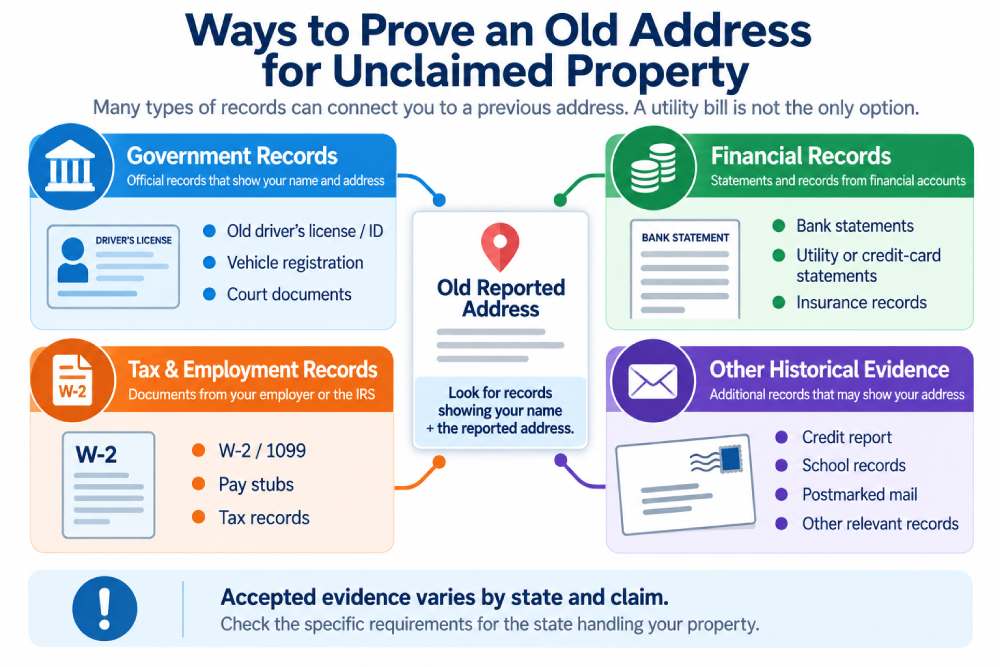
New York’s Office of Unclaimed Funds currently lists many of these records as acceptable examples of old-address evidence, including IDs, bank and utility statements, tax records, school records, insurance records, legal documents and postmarked envelopes.
New York Office of Unclaimed Funds — Required Documentation
What are the best documents to look for first?
If the address is many years old, search in places where historical records are likely to survive.
I would start with:
- Old tax records.
W-2 and 1099 forms are particularly useful because people often retain them longer than utility bills. - Bank and credit-card statements.
Check downloaded PDFs, paper files and old online accounts if they are still accessible. - Employment records.
Pay stubs, W-2s and old HR documents may show the address your employer had on file. - Insurance records.
Auto, health, renter’s, homeowner’s or life insurance documents may contain your former address. - Credit records.
A credit report may show historical addresses associated with your file. - Government records.
Old IDs, vehicle registrations, court documents and tax records may help. - Old correspondence.
A postmarked envelope addressed to you can sometimes be useful even when you no longer have formal account statements.
What if I no longer have any old utility bills?
That is not necessarily a problem.
A utility bill is only one possible form of proof.
Arizona currently gives examples including:
- credit reports;
- auto registrations;
- school records;
- marriage certificates;
- bank statements;
- court documents;
- insurance policies;
- old driver’s licenses;
- state income tax returns; and
- postmarked envelopes.
Arizona Department of Revenue — Unclaimed Asset Owner Location Efforts
New York goes even further and tells claimants that if they cannot provide the requested proof, they should submit a written explanation along with their other documentation so the office can provide further instructions.
Can a W-2 or 1099 prove my old address?
It can be very useful.
New York specifically mentions W-2 and 1099 tax records as acceptable examples of address proof and even notes that many claimants use tax records to establish an old address.
New York Office of Unclaimed Funds — Old Address Help
W-2s can be particularly valuable when the property is related to an employer because one document may help establish both:
- your address at the time; and
- your relationship with the company that may have reported the funds.
Can a credit report prove an old address?
Some state programs accept a credit report as evidence of a historical address.
Both Tennessee and Arizona currently list credit reports among examples that may be used to establish an address connection.
A credit report can be especially useful when the address is old enough that bills, bank statements and paper correspondence are no longer available.
However, do not assume that:
- every historical address will appear;
- every state will accept a credit report by itself; or
- a listed address proves every detail of the claim.
Use it as part of the evidence the state requests.
Can old mail prove I lived at an address?
It may help, particularly if it is postmarked and clearly addressed to you.
New York, Tennessee and Arizona all include old or postmarked mail among examples of address evidence.
A useful piece of mail would ideally show:
- your name;
- the old address;
- a postmark or other indication of when it was sent; and
- enough information to show the document is authentic and unaltered.
Random mail addressed to someone else at the same property is much less useful because it does not establish your connection to the address.
What if I lived with my parents and had no bills in my name?
This is a common problem, especially for property associated with an address from early adulthood or childhood.
You may still have other records connecting you personally to that address, such as:
- school records or transcripts;
- tax forms;
- an old driver’s license or state ID;
- bank statements;
- pay stubs;
- insurance records;
- vehicle registration;
- postmarked mail; or
- certain birth or other official records containing the address.
Tennessee’s evidence guidance also shows why family records can sometimes matter: in specific situations, a long-form birth certificate may be used to establish the claimant’s relationship with a parent connected to an original address.
That does not mean a parent’s utility bill automatically proves that you personally lived there. If none of your own records show the address, explain the situation to the state and ask what evidence it will accept.
What if I rented a room or lived with someone else?
You do not necessarily need to have been the homeowner or the person named on the lease for an address to be legitimately associated with you.
The more important question is whether you have records showing that you lived there or received mail there.
Possible evidence could include:
- tax documents;
- bank statements;
- employment records;
- driver’s license or vehicle registration;
- insurance documents;
- school records;
- government correspondence; or
- postmarked mail addressed to you.
If you were never on the lease, focus on records that directly connect your name to the address rather than trying to prove who legally rented the property.
What if the address on the unclaimed property record has a typo?
A small error does not automatically mean the record is unrelated to you.
Old holder data can contain:
- misspelled street names;
- missing apartment numbers;
- old ZIP codes;
- abbreviations;
- transposed numbers; or
- incomplete address information.
If most of the record fits your history but the address contains an apparent error, do not alter your documents or invent an exact match.
Instead:
- Save the property ID.
- Submit the genuine address evidence you have.
- Explain the discrepancy.
- Ask the state whether the reported address contains additional information not visible publicly.
The goal is to establish that the record belongs to you—not to make your records artificially match a typo.
What if the record only shows an old city and not the full address?
A public search database may hide or abbreviate some identifying information for privacy and fraud-prevention reasons.
If only the city or part of the address is visible, do not assume that this is all the information the state has.
Start the official claim or contact the state using the property ID. The program may compare your information with details contained in the underlying report that are not displayed publicly.
A city match is useful, but by itself it usually should not be treated as definitive proof of ownership.
What if the address was a P.O. box?
If the reported address is a P.O. box or another mailing address rather than your residence, focus on evidence showing that you received mail there.
Useful evidence may include:
- bank statements;
- tax documents;
- insurance correspondence;
- business records;
- old government mail; or
- other dated records addressed to you at that location.
The relevant connection may be a mailing relationship rather than proof that you physically lived at the address.
What if I never lived at the reported address?
Do not automatically assume the property is not yours—but do not pretend you lived there either.
There are several possible explanations worth investigating:
- It may have been a mailing address.
- It may have been an employer or business address connected to the account.
- The holder may have reported an incomplete or incorrect address.
- The listing may belong to another person with the same name.
New York specifically tells claimants who cannot prove an address because they never lived there to submit an explanation in writing when requested.
New York — What to Do if You Cannot Provide Proof
In this situation, another type of ownership evidence becomes especially important.
Can I prove ownership without proving the old address?
Sometimes.
An old address is one way to establish the connection between you and the property, but it is not necessarily the only way.
Tennessee explains the logic particularly well:
- If the reporting company supplied an SSN, matching SSN evidence may be sufficient in some claims.
- If it supplied a last-known address, the claimant may prove a connection to that address.
- If neither is available, proof showing a relationship with the company that reported the property may become important.
Examples of evidence connecting you directly with the holder can include:
- an old account statement;
- insurance policy;
- original uncashed check;
- bank book;
- stock certificate;
- contract;
- court document;
- invoice;
- pay stub; or
- other correspondence from the reporting company.
What if the property is from an old bank account?
For a bank-related property, useful evidence can include:
- old account statements;
- passbooks;
- bank correspondence;
- cancelled checks;
- tax records showing interest from the institution;
- documents containing the old account number; or
- proof that you lived at the address associated with the account.
California’s claim guidance provides a useful example. For savings or checking accounts, it identifies account statements, bank passbooks or correspondence listing account numbers as ownership evidence. If those are unavailable, proof of residence at the address associated with the reported account can become important.
California State Controller — Guidelines for Claiming Unclaimed Property
Again, that is a California example—not a universal document rule.
What if the old address belonged to a deceased owner?
If the property belongs to someone who has died, the old-address problem applies to the deceased owner, not simply to the person now filing the claim.
You may need evidence showing that the deceased person was connected to the reported address.
Arizona’s deceased-owner guidance, for example, asks for verification that the deceased owner lived or received mail at the address reported by the original holder and lists records such as tax returns, bank or utility statements, insurance policies, credit reports, school transcripts and court documents as possible evidence.
Arizona — Evidence for a Deceased Owner
You will generally also have a separate question to answer: why are you entitled or authorized to claim for that deceased owner?
Read Who Can Claim Unclaimed Money From Deceased Relatives? before filing a complex estate claim.
What if my name has changed since I lived there?
If your old address evidence uses a former name, you may need to connect that name with your current identity.
Documents may include:
- marriage certificate;
- divorce decree;
- adoption records; or
- court-ordered name-change documents.
New York currently lists these as examples of evidence that can establish a name change in an unclaimed property claim.
The goal is to create a clear chain:
Reported owner name → old address → current claimant identity.
How old can my proof of address be?
There is no useful nationwide rule such as “the document must be less than 90 days old” when you are proving a historical address.
That type of recency requirement is more commonly relevant when proving a current mailing address.
For historical ownership evidence, an older record may actually be more useful if it comes from the time connected to the property.
For example, if the unclaimed account dates from 2008, a 2008 W-2 showing the reported address may be much more relevant than a recent document showing where you live today.
Follow the state’s actual request, because it may ask separately for:
- proof of your current address; and
- proof of your connection to the old reported address.
Should I send several old-address documents?
Send what the program requests and prioritize strong, relevant evidence.
If one document clearly establishes the connection, sending twenty weak or unrelated records may add little value.
A good approach is:
- Read the state’s document request.
- Identify what fact it is trying to verify.
- Choose the clearest evidence you have.
- Provide additional supporting records if the first document does not fully establish the connection.
Think:
quality of evidence > quantity of documents.
Can I edit or annotate a document to explain the address?
Do not alter the underlying evidence.
If an explanation is necessary, submit it separately or use the official claim portal’s comment or correspondence process.
A scanned statement, tax form or official record should remain a faithful copy of the original.
New York’s document-upload guidance, for example, requires claimants to affirm that uploaded documentation is true, unaltered and factual.
If there is a discrepancy, explain it rather than modifying the record.
Should I send address documents by email?
Only use the submission method authorized by the official state program.
Historical records can contain:
- Social Security Numbers;
- account numbers;
- dates of birth;
- financial information; and
- other sensitive personal data.
Use the state’s secure upload portal, official mailing address or another method specifically provided for the claim.
Do not send sensitive documents simply because an unsolicited caller, text message or email asks for them.
If you are unsure whether a contact is legitimate, see Is Unclaimed Property a Trap?.
What should I do if the state rejects my proof of address?
A rejected document does not necessarily mean the underlying claim is invalid.
It may simply mean that the document did not prove the specific connection the examiner needed.
If the state asks for additional evidence:
- Read the request literally.
Determine whether it needs an old address, ownership connection, identity document or something else. - Do not resend the same weak evidence repeatedly.
- Ask what alternatives are accepted.
- Provide another independent record if possible.
- Include your claim ID or property ID.
New York explicitly tells claimants who cannot provide requested proof to submit a written explanation. Arizona likewise notes that a claim specialist may request additional evidence after reviewing the submission.
Requests for additional information can also affect processing time. See How Long Do Unclaimed Property Claims Take?.
Step-by-step: how to prove an old address
If you need to establish a historical address, use this process:
- Write down the exact reported address.
- Identify the approximate time period connected to the property.
- Search your existing records first.
Tax documents, bank statements, IDs, insurance records and employment files are good starting points. - Look for one document showing your name and the old address.
- Look for a second independent record if the first one is weak or incomplete.
- Check whether the holder itself can be connected to you.
An old bank statement, paycheck or insurance policy may prove ownership another way. - Follow the state’s actual document request.
- If you cannot produce the requested record, explain why and ask for acceptable alternatives.
- Submit documents only through an official channel.
Old-address evidence checklist
Before contacting the state, check whether you have any of the following:
- ☐ Old driver’s license or ID.
- ☐ W-2 or 1099.
- ☐ Tax return or state tax record.
- ☐ Bank statement.
- ☐ Utility bill.
- ☐ Credit-card statement.
- ☐ Pay stub.
- ☐ Credit report showing the address.
- ☐ Insurance document.
- ☐ School record or transcript.
- ☐ Vehicle registration.
- ☐ Mortgage or property record.
- ☐ Court document.
- ☐ Postmarked mail addressed to you.
- ☐ Account statement or correspondence from the holder.
You do not need all of these. One strong piece of evidence may be more useful than several records that do not clearly connect you to the reported address.
Frequently asked questions
What can I use as proof of an old address for unclaimed property?
Depending on the state, examples can include old driver’s licenses, W-2 or 1099 forms, bank or utility statements, credit reports, insurance records, school records, auto registrations, court documents or postmarked mail.
What if I have no proof of my old address?
Contact the official state program and ask what alternative evidence it accepts. Some states allow a written explanation and may be able to verify ownership using other identifiers or your relationship with the reporting holder.
Can a credit report show my old address?
It may. Arizona and Tennessee currently list credit reports among examples of historical-address evidence. Whether it is sufficient depends on the state and claim.
Can I use a W-2 to prove where I lived?
Yes, some programs specifically recognize W-2 forms as address evidence. A W-2 can be especially useful when the reported property is connected to a former employer.
Can old mail prove an address?
It may. Several official programs identify postmarked mail addressed to the claimant as one possible form of evidence.
What if I lived with my parents?
Look for records in your own name, such as school records, tax forms, bank statements, IDs, pay stubs, insurance records or postmarked mail. If you have none, explain the situation to the state and ask what alternatives are accepted.
What if I never lived at the listed address?
Do not claim that you did. Investigate whether it was a mailing, business or incorrectly reported address. If the property otherwise appears connected to you, explain the discrepancy and provide other ownership evidence.
Can I use my current driver’s license to prove an old address?
A current license usually proves your current identity or address, not necessarily your historical connection to a different address. Another historical record may still be needed.
What if the old address has a typo?
Submit your authentic records and explain the discrepancy. Do not alter documents to match the reported address.
Do I need the exact old address if I can prove the account was mine?
Not necessarily in every claim. Some states may be able to establish ownership through an SSN match, account records or evidence connecting you directly to the holder. Follow the state’s specific instructions.
Should I send every old document I find?
No. Focus on the strongest evidence responsive to the state’s request. Keep additional records available if the examiner asks for more.
Bottom line
Proving an old address for unclaimed property is about establishing a credible historical connection between you and the address reported by the holder.
You do not necessarily need a utility bill.
Useful alternatives can include:
- tax records;
- bank statements;
- old IDs;
- credit reports;
- insurance records;
- school records;
- pay stubs;
- vehicle registrations;
- legal records; and
- postmarked mail.
If none of those are available, do not fabricate evidence and do not automatically abandon the claim. Ask the official state program whether it can verify ownership another way or which alternative documents it accepts.
If you are still gathering evidence, read What Documents Do I Need to Claim Unclaimed Property?.
Once you are ready to submit, use our Unclaimed Property by State directory to reach the correct government program and our complete claim guide for the next steps.
Important information: UnclaimedPropertyGuide.net is an independent informational website and is not affiliated with any state or federal government agency. Address-verification and documentation requirements vary by state and by claim. Always follow the instructions provided by the official program handling your property.