Yes. You can generally claim unclaimed property from another state even if you no longer live there.
If you find money or property in an official unclaimed property database for a state where you previously lived, worked or did business, you normally file the claim with the state program currently holding or administering that property—not with the state where you live today.
Moving does not automatically transfer your unclaimed property to your new state.
Can I claim unclaimed property from a state where I no longer live?
Yes.
USAGov specifically recommends checking the unclaimed property office of every state where you have lived.
USAGov — How to Find Unclaimed Money
The National Association of Unclaimed Property Administrators (NAUPA) similarly recommends checking each state where you have lived or done business.
NAUPA — Find Official State Unclaimed Property Programs
That recommendation exists because it is completely normal for someone to have unclaimed property in a state other than their current state of residence.
You may have:
- moved to another state;
- worked in another state;
- attended college somewhere else;
- owned a business in another state;
- maintained a bank or investment account with an old address;
- received insurance coverage while living somewhere else;
- had a utility deposit at a previous residence; or
- inherited property connected with a deceased relative in another state.
Which state should I file the claim with?
File with the official unclaimed property program that currently holds or administers the property you found.
For example:
| Your current residence | Where the property appears | Where you normally file |
|---|---|---|
| Texas | California | California |
| Florida | New York | New York |
| Arizona | Tennessee | Tennessee |
| Colorado | Washington | Washington |
NAUPA advises owners with questions about a specific property or claim to contact the appropriate state office holding the property.
NAUPA — State Unclaimed Property Offices
Your current state generally does not take over the claim simply because you moved there.
Why is my unclaimed property in another state?
One of the biggest reasons is your last known address.
For many types of intangible property, the primary reporting rule generally points to the state of the owner’s last known address in the holder’s records.
Tennessee’s official unclaimed property reporting guidance summarizes the general priority rules as:
- Primary rule: report to the state of the owner’s last known address;
- Secondary rule: if there is no address or the owner is unknown, the holder’s state of domicile can become relevant; and
- special rules can apply to certain property types.
Tennessee Treasury — Unclaimed Property Priority Rules
Arizona similarly instructs holders to report property to the state of the owner’s last known address.
Arizona Department of Revenue — Reporting Guidance
This means your property may follow an address you stopped using years ago.
Example: you moved from California to Texas
Imagine this situation:
2018:
You live in California and open a savings account.
2020:
You move to Texas.
Problem:
You never update your address with the financial institution.
Holder’s records still show:
Los Angeles, California.
Later:
The account becomes subject to applicable unclaimed property rules.
Result:
The property may be reported to California based on the last known address in the holder’s records.
You now live:
Texas.
Where would you normally claim?
California, because that is the state holding the property.
Your Texas address is still important—it tells California where you live now—but it does not erase your historical California connection.
Does my current address need to match the address on the property?
No.
It is completely normal for the two addresses to be different.
The property record might say:
Last Known Address: Nashville, Tennessee
while your claim says:
Current Address: Orlando, Florida
Tennessee’s current claim guidance specifically distinguishes between:
- the claimant’s current address, which is used for claim and payment purposes; and
- the last known address associated with the property, which can be used to establish ownership.
Tennessee Treasury — Prove Your Ownership
For a complete explanation, see What Does Last Known Address Mean in Unclaimed Property?.
Do I have to prove I lived in the other state?
You may need to prove a connection to the old address, but not every claim uses exactly the same evidence.
Arizona, for example, currently asks claimants to provide proof that the owner lived at or received mail at the last known address reported by the original holder when that evidence is needed.
Examples Arizona lists include:
- old driver’s license;
- bank statement;
- utility statement;
- state income tax return;
- court documents;
- college transcript;
- insurance policy;
- cancelled check;
- postmarked envelope; and
- other historical records.
Arizona — Filing an Unclaimed Property Claim
However, old-address evidence is not always the only way to prove ownership.
What if I cannot prove my old address?
You may still have other ways to establish that the property belongs to you.
Tennessee explains that proof requirements can depend on what information the reporting company originally provided.
For example:
- if the holder supplied a Social Security Number, that identifier may help establish ownership;
- if the holder supplied an old address, proof connecting you to that address may be requested;
- if neither is sufficient, you may need evidence connecting you directly to the reporting company or specific property.
Potential holder-relationship evidence can include:
- old bank statements;
- insurance policies;
- stock certificates;
- contracts;
- original checks;
- payroll records;
- account statements; or
- other correspondence from the holder.
Tennessee — Ownership Documentation
See How to Prove an Old Address for Unclaimed Property if your old address is the main obstacle.
Do I need to travel to the other state?
Usually, you should not assume an in-person trip is necessary.
Many state programs allow at least some claims to be started or completed remotely.
California, for example, currently allows eligible claims to be filed electronically. Claims that are not eligible for electronic processing can follow the state’s paper-claim procedure.
California State Controller — Claim Filing Instructions
Tennessee currently allows owners to search for property and file claims through its online ClaimItTN portal and also provides paper claim procedures.
Tennessee Treasury — ClaimItTN
Procedures vary by jurisdiction, so follow the instructions of the state actually holding your property.
Can the state mail my payment to another state?
State claim systems generally distinguish your current mailing address from the historical address associated with the property.
Tennessee, for example, states that the address entered on the claim form is where it will mail the check.
Tennessee — Claim Address Requirements
This is why moving does not normally make an old property impossible to claim.
You simply need to distinguish:
Where you live now
from:
Where the holder knew you in the past.
Can I claim property from a state where I have never lived?
Possibly.
Do not assume that every property located in a state must belong to someone who personally lived there.
There can be several explanations.
The holder had no usable owner address
For many intangible property types, if there is no known owner address, the holder’s state of domicile can become relevant under the secondary reporting rule.
You did business there
You may have had:
- a job;
- a business;
- an insurance relationship;
- an investment account;
- a legal matter;
- a customer relationship; or
- another financial connection
without having lived there permanently.
The property may be connected to a deceased relative
An estate property could be held in a state associated with the deceased owner’s address rather than yours.
A special reporting rule may apply
Certain types of property can be subject to special jurisdiction rules.
What if I find the same name in several states?
A name match alone is not enough to establish ownership.
Suppose you search:
Michael Johnson
and find records in:
- California;
- Florida;
- Ohio; and
- Texas.
Some may belong to you.
Others may belong to completely different people.
Compare:
- last known address;
- holder name;
- property type;
- co-owner;
- former names;
- city;
- ZIP code; and
- other available information.
See What Does Holder Mean in Unclaimed Property? if you do not recognize the company listed on the record.
Can I have unclaimed property in several states at the same time?
Yes.
This is particularly common for people who have:
- moved several times;
- worked in multiple states;
- owned businesses;
- had numerous financial accounts;
- attended college away from home;
- served in the military; or
- received property from deceased relatives.
NAUPA specifically recommends searching every state where you have lived or done business.
NAUPA — Search for Unclaimed Property
USAGov also says there is no single place that contains every type of unclaimed money and recommends checking other states where you have lived.
USAGov — Search for Unclaimed Money
Can I search multiple states at once?
Yes, for many participating states.
NAUPA currently recommends MissingMoney.com as a free multi-state search resource.
Most states participate, and results can direct you to the appropriate official government website to begin the claim.
NAUPA — Multi-State Search Information
However, you should not rely on one multi-state search alone.
A thorough search should also include the official program for every state that is relevant to your history.
Use our Unclaimed Property by State directory to reach those programs.
Should I search my current state first?
You can, but do not stop there.
A better checklist is:
- Current state
- Every previous state of residence
- States where you worked
- States where you operated a business
- States connected with deceased relatives
- Relevant former names
- Relevant business names
You may be surprised to find that your strongest record is in a state you left many years ago.
How do I claim unclaimed property from another state?
The basic process is straightforward.
- Find the property in the official state database.
- Confirm that the name, holder and address information plausibly match you.
- Save the Property ID or record number.
- Start the claim through that state’s official program.
- Enter your current contact and mailing information.
- Provide identity documentation when requested.
- Provide proof connecting you to the reported owner or historical address when required.
- Submit any property-specific documentation.
- Track the claim with the state that received it.
For the complete process, read How to Find and Claim Unclaimed Property for Free.
What documents might I need?
Claim requirements vary by state and property type, but you may be asked for:
- government-issued photo ID;
- Social Security Number or TIN documentation when applicable;
- proof of your current mailing address;
- proof of your former address;
- bank or brokerage statements;
- insurance records;
- employment records;
- old tax documents;
- name-change documents;
- business authorization records;
- estate documents; or
- other evidence connecting you to the holder.
Tennessee’s official guidance emphasizes that each claim is unique and the exact documentation requested depends on the property and information originally reported.
Tennessee — Examples of Claim Evidence
See What Documents Do I Need to Claim Unclaimed Property? for a detailed checklist.
What if my driver’s license is from my current state?
That is normal.
Your current driver’s license proves your current identity and address.
It does not necessarily need to display the historical address associated with an old unclaimed property record.
The state may separately request evidence connecting you to the previous address.
For example:
Current ID: Texas
Reported unclaimed property address: California
You could potentially provide:
- your current Texas ID for current identification; and
- an old California tax record, bank statement, credit report or other historical document to establish the old address.
The two documents perform different functions.
What if I changed my name after moving?
You may need to establish a chain connecting:
old name → old address → current identity.
For example:
Property record:
Sarah Williams
Portland, Oregon
Current claimant:
Sarah Thompson
Denver, Colorado
Possible evidence:
Old Oregon bank statement + marriage certificate + current identification.
The exact documentation accepted depends on the state handling the claim.
Can I claim another state’s property for a deceased relative?
Potentially, yes.
Your current state of residence does not necessarily determine where the deceased owner’s property is held.
Suppose your father:
- lived in Ohio;
- died years ago;
- left an uncashed insurance payment; and
- you now live in Arizona.
If Ohio holds the property, you would normally work with Ohio’s unclaimed property program.
The claim may require two separate forms of proof:
- Proof that the deceased person owned the property.
- Proof that you are legally entitled or authorized to claim it.
Arizona’s current deceased-owner claim guidance, for example, requires evidence connecting the deceased owner to the reported property and documentation establishing the claimant’s authority or entitlement.
Arizona — Deceased Owner Claims
See Who Can Claim Unclaimed Money From Deceased Relatives?.
Can someone in the other state claim it for me?
Do not assume that another person can claim your property simply because they live in that state.
Residency does not give someone legal ownership of your unclaimed property.
Depending on the circumstances and state rules, another person may be able to act through a legally recognized capacity such as:
- power of attorney;
- guardian or conservator;
- trustee;
- estate representative;
- authorized business representative; or
- another legally recognized role.
See Can Someone Else Claim My Unclaimed Property?.
Can I transfer the property to my current state’s unclaimed property office?
Normally, you should work with the program that currently holds the property rather than trying to move the claim to your current state.
For example, if California’s official database shows your property, California’s State Controller provides the claim process.
California — How to Claim Property
If you believe the property was reported to the wrong jurisdiction, contact the program holding the record and ask for guidance rather than submitting duplicate claims to multiple states.
What if two states appear to have the same property?
Do not assume you are entitled to receive the amount twice.
First compare:
- Property ID;
- holder;
- owner name;
- reported address;
- property type;
- amount or range;
- co-owner; and
- reporting date when available.
They may be separate obligations from the same company, but they could also represent transferred, duplicated or related records.
If the records appear identical, contact the relevant state programs before filing competing claims.
What if I live in one state but the holder is in another?
The holder’s physical location by itself does not necessarily determine where the property ultimately belongs.
Consider:
You lived in Arizona.
Your insurance company was headquartered in Illinois.
If Arizona was the last known address in the holder’s records, the primary reporting rule may point to Arizona rather than Illinois.
Arizona’s current reporting requirements say that holders located both inside and outside Arizona must report qualifying property owed to Arizona residents.
Arizona — Unclaimed Property Reporting Requirements
This is another reason not to search only the state where a bank, insurer or employer is headquartered.
What if there was no address on the account?
When the holder has no usable owner address, jurisdiction can become more complicated.
Under the commonly applied priority structure, the holder’s state of domicile can become relevant for certain intangible property when there is no known owner address.
Special rules can also apply to certain categories of property.
This can produce a surprising result:
You might find legitimate property in a state where you never lived because the holder did not have a usable address for you.
Do not automatically reject the match.
Instead, focus on:
- the holder;
- your relationship with that holder;
- Social Security or TIN matching when applicable;
- account documentation;
- property type; and
- other identifying evidence.
Can I claim property if I now live outside the United States?
Potentially, yes, depending on the state program and claim.
Moving outside the United States does not automatically erase your ownership of property already held by a state.
For example, California’s Unclaimed Property Division currently provides contact channels for people outside the United States, and its inquiry system accepts country information.
California Unclaimed Property Division — Contact Information
International claims can require additional identification, notarization, mailing or payment procedures, so contact the state directly if its online instructions do not cover your situation.
Does claiming from another state cost money?
You generally do not need to pay a private finder simply because the property is in another state.
Official state unclaimed property searches are free.
NAUPA states that searching through official state government programs is free.
NAUPA — Free Official Searches
Tennessee also states that its search and claim service is free.
Tennessee — Free Unclaimed Property Claims
That does not mean you will never incur incidental costs—for example, obtaining historical records or notarization when required—but another state’s location alone is not a reason to pay someone to recover the property.
How long does an out-of-state claim take?
There is no special nationwide processing time simply because you live elsewhere.
Processing depends more on:
- the state;
- claim volume;
- property type;
- quality of your documentation;
- whether the owner is deceased;
- whether securities are involved; and
- whether additional research is required.
An address change can add documentation if the state needs proof connecting you to the old reported address, but being an out-of-state resident does not by itself tell you how long the claim will take.
See How Long Do Unclaimed Property Claims Take?.
Can old out-of-state property expire?
Claim deadlines depend on the state.
Some state programs currently impose no general time limit, while others can have long-term limits or property-specific rules.
For example, California currently states there is no time limit for claiming property from the state.
Moving to another state does not restart or change whatever claim rule applies in the state holding the property.
See Does Unclaimed Property Expire? before assuming that an old record is either permanently available or already lost.
What if my out-of-state claim is denied?
A different current address should not automatically mean that the property is not yours.
A state may instead need stronger evidence connecting you to:
- the old address;
- the holder;
- the account;
- the deceased owner;
- a previous legal name; or
- another reported identifier.
If the state rejects the initial evidence, read the decision or request carefully.
There is an important difference between:
- a request for more documents;
- an incomplete claim;
- a claim that cannot yet be verified; and
- a formal denial.
See Unclaimed Property Claim Denied? What to Do Next.
Example: claiming property after moving to another state
Property record:
Owner: Emily Carter
Last Known Address: Nashville, Tennessee
Holder: ABC Insurance Company
Property Type: Insurance Proceeds
Current situation:
Emily now lives in Denver, Colorado.
What should Emily do?
1. Confirm the record appears in Tennessee’s official unclaimed property system.
2. File the claim with Tennessee.
3. Enter her current Colorado mailing address.
4. Provide current identification.
5. If requested, provide evidence connecting her to the old Tennessee address or ABC Insurance Company.
Does Emily need to move back to Tennessee?
No.
Does Colorado need to take over the property first?
Normally, no. Emily works with the state program already administering the property.
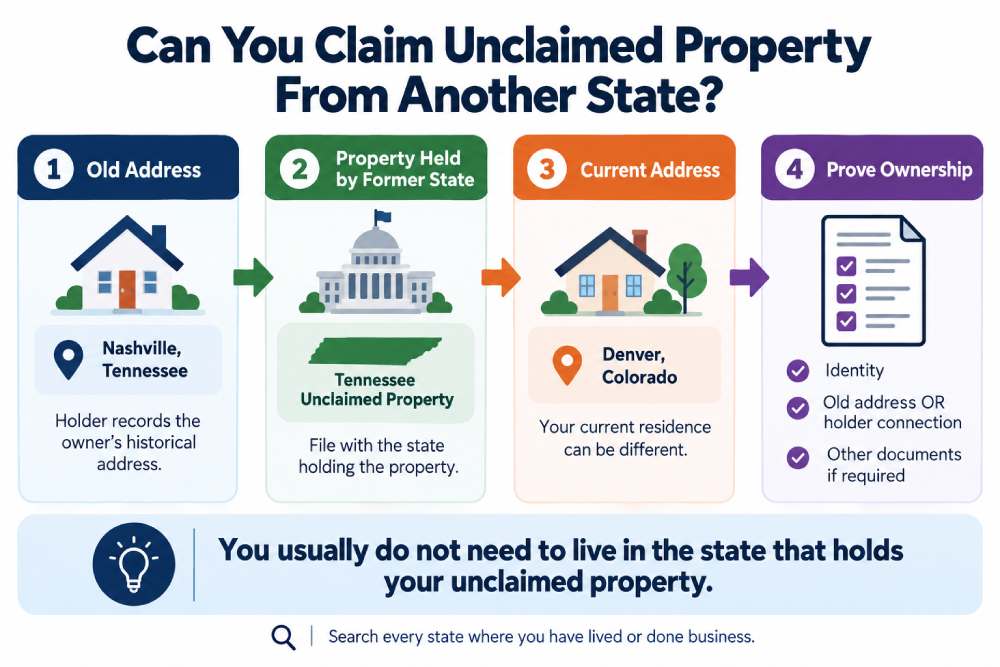
What should I do if I find property in another state?
Use this checklist:
- Make sure you are on an official state site.
- Verify the owner name.
- Check the last known address.
- Identify the holder.
- Confirm that you had a plausible relationship with that holder.
- Save the Property ID.
- Start the claim with the state holding the record.
- Use your current address on the claim where requested.
- Provide historical evidence if required.
- Keep copies of everything submitted.
- Track the claim directly with that state’s program.
Should I search every state I have lived in?
Yes.
Both USAGov and NAUPA recommend searching beyond your current state.
A useful personal search list includes:
- your current state;
- every previous state of residence;
- states where you attended school;
- states where you worked;
- states where you owned or operated a business;
- states associated with old financial accounts; and
- relevant states for deceased relatives or estates.
Also search:
- former names;
- maiden names;
- middle-name variations;
- business names; and
- common spelling variations.
For an ongoing routine, see How Often Should You Search for Unclaimed Property?.
Frequently asked questions
Can I claim unclaimed property from another state?
Yes. If an official unclaimed property program in another state holds property that belongs to you, you can generally file a claim with that state even though you currently live elsewhere.
Do I have to live in the state where I found the property?
No. Your current residence can be different from the state holding the unclaimed property.
Why is my money in my old state?
For many intangible assets, the owner’s last known address is the primary factor used to determine the state to which the holder reports the property. Your old address may therefore explain why the property is held there.
Should I claim through my current state instead?
Normally, claim through the official program that currently holds or administers the property record you found.
Do I have to travel to the other state?
Not necessarily. Many states provide online or paper claim procedures that can be handled remotely, although the exact process varies by jurisdiction and claim type.
Can the check be sent to my current address?
State claim processes generally collect your current mailing information separately from the historical address associated with the property. Tennessee, for example, states that the address on its claim form is where the check will be mailed.
What if I cannot prove my old address?
You may be able to establish ownership using another identifier or documentation showing your relationship with the company that reported the property. Requirements vary by state.
Can I claim property from a state where I never lived?
Possibly. Property can sometimes be reported under rules involving the holder’s domicile when no owner address exists, and other special jurisdiction rules can apply. Verify the holder and other identifying information carefully.
Can I have unclaimed money in more than one state?
Yes. People who have moved, worked or done business in multiple states can have separate unclaimed property records in several jurisdictions.
Is there one nationwide database for all unclaimed property?
No single database covers every type of U.S. unclaimed money. NAUPA recommends MissingMoney.com for a multi-state search across participating programs and also recommends checking official state sites.
Can I claim property for a deceased relative who lived in another state?
Potentially. You generally file with the state holding the deceased owner’s property and must establish both the deceased owner’s connection to the property and your legal entitlement or authority to claim it.
Can another person claim it just because they live in that state?
No. Living in the state does not make someone the owner. Another person generally needs recognized legal authority to claim on the owner’s behalf.
Does moving cause my unclaimed property to move too?
No. Your current residence does not automatically transfer an existing unclaimed property record from one state program to another.
How do I find the official program for another state?
Use NAUPA’s official state directory or our Unclaimed Property by State directory to reach the government program for the relevant jurisdiction.
Bottom line
You can generally claim unclaimed property from another state even if you no longer live there.
The key is not your current state of residence.
The important questions are:
- Which state currently holds the property?
- Does the record genuinely match you?
- Can you establish your identity?
- Can you connect yourself to the reported owner, old address or holder?
- Have you followed that state’s specific claim instructions?
If you moved from one state to another, it is completely normal for an old property record to remain associated with your former state.
Your claim may show:
Historical address in State A
while you now have:
Current address in State B.
That difference alone does not mean the property cannot belong to you.
Start by identifying the official program using our Unclaimed Property by State directory.
Then follow How to Find and Claim Unclaimed Property for Free for the complete claim process.
Important information: UnclaimedPropertyGuide.net is an independent informational website and is not affiliated with any state or federal government agency. Unclaimed property jurisdiction, ownership evidence and claim procedures vary by state and property type. Always follow the current instructions of the official state program holding the property.