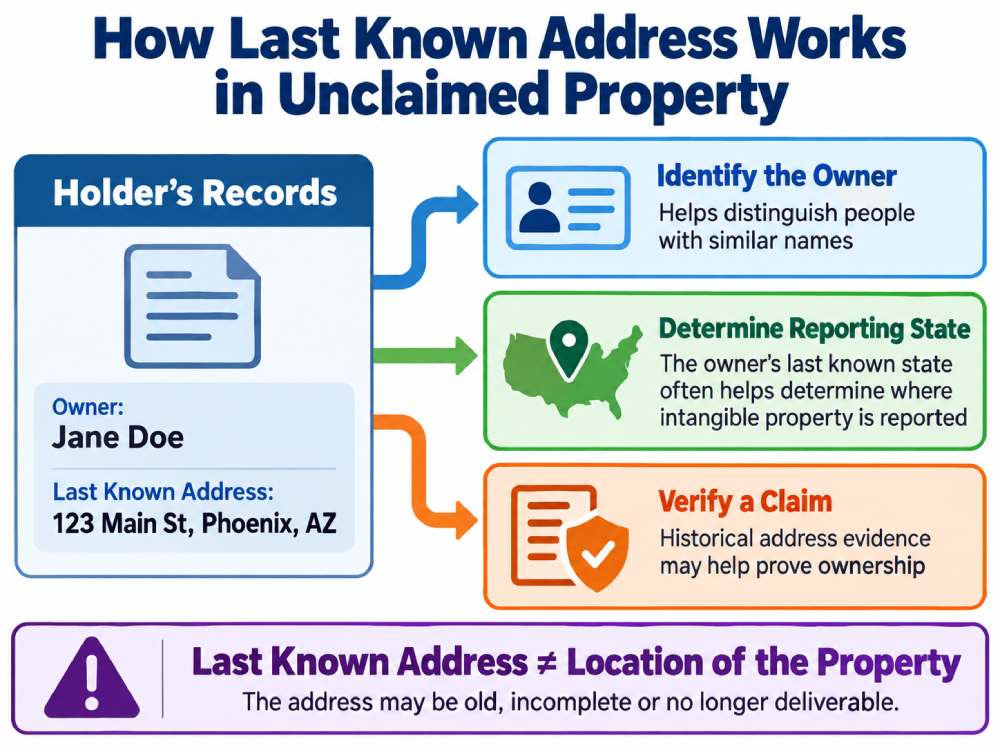
In unclaimed property, a “last known address” generally means the address associated with the owner in the reporting company’s records before the property was transferred or reported to the state.
It is primarily an identifying and reporting detail.
It does not necessarily mean:
- that you still live there;
- that it was the last home you physically occupied;
- that the money or property is located at that address; or
- that an address match by itself proves the property belongs to you.
The address can be important because it may help determine which state should receive the unclaimed property and can later help the state verify that a claimant is connected to the reported owner.
What exactly is a last known address?
The National Association of Unclaimed Property Administrators (NAUPA) defines a last known address as a description of the apparent owner’s location that is sufficient for delivery of mail.
NAUPA — Unclaimed Property Glossary
In practical terms, think of it as:
the mailing-location information the holder associated with the owner in its records.
For example, a bank might have:
Last Known Address: 214 Pine Avenue, Denver, Colorado
Property Type: Savings Account
Even if Jennifer moved years ago, that Denver address may remain important because it was the address connected to her account when the bank lost contact with her.
Is the last known address my current address?
Usually not unless you still happen to live there.
Your current address is where you live or receive mail now.
Your last known address in an unclaimed property record is historical information from the holder’s records.
| Address type | What it generally means |
|---|---|
| Current address | Where the claimant currently lives or receives mail. |
| Last known address | The address associated with the apparent owner in the holder’s records. |
| Reported address | A label some systems may use for the address reported with the property. |
| Property location | Not the same thing as the owner’s last known address. |
A claim form may therefore ask you for both:
- your current mailing address; and
- proof connecting you to an old reported address.
Does the last known address show where the unclaimed money is?
No.
This is an important misconception.
Arizona’s Unclaimed Property Unit states explicitly that the address listed with a property represents the last known address of the owner, not the location of the asset itself.
Arizona Department of Revenue — Owner Location Information
For example:
Last Known Address: Tucson, Arizona
does not mean:
- cash is stored at that address;
- the home itself is unclaimed property;
- the state owns that house; or
- the bank account physically exists there.
The address is simply information associated with the owner.
Why is the last known address important?
It can serve at least three major purposes.
1. It can help identify the rightful owner
A name alone is often not enough.
Imagine a database contains:
Owner: Robert Johnson
There may be thousands of people with that name.
Adding:
Last Known Address: 318 Oak Street, Phoenix, Arizona
creates another identifying connection that can help distinguish one Robert Johnson from another.
Arizona specifically says it uses the last known address to help establish an owner’s claim.
2. It can help determine which state receives the property
For many types of intangible unclaimed property, the state of the owner’s last known address generally has priority for reporting purposes.
Arizona’s current holder guidance states:
holders should report property to the state of the owner’s last known address.
Arizona Department of Revenue — Holder Quick Reference Guide
This helps explain why property may be held by a state where you no longer live.
For example:
Old account address: Georgia
Holder loses contact while Georgia is on file
The property may ultimately be associated with Georgia rather than Florida, depending on the applicable reporting rules.
If no owner address exists, different jurisdiction rules can apply, including rules involving the holder’s state of domicile.
This is one reason you should search every state where you have lived or done business, not only your current state.
Use our Unclaimed Property by State directory to reach official programs.
3. It can be used to contact the owner before transfer
Unclaimed property laws commonly require holders to make an effort to contact owners before transferring qualifying property to a state.
California currently requires holders to send qualifying notices to the owner’s last known address before the property is reported and transferred when the statutory conditions are met.
California State Controller — Holder Due Diligence Requirements
NAUPA describes this owner-contact process as a normal part of unclaimed property reporting.
NAUPA — Unclaimed Property Reporting Overview
Can the last known address be old?
Yes. Very old.
In fact, an old address is completely normal in an unclaimed property record.
The address may date from when you:
- opened a bank account;
- worked for a former employer;
- had an insurance policy;
- rented an apartment;
- maintained an investment account;
- paid a utility deposit; or
- had another financial relationship with the holder.
If the holder never received an updated address from you, its records may continue showing the older one.
Can the last known address be a mailing address rather than my home?
Yes.
The concept is fundamentally connected to where the holder could send mail to the owner.
That means a last known address does not necessarily have to represent a property you owned or your permanent residence.
Depending on what was in the holder’s records, it could potentially be:
- a residential address;
- a previous apartment;
- a P.O. box;
- another mailing address; or
- an incomplete address associated with the owner.
What matters is the information the holder had associated with the apparent owner.
Can a P.O. box be a last known address?
Yes, if it was the mailing address associated with the owner in the holder’s records.
A last known address is not necessarily proof of physical residence.
If an unclaimed property record shows:
P.O. Box 1452, Austin, Texas
the relevant claim question may be whether you can establish that you received mail there, rather than whether you physically lived inside a particular residential property.
What if the last known address is no longer valid?
It can still remain on the unclaimed property report.
Arizona’s holder FAQ specifically addresses this situation.
When a company sends a check to an owner and the mail is returned as undeliverable, Arizona tells holders to:
report the last known address anyway.
Arizona explains that it uses the address to help establish the owner’s claim.
Arizona — Reporting an Undeliverable Address
So an address being:
- outdated;
- no longer occupied;
- undeliverable; or
- associated with returned mail
does not necessarily make it irrelevant.
What if the last known address is incomplete?
A holder may not always have a complete street address.
Arizona’s current reporting instructions tell holders to provide the complete owner address when available but, if the complete address is unavailable, to report the portion that is known.
Arizona — Unclaimed Property Reporting Instructions
This means a record may sometimes contain only:
- a city;
- a state;
- a ZIP code;
- part of a street address; or
- another incomplete location reference.
A partial public listing therefore does not necessarily mean the property record itself is invalid.
Why does my unclaimed property listing show the wrong address?
There are several possible explanations.
The address may be:
- an older address you forgot about;
- a mailing address rather than a residence;
- an address associated with an old financial account;
- incomplete;
- incorrectly entered in the holder’s records;
- missing an apartment or unit number;
- affected by a spelling or formatting error; or
- evidence that the listing belongs to another person with the same name.
Do not force a match.
If you genuinely never had any connection to the address, compare the other fields before filing:
- holder;
- property type;
- co-owner;
- former names;
- city and state;
- property ID; and
- any additional identifying information.
What if I never lived at the listed address?
That does not automatically prove the property is not yours—but it is something you need to investigate.
Ask yourself:
- Did I ever receive mail there?
- Was it a P.O. box?
- Was it connected to an account I recognize?
- Did the reporting company know me at that time?
- Does the property type make sense?
- Could the address contain an error?
- Could this belong to another person with my name?
Do not tell the state that you lived somewhere if you did not.
Instead, explain the discrepancy honestly and provide another legitimate ownership connection if available.
Does matching the last known address prove the property is mine?
No.
An address is an important identifier, but it is only one piece of the ownership analysis.
A strong match can involve several pieces of information:
- owner name;
- last known address;
- Social Security Number or TIN when available to the state;
- date of birth;
- holder relationship;
- account information;
- property type; and
- other documentation.
Arizona emphasizes that ownership cannot simply be established based on name similarity.
Likewise, an address alone does not turn a person into the rightful owner.
How is the last known address used to verify my claim?
Tennessee’s current claim guidance provides a useful explanation.
If the reporting company provided a Social Security Number, that identifier may be enough in some cases to prove ownership.
If the reporting company did not provide an SSN but did provide a last known address, Tennessee may ask the claimant to provide documentation connecting them to that address.
If neither an SSN nor a usable address was reported, evidence showing a relationship with the reporting company may become important.
Tennessee Department of Treasury — Prove Your Ownership
This illustrates an important principle:
The address is one route to proving ownership—not necessarily the only route.
What documents can prove a last known address?
Accepted evidence varies by state, but examples can include:
- old driver’s license or state ID;
- bank statements;
- utility statements;
- W-2 or 1099 forms;
- tax returns;
- credit reports;
- pay stubs;
- insurance policies;
- vehicle registrations;
- school records;
- court documents;
- cancelled checks; and
- postmarked mail addressed to you.
Arizona currently lists many of these records as examples of evidence connecting a claimant to the last known address.
Arizona — Proof of Last Known Address
For the complete strategy, see How to Prove an Old Address for Unclaimed Property.
What if I have no documents showing the old address?
Do not automatically abandon the claim.
The state may have other identifying information, or another type of evidence may establish your connection with the property.
Possible alternatives can include:
- an old account statement;
- an insurance policy;
- an employment record;
- a stock certificate;
- a contract;
- an original check;
- a bank book;
- correspondence from the holder; or
- another record linking you directly to the reporting company.
Tennessee specifically recognizes this kind of holder-relationship evidence when the reporting company did not supply enough SSN or address information.
For broader documentation guidance, see What Documents Do I Need to Claim Unclaimed Property?.
What if the address has a typo?
An apparent typo does not necessarily invalidate the property record.
Examples could include:
- “315 Main St” instead of “351 Main St”;
- a misspelled street name;
- a missing apartment number;
- an old ZIP code;
- an abbreviated city name; or
- another minor recordkeeping error.
If the holder, owner name, time period and property type all fit your history, submit authentic evidence and explain the discrepancy.
Never alter a document to make it match the reported address.
What if only the city and state match?
A city-and-state match can be useful, but it is usually weaker than a complete historical address match.
Some holder records may contain only partial address information.
California law even recognizes, for certain jurisdictional purposes, location information that identifies the state of an apparent owner even when it is not detailed enough to deliver first-class mail.
California Unclaimed Property Law
That does not mean a matching city alone proves you are the owner.
The state can still evaluate other identifiers and documentation.
Why is my property in a state I no longer live in?
The most likely explanation is that the holder had an address for you in that state when the property became subject to reporting.
For example:
2015: You move to Texas but do not update the account.
Later: The holder loses contact with you.
Last Known Address in holder records: Illinois.
The resulting unclaimed property can therefore be associated with Illinois even though you have lived in Texas for years.
NAUPA recommends searching every state where you have lived or done business.
NAUPA — Find Official State Unclaimed Property Programs
What happens if there is no last known address?
The property does not automatically disappear.
Different jurisdiction rules can determine where the holder reports property when there is no usable owner address.
For example, Tennessee’s holder guidance describes the general priority structure as:
- Primary rule: report to the state of the owner’s last known address.
- Secondary rule: when there is no address or the owner is unknown, the holder’s state of domicile can become relevant.
Tennessee Treasury — Unclaimed Property Priority Rules
There are additional special rules for certain property types, so this should not be treated as a complete nationwide jurisdiction analysis.
Can the holder report an address even if mail was returned?
Yes.
Arizona currently instructs holders to report the owner’s last known address even when mail sent there was returned as undeliverable.
Arizona — Last Known Address and Returned Mail
That is important because:
“Last known” does not mean “currently valid.”
It means the best or latest address information the holder had associated with the owner.
Is the last known address the same as the address on my claim form?
No.
Your claim form may ask for your current address so the agency knows:
- where you live now;
- where correspondence should be sent; or
- where a payment should be mailed when applicable.
Tennessee’s current claim guidance specifically distinguishes the address entered on the claim form—where it will mail the check—from the historical last known address that may be used as proof of ownership.
Tennessee — Current Address vs Ownership Documentation
What if I moved many times?
That is one of the strongest reasons to search multiple states and try multiple historical addresses.
A person might have records associated with:
- college housing;
- a first apartment;
- a former family home;
- an old P.O. box;
- a previous state;
- a business address; or
- another legitimate mailing address.
Different holders may have different addresses for the same person.
So you might find:
Property A → California address
and:
Property B → Nevada address
even though both properties belong to you.
What if my name also changed?
Historical address and historical name data often appear together.
A record might contain:
Former name + former address
while your current identity shows:
Current name + current address.
The claim may then require evidence linking both changes.
Possible documents can include:
- marriage certificate;
- divorce decree;
- court-ordered name change;
- old ID;
- historical tax records; or
- other documents establishing the connection.
The goal is to create a logical chain:
reported owner → historical address → name change → current claimant.
How does the last known address work for a deceased owner?
The address still relates to the original owner.
If the owner has died, you may need to prove that the deceased person lived at or received mail at the reported address.
Arizona currently tells deceased-owner claimants to provide verification connecting the deceased owner to the last known address reported by the original holder.
Examples include:
- driver’s license;
- tax returns;
- bank or utility statements;
- insurance records;
- credit reports;
- school records;
- court records; or
- postmarked mail.
Arizona — Address Evidence for a Deceased Owner
You then have a separate question to prove:
Why are you legally entitled or authorized to claim for that deceased person?
See Who Can Claim Unclaimed Money From Deceased Relatives?.
Can a business have a last known address?
Yes.
Unclaimed property owners can be businesses as well as individuals.
The holder may report an address associated with:
- a corporation;
- partnership;
- sole proprietorship;
- LLC;
- nonprofit;
- trust; or
- other organization.
Arizona’s current business-claim guidance requires evidence connecting the entity to the reported last known address in certain claims, in addition to proof of the claimant’s authority to act for the business.
Arizona — Business Entity Claim Evidence
What if the public database does not show the full address?
Do not assume the state has no additional information.
Public-search interfaces vary.
A public record may show:
- full address;
- partial address;
- city and state only;
- ZIP code;
- limited location information; or
- no publicly visible address.
New York, for example, notes that not all records in its full unclaimed funds system are included in its downloadable public owner list, including some records reported without an owner address.
New York Office of Unclaimed Funds — Owner Record Information
If the listing otherwise appears to match you, follow the official claim process and let the state determine what additional identifying information exists in the underlying report.
What should I do if I recognize the last known address?
If the name, address and holder all appear connected to you:
- Save the Property ID.
- Confirm the holder.
Did you have an account, policy, job or other relationship with that organization? - Check the property type.
- Gather address evidence if you still have it.
- Start the claim through the official state program.
- Provide only the documentation the state requests.
Use our complete guide to finding and claiming unclaimed property for the overall process.
What should I do if I do not recognize the address?
Do not immediately file based only on a matching name.
Instead:
- Check whether you ever received mail there.
- Review former addresses and P.O. boxes.
- Identify the holder.
- Check whether you had a relationship with that company.
- Review the property type.
- Consider whether the record could belong to another person with the same name.
- Contact the official state program if the rest of the record appears to match.
If ownership cannot be established through the address, another identifier or holder connection may still be relevant.
Can a bad address cause my claim to be denied?
Insufficient ownership evidence can cause problems, but an address discrepancy is not automatically the same thing as a final denial.
The state may ask for:
- additional address evidence;
- proof of your Social Security Number or TIN when appropriate;
- records connecting you to the holder;
- name-change documents; or
- other ownership evidence.
If your claim has already been rejected or additional evidence has been requested, see Unclaimed Property Claim Denied? What to Do Next.
Example: how a last known address helps identify property
Public record:
Owner: Michael Davis
Last Known Address: 42 West Elm Street, Seattle, WA
Holder: ABC Insurance Company
Property Type: Insurance Proceeds
Claimant history:
Michael Davis lived at 42 West Elm Street in 2014 and had an insurance policy with ABC Insurance Company.
Why the address matters:
The matching historical address strengthens the connection between Michael Davis, the reporting holder and the specific property.
What it does not prove by itself:
The address alone does not automatically establish ownership. The state may still compare additional identifiers and request documentation.
Frequently asked questions
What does last known address mean in unclaimed property?
It generally means the address associated with the apparent owner in the reporting holder’s records. It may be an old mailing address and does not necessarily represent the claimant’s current residence.
Is the last known address where the money is located?
No. The address identifies the owner, not the physical location of the unclaimed money or asset.
Why does the state need my old address?
The state can use it as one piece of evidence connecting you to the reported owner and property. It can also be important in determining the state to which the holder reports the property.
Does the last known address have to be a house I lived in?
No. It can be a mailing address associated with the owner in the holder’s records, including a P.O. box or another legitimate address where the owner received mail.
Can a last known address be wrong?
Yes. Holder records can contain outdated, incomplete or incorrect information. Compare the address with the holder, property type and other identifiers before assuming a listing is yours.
Can an undeliverable address still be reported?
Yes. Arizona, for example, explicitly tells holders to report the last known address even if mail to that address was returned as undeliverable.
What if I never lived at the address?
Consider whether you ever received mail there or used it with the reporting company. If you genuinely have no connection to it, investigate the rest of the record and do not claim the property based only on a matching name.
What if the address has a typo?
Submit authentic evidence showing your actual historical address and explain the discrepancy. Do not alter documents to match an apparent error in the property record.
Can I claim property if I cannot prove the old address?
Possibly. Another identifier or evidence connecting you directly to the holder may establish ownership, depending on the state and the information originally reported.
What documents prove a last known address?
Possible examples include old IDs, bank or utility statements, tax records, W-2s, credit reports, insurance records, school records, vehicle registrations, court documents and postmarked mail. Accepted evidence varies by state.
Why is my property in a state where I no longer live?
The holder may have had your old address in that state when the property became reportable. For many types of intangible property, the state of the owner’s last known address generally has priority for reporting.
What if there is no last known address?
Other jurisdiction rules can determine where the property is reported. A common secondary rule can involve the holder’s state of domicile, although special rules exist for certain property types.
Is the address on my claim form the same as the last known address?
No. Your claim form usually uses your current mailing information, while the last known address is historical information originally associated with the reported property.
Can a deceased person’s old address be used to verify a claim?
Yes. A claimant may be asked to establish that the deceased owner lived at or received mail at the reported address, in addition to proving authority or entitlement to claim for the estate.
Bottom line
The “Last Known Address” in an unclaimed property record is generally the historical address the holder associated with the owner.
It can help:
- identify the correct owner;
- distinguish between people with similar names;
- determine the state to which property should generally be reported;
- give the holder an address for pre-reporting contact attempts; and
- provide evidence during the claim process.
But remember:
- it may be years or decades old;
- it may be a mailing address rather than a residence;
- it may be incomplete or undeliverable;
- it does not show where the money is physically located; and
- a matching address alone does not automatically prove ownership.
If the address matches your history but you no longer have obvious records, use our guide to proving an old address for unclaimed property.
If you are ready to pursue the property, follow How to Find and Claim Unclaimed Property for Free.
Important information: UnclaimedPropertyGuide.net is an independent informational website and is not affiliated with any state or federal government agency. Address-verification, jurisdiction, reporting and claim requirements vary by state and property type. Always follow the current instructions of the official unclaimed property program handling your claim.
[…] For a complete explanation, see What Does Last Known Address Mean in Unclaimed Property?. […]