For most people, searching for unclaimed property about once a year is a practical baseline. You should also search again periodically even if you found nothing the last time, because businesses continue reporting newly abandoned property to states and state databases continue to change.
There is no national rule requiring you to search every 6 months, every year or on a particular date. However, some state unclaimed property programs specifically encourage annual searches. Utah, for example, currently recommends that residents search its database at least once a year.
How often should you check for unclaimed property?
Once a year is a reasonable routine for most people.
That recommendation is not based on a nationwide legal deadline. Instead, it reflects how the unclaimed property system works.
Businesses and other organizations continue reporting property when accounts, payments or other obligations remain unclaimed for the applicable dormancy period. That means a property that is still held by a company today may eventually be transferred to a state program and become searchable later.
Utah’s Office of State Treasurer currently tells residents—including people who have already received money through its automatic matching program—to search the state’s unclaimed property database at least once a year.
Utah Office of State Treasurer — MyCash Now
Utah has also explained why repeat searches matter: the state receives new unclaimed property each year, so people who searched previously are encouraged to check again.
Utah Treasurer — Why Residents Should Search Again
Why should I search again if I already checked?
Because an unclaimed property database is not a fixed historical list.
New property can be added over time as businesses report assets that have completed the applicable dormancy and reporting process.
Possible sources include:
- old checking or savings accounts;
- uncashed payroll checks;
- refunds;
- insurance benefits;
- utility deposits;
- customer credits;
- dividends;
- securities;
- safe deposit box contents; and
- other obligations a holder could not return to the owner.
A search you performed two years ago only tells you what you could find at that time. It does not tell you what may be reported later.
How often are unclaimed property databases updated?
There is no single update schedule used by every state.
California provides a useful example. The State Controller currently says it receives most unclaimed property in June and insurance-related property in December, but its public Unclaimed Property Database System is continually updated.
California State Controller — Database Update Information
California also publishes downloadable unclaimed property records and currently states that those files are updated every Thursday.
California — Download Unclaimed Property Records
That does not mean every consumer should search California every Thursday, and it does not establish a national update schedule. It simply demonstrates that state databases can change throughout the year.
Is once a year an official rule?
No. There is no nationwide law requiring consumers to search for unclaimed property once a year.
Think of annual searching as a simple financial housekeeping habit.
It works well because:
- new property continues to enter state systems;
- it is frequent enough to catch changes over time;
- it is easy to remember;
- searching official databases is generally free; and
- there is usually little benefit for an ordinary person in checking the same databases every few days.
If your state specifically recommends a different routine, follow the guidance of that official program.
Is February 1 the best day to search?
You can search at any time of year.
February 1 is recognized by the National Association of Unclaimed Property Administrators (NAUPA) as Unclaimed Property Day. NAUPA uses the date to encourage people to search state databases and participating states through MissingMoney.com.
NAUPA — Unclaimed Property Day
February 1 can therefore make a convenient annual reminder:
February 1 → Search for unclaimed property → Repeat next year.
But there is nothing about February 1 that makes a property legally searchable only on that date, and state databases may be updated at other times throughout the year.
Should I search again after moving?
Yes, moving is a good reason to keep unclaimed property on your future search checklist.
Moving does not mean that your money immediately becomes unclaimed property. Property generally must first remain inactive or unclaimed for the applicable period before a holder reports it to the state.
However, moves are one of the situations in which people can lose contact with:
- banks;
- former landlords;
- utility companies;
- insurance companies;
- employers;
- brokerages; or
- other businesses holding money for them.
If you moved recently, update your address directly with companies that owe or hold money for you rather than waiting for funds to become unclaimed.
Then keep the states where you previously lived on your annual search list.
Should I search after changing jobs?
It can be worthwhile, especially as part of future annual searches.
Employment-related unclaimed property can include:
- uncashed payroll checks;
- commissions;
- expense reimbursements;
- other employer payments; or
- certain benefits or financial accounts.
Again, leaving a job does not instantly turn money into state-held unclaimed property. Applicable dormancy and reporting rules generally come first.
If you know a former employer owes you money now, contacting the employer may be more appropriate than waiting for it to appear in a state database.
Should I search after closing a bank account?
If you properly closed the account and received all remaining funds, there may be nothing to find.
However, old financial relationships are worth remembering during later searches because people sometimes lose track of:
- small remaining balances;
- uncashed cashier’s checks;
- certificates of deposit;
- interest payments;
- refunds; or
- accounts they believed had already been closed.
The same reasoning applies to old brokerage, insurance and utility accounts.
Should I search after changing my name?
Yes, include former names in future searches whenever the search system allows it.
For example, property may have been reported under:
- a maiden name;
- a former married name;
- a previous legal name;
- a middle initial;
- a name with or without a suffix; or
- a slightly different format used by an old account.
Changing your legal name does not automatically update every historical account or property record.
If you find property under an old name, the state may request documentation connecting that name to your current identity.
What states should I search every year?
Do not search only the state where you live now.
NAUPA recommends checking every state where you have lived or done business. Its search guidance notes that property can be associated with multiple states, particularly for people who have moved.
NAUPA — Search for Your Unclaimed Property
Your annual list might therefore include:
- your current state;
- states where you previously lived;
- states where you worked;
- states where you operated a business;
- states connected to old financial accounts; and
- states connected to a deceased relative whose property you may legally be entitled to claim.
Use our Unclaimed Property by State directory to reach official programs.
Do I need to search all 50 states individually?
Not necessarily.
NAUPA sponsors MissingMoney.com, which allows users to search participating states through one service.
However, NAUPA says most states participate—not necessarily every possible database or source.
You can also use NAUPA’s official state directory to search individual state programs directly.
NAUPA Official State Search Directory
What if I searched last year and found nothing?
Search again this year.
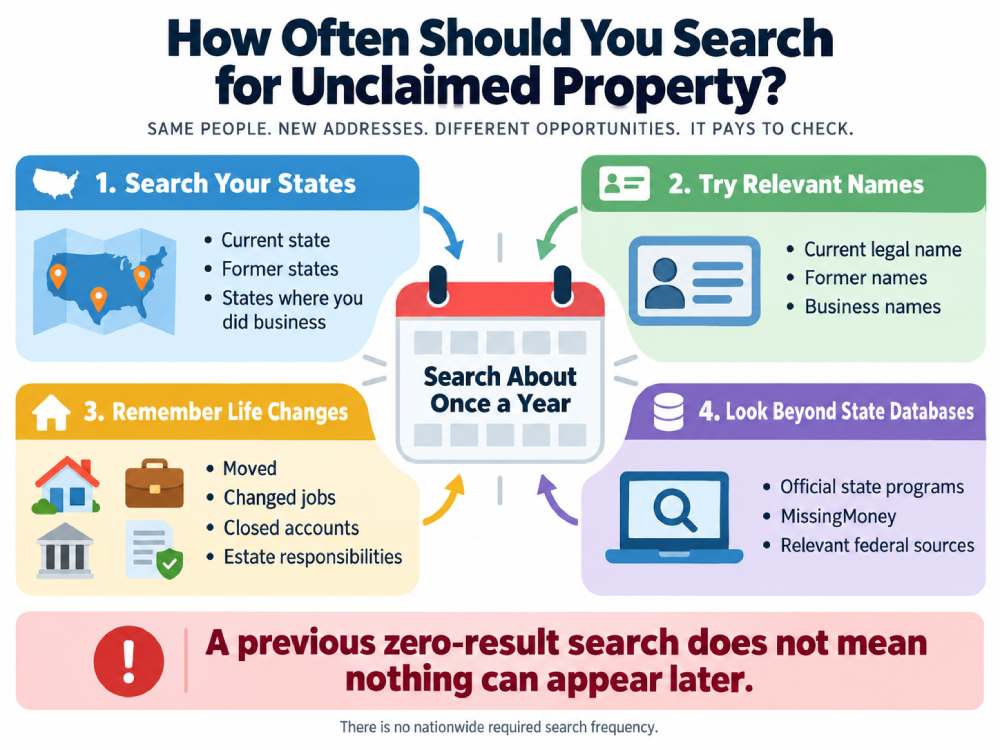
A previous zero-result search does not establish that:
- no company owes you money;
- no new property has since been reported;
- you searched every relevant state;
- you searched every useful version of your name; or
- there are no federal or other specialized sources to check.
This is exactly why an annual search is useful.
You are not trying to repeatedly search the same static list. You are checking a system that can receive new records over time.
What if I already claimed unclaimed property once?
You can still have additional unclaimed property later.
Recovering one account does not prevent another unrelated account, check, refund or benefit from becoming unclaimed in the future.
For example, you might recover:
2026 → old utility deposit
and later discover:
2028 → forgotten insurance payment
Those would be separate properties from different holders.
So receiving unclaimed property once is not a reason to stop checking.
Should I search every month?
For most ordinary consumers, monthly searching is probably unnecessary.
State systems do change over time, but unclaimed property typically reaches the state only after the underlying holder has completed the applicable dormancy and reporting process.
Checking every week or month is therefore unlikely to provide much additional value for someone who is simply performing routine searches.
An annual check is easier to maintain and is consistent with the recurring-search guidance published by Utah’s unclaimed property program.
There are exceptions. If you know that a specific property is in the process of being transferred to a state, or a state agency has told you when to check again, follow that program’s instructions instead.
Why doesn’t property appear immediately?
Because money generally does not move directly from “I forgot about it” to a state database overnight.
The process can look roughly like this:
- You have money or property with a company.
- The company loses contact with you or the account becomes inactive.
- An applicable dormancy period runs.
- The holder may be required to perform notices or other due-diligence steps.
- The property is reported and transferred under state law.
- The state processes the information.
- The property can become available through the state’s search system.
The exact sequence and timing depend on the property type and state.
See What Is a Dormancy Period in Unclaimed Property? for a detailed explanation.
Should I search for deceased relatives every year?
If you are responsible for an estate or may legally be entitled to property from a deceased relative, periodic repeat searches can make sense.
Not all of a deceased person’s property necessarily reaches state systems at the same time.
Different accounts may have:
- different holders;
- different property types;
- different dormancy periods;
- different reporting dates; and
- different states connected to them.
Searching again later can therefore uncover a property that was not visible during the first estate search.
However, finding the property does not automatically mean every relative can claim it.
See Who Can Claim Unclaimed Money From Deceased Relatives?.
Should I search for my parents or grandparents even if they are alive?
You can help a living relative search official databases, but finding a listing does not automatically give you the right to claim their property.
If the owner is capable of filing their own claim, the simplest approach may be for them to complete the process directly.
Representatives, guardians, trustees and powers of attorney can have separate rules.
If you plan to claim for someone else, check the state’s requirements before submitting anything.
What about old businesses?
If you owned or represented a business, include relevant business names in periodic searches.
Property can sometimes be reported under:
- the current legal business name;
- a former business name;
- a DBA;
- a predecessor company;
- a dissolved entity; or
- a business address instead of an individual’s home address.
Finding business property is only the first step. The claimant may need to prove authority to act for the organization or its successor.
Should I only search state unclaimed property databases?
No.
USA.gov explains that there is no single database containing every type of unclaimed money in the United States.
State programs hold much of the country’s unclaimed property, but some money is handled through separate federal systems.
USA.gov — How to Find Unclaimed Money From the Government
Depending on your circumstances, separate sources can include:
- TreasuryHunt for certain matured U.S. savings bonds;
- FDIC for unclaimed funds from failed banks;
- NCUA for certain funds from liquidated credit unions;
- U.S. Courts for unclaimed bankruptcy funds;
- SEC databases for certain investment-related distributions; and
- other federal programs listed by USA.gov.
Your annual unclaimed-money check can therefore include both state property searches and any federal databases that are relevant to you.
What should I search each year?
A useful annual routine is:
- Search your current state.
- Search every state where you previously lived.
- Search states where you did business or maintained significant financial relationships.
- Search your full legal name.
- Try former names or reasonable name variations where the search tool permits them.
- Check a spouse’s name separately where appropriate.
- Check relevant deceased relatives if you may have a legitimate estate or heirship interest.
- Search former business names if applicable.
- Review relevant federal unclaimed-money sources.
Annual unclaimed property search checklist
| What to check | How often |
|---|---|
| Your current state | About once a year |
| Previous states of residence | Include in your annual search |
| Former names | Include when searching if the database permits |
| Old business names | Include if relevant |
| Deceased relatives | Periodically when you have a legitimate reason to search |
| Federal databases | Periodically based on the type of money you may be missing |
| Known property being transferred | Follow the specific state’s instructions |
What if I find property during my annual search?
Once you find a possible match:
- Open the official state record.
- Compare the owner name, address, holder and property type.
- Start the claim through the official program.
- Provide documentation if requested.
- Keep your claim or property number.
- Follow the state’s status instructions.
Use our How to Find and Claim Unclaimed Property for Free guide for the complete process.
How often should I check a claim that is already pending?
This is different from how often you should search for new property.
If you already filed a claim, use the status system and communication schedule provided by that state.
Do not submit duplicate claims simply because the claim has been pending for several weeks.
Some claims require additional documentation or manual review.
See How Long Do Unclaimed Property Claims Take? for more information.
Can I set a reminder to search every year?
Yes—and that may be the easiest way to make repeat searching useful.
Pick a date that you will remember, such as:
- February 1, Unclaimed Property Day;
- your birthday;
- the beginning of the year;
- tax season; or
- another annual financial-review date.
Add a calendar reminder:
“Search official unclaimed property databases.”
Then repeat the same checklist each year.
Should I pay for an annual unclaimed property search service?
You generally do not need to pay someone just to conduct routine searches.
NAUPA provides links to official state programs, and participating states can be searched through MissingMoney.com for free.
Be cautious with companies or messages that suggest you must pay simply to discover whether a state is holding property in your name.
If you receive an unsolicited message about money supposedly waiting for you, verify the property independently through the appropriate official program.
See Is Unclaimed Property a Trap? How to Spot Scams.
Frequently asked questions
How often should I check for unclaimed property?
For most people, about once a year is a practical routine. Utah’s official unclaimed property program currently recommends searching at least once a year. There is no nationwide mandatory search frequency.
Should I search for unclaimed property every year?
Yes, an annual search is reasonable because new property continues to be reported and state databases change over time. A search that produced no results last year does not guarantee the same result this year.
How often are unclaimed property websites updated?
Update schedules vary by state. California, for example, says its Unclaimed Property Database System is continually updated, while property itself is received through reporting cycles. Do not assume all states use California’s schedule.
What is the best time of year to search for unclaimed property?
There is no nationwide best month. You can search throughout the year. February 1 is Unclaimed Property Day and can be a convenient annual reminder, but it is not a legal search deadline.
Should I check after moving?
Moving is a good reason to keep former states on future searches because address changes can contribute to lost contact with financial institutions and other holders. Property does not necessarily become unclaimed immediately after a move.
Should I check after changing jobs?
It can be useful to include former employers and states in future searches, especially if you may have missed wages, reimbursements or other payments. Contact an employer directly if you already know it owes you money.
Can new unclaimed property appear after I already searched?
Yes. New property continues to be reported to state programs, so an item may become searchable after an earlier search produced no match.
Do I need to search states where I no longer live?
Yes. NAUPA recommends checking each state where you have lived or done business. Moving away does not eliminate property connected to a previous state.
Should I search under my maiden name?
If you previously used another legal name, it is sensible to include it when the state’s search tool allows name variations. Historical accounts may still be associated with that name.
Is MissingMoney.com enough?
MissingMoney.com is a useful free search service sponsored by NAUPA and covers participating states, but it should not be treated as the only possible source of unclaimed money. State programs and separate federal databases may also need to be checked.
Should I search every month?
For routine consumer searching, usually not. Annual searching is a practical baseline. If a state tells you a specific property will become searchable later, follow that program’s instructions instead.
Bottom line
Search for unclaimed property about once a year, even if your previous search found nothing.
The reason is simple: new property continues to be reported, and state databases change over time.
Your annual search should include:
- your current state;
- states where you previously lived;
- states where you did business;
- former names where appropriate;
- relevant business names;
- deceased relatives when you have a legitimate reason to search; and
- relevant federal unclaimed-money databases.
There is no nationwide rule saying you must search exactly once a year, and there is no universal best month. Annual searching is simply an easy, practical habit supported by the fact that new unclaimed property continues entering state systems.
Ready to check again? Start with our Unclaimed Property by State directory or follow the complete step-by-step guide to finding and claiming unclaimed property.
Important information: UnclaimedPropertyGuide.net is an independent informational website and is not affiliated with any state or federal government agency. Reporting cycles, database updates, dormancy periods and search systems vary by jurisdiction. Always use official government programs to verify and claim property.