Someone else cannot normally take your unclaimed property simply because they found your name in a public database. States generally require the claimant to prove either that they are the rightful owner or that they have recognized legal authority to act for the owner.
However, another person may be able to submit or manage a claim in certain situations. Examples can include a legal guardian, trustee, estate representative, custodial parent, authorized agent or person holding an acceptable power of attorney.
The exact rules depend on the state holding the property and on whether the owner is living, deceased, a minor, a business or part of a jointly owned account.
Can a stranger claim unclaimed property that belongs to me?
Not simply because they discovered the listing.
Public unclaimed property databases are designed to help owners locate property, but a search result is not the same thing as proof of entitlement.
For example, Arizona states that its Unclaimed Property Unit cannot pay a claim based on name similarity alone. The claimant must provide evidence supporting ownership or authority.
Arizona Department of Revenue — Unclaimed Property Evidence Requirements
A stranger who sees:
Michael Brown — Dallas, Texas — ABC Insurance
cannot legitimately claim the money merely by having the same name or knowing the address displayed in the database.
The state may use information such as:
- identity documents;
- Social Security Number or other identifiers when applicable;
- historical addresses;
- the claimant’s relationship with the holder;
- account or employment records;
- estate documents; and
- legal authority to act for another person.
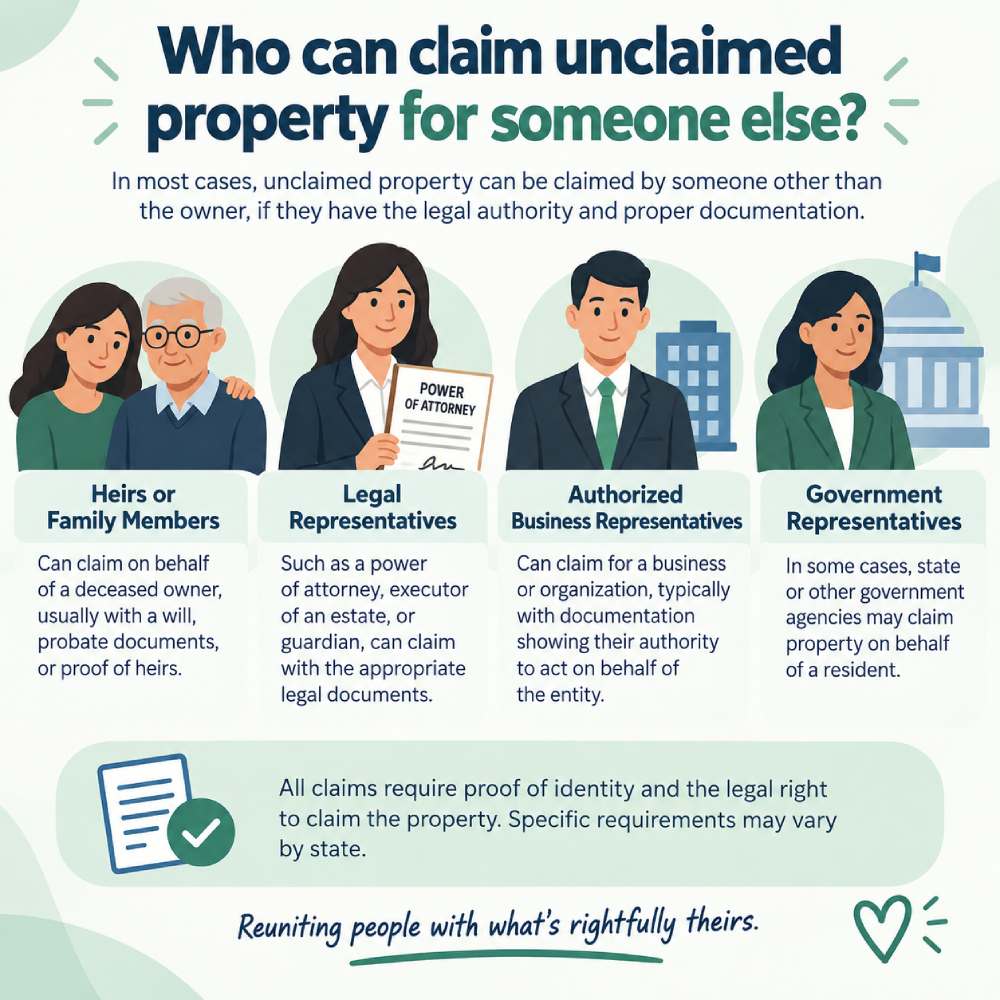
Who can claim unclaimed property for someone else?
The answer depends heavily on the claimant’s legal relationship to the owner.
New York’s Office of Unclaimed Funds currently states that claims may be submitted on behalf of another person by certain recognized representatives, including an owner’s:
- parent;
- custodian;
- guardian;
- conservator;
- trustee;
- power of attorney; or
- legal representative.
New York Office of Unclaimed Funds — How to Search and Claim Property
That does not mean every state uses exactly the same categories or accepts the same documents.
Think of the issue as two separate questions:
- Who owns the property?
- If someone else is filing, what gives that person authority to act for the owner?
Can a family member claim my unclaimed property?
Being related to you usually does not, by itself, give a family member the right to claim property belonging to you while you are alive.
Your:
- spouse;
- adult child;
- parent;
- sibling;
- cousin; or
- other relative
may still need recognized authority if they are filing on your behalf.
That might involve a valid power of attorney, guardianship, conservatorship, trusteeship or another relationship recognized by the state.
Can my spouse claim my unclaimed property?
Not automatically just because you are married.
The answer may depend on:
- how the property was originally titled;
- whether both spouses were reported as owners;
- the state’s marital-property rules;
- whether the owner is living or deceased; and
- whether the spouse has separate legal authority to act.
If only your name appears as the reported owner and you are living, your spouse should not assume that marriage alone allows them to claim the funds.
If both names appear, then the issue becomes one of joint ownership, which can follow different rules.
Can a joint owner claim the property without me?
Sometimes, but this is very state- and ownership-specific.
This is a good example of why unclaimed property rules should not be generalized nationally.
New York currently says that when property has multiple owners, one co-owner may submit a claim without the other owners jointly filing. The office will request additional information if needed.
New York — Claims for Properties With Multiple Owners
Arizona operates differently in some circumstances. Its current claim guidance states that joint owners are generally required to claim together, with specific procedures for circumstances such as:
- a deceased joint owner;
- divorce; or
- joint owners who have lost contact.
Arizona Department of Revenue — Filing a Claim
The original ownership designation can also matter. Property may have been reported as:
- joint tenants;
- tenants in common;
- either party owner;
- community property;
- multiple payees; or
- another relationship type.
Do not assume that every person named on a property record is entitled to the entire amount.
Can someone claim my property with a power of attorney?
A valid power of attorney may allow another person to act for a living owner in some states, but the requirements vary significantly.
Arizona, for example, says that a person filing as an agent for a living owner must prove their authority. Its listed possibilities include:
- a valid power of attorney;
- certain court-issued authority;
- trustee documentation; or
- documentation establishing authority for a minor owner.
Arizona — Agent for a Living Owner
Arizona also has a specific authorization form that can grant an appointee authority to claim and collect unclaimed property for the claimant.
Arizona Form 285UP — Representation Authorization
Does every state accept a power of attorney?
No. You should never assume that a POA accepted in one state will automatically work the same way in another.
California provides an important contrast.
California’s published investigator guidance says that when an owner cannot sign the claim form, the State Controller’s Office accepts a power of attorney in a much narrower situation: the POA must convey authority over the owner’s finances or property and be accompanied by medical documentation stating that the owner is incapacitated. Those claims are sent for legal review.
California State Controller — Power of Attorney Guidance
California’s general owner-claim instructions likewise focus on the property owner’s own signed Claim Affirmation Form.
California — Claim Filing Instructions and Forms
Can a power of attorney claim after the owner has died?
A deceased-owner claim normally follows estate and heirship procedures, not the same process used for an agent acting for a living person.
Tennessee’s current evidence guidance explicitly states that a power of attorney cannot be used when the original owner is deceased.
Tennessee Department of Treasury — Examples of Evidence
Once the owner has died, the relevant claimant may instead be an:
- executor;
- administrator;
- personal representative;
- trustee;
- eligible heir; or
- other person permitted by the state’s estate procedure.
For more detail, see Who Can Claim Unclaimed Money From Deceased Relatives?.
Can an heir claim someone else’s unclaimed property?
An heir may sometimes claim property belonging to a deceased owner, but being related to the deceased does not automatically prove entitlement.
States may need to establish:
- that the property really belonged to the deceased;
- that the original owner is deceased;
- who has authority over the estate; and
- who is entitled to receive the property under the applicable estate rules.
New York, for example, says that when a court-appointed representative exists, that representative is generally the person who must submit the claim.
In limited situations where there is no court-appointed representative, New York permits certain heirs to proceed under its small-estate rules, subject to conditions including the value of the property and the claimant’s relationship to the deceased.
New York — Claims for Deceased Owners and Estates
Those are New York procedures. Estate rules elsewhere can differ substantially.
Can my child claim my unclaimed property?
If you are a living adult owner, an adult child generally should not assume that being your child gives them authority to claim property in your name.
They may need separate legal authority to represent you.
If the child is the actual owner and is still a minor, however, a parent, guardian or custodian may sometimes be able to act for the child.
Arizona, for example, lists a birth certificate and written statement establishing that the claimant is the custodial parent of a minor unclaimed property owner as one possible basis for filing as an agent.
Can a guardian or conservator claim for another person?
Potentially, yes.
States may allow a legally appointed guardian or conservator to act for someone who cannot manage the claim personally.
New York lists both guardians and conservators among the people who may submit a claim on behalf of another person.
Its documentation guidance may require court or authority records such as Letters of Guardianship or Letters of Conservatorship.
New York — Required Documentation
Simply caring for another person does not necessarily create the same legal authority as a court-recognized guardianship or conservatorship.
Can a trustee claim unclaimed property?
Yes, in appropriate trust situations, if the claimant can establish current authority as trustee.
For example, Arizona may accept:
- Letters of Acceptance as Trustee;
- a Certificate of Trust; or
- a trust document identifying the trustee and granting relevant authority.
New York also lists trustees among the categories that may claim for someone else.
The payment itself may remain property of the trust rather than becoming the trustee’s personal money.
Can someone claim unclaimed property for my business?
A business representative may be able to file, but the person normally needs to prove authority to act for the organization.
Merely being an employee is not necessarily enough.
Depending on the state and business structure, documentation might include:
- business registration records;
- FEIN evidence;
- partnership agreements;
- corporate authorization;
- power of attorney;
- merger or acquisition records;
- DBA documentation; or
- evidence establishing the claimant’s role in the business.
New York and Arizona both publish separate documentation requirements for organization or business claims.
New York — Proof for Organizations
Arizona — Evidence for a Business Entity
Can an asset finder or recovery company claim the money for me?
A finder or investigator may sometimes assist an owner with a claim, but that does not normally make the finder the owner of the property.
California, for example, recognizes businesses sometimes called:
- investigators;
- asset locators; or
- heir finders.
These companies may offer to locate owners and assist with recovering property for a fee.
California requires a disclosure agreement between the owner and investigator and currently limits the investigator’s fee to no more than 10% of the value returned for most unclaimed property, with a specific exception described by the state for county probated estates.
California State Controller — About Investigators for Consumers
California also emphasizes that owners and heirs can file directly with the State Controller’s Office for free.
California — Claiming Property FAQ
The rules for finders, fees and representation vary by state.
Can a finder transfer my unclaimed property into their own name?
Helping with a claim is not the same as becoming the rightful owner.
A legitimate representative should be able to explain:
- who the reported owner is;
- what authority allows the representative to act;
- what contract or authorization you are signing;
- how any fee is calculated; and
- who will ultimately receive the property.
California’s published investigator agreement, for example, identifies the claimant as the person who may be entitled to the assets and treats the investigator’s compensation separately as an agreed percentage of property actually recovered.
California — Standard Investigator Agreement
Knowing one piece of personal information does not automatically establish entitlement to unclaimed property.
State programs can require multiple forms of verification, particularly when the holder’s original report contains enough identifying information to compare against the claim.
However, your SSN, date of birth, old addresses and identification documents are sensitive information.
Do not provide them to someone merely because they:
- found your name online;
- sent you a text;
- called claiming to represent the state;
- promised guaranteed payment; or
- said they need your documents immediately.
Instead, independently locate the official state program and verify the property there.
See Is Unclaimed Property a Trap? How to Spot Scams.
Can someone with the same name as me claim my money?
A matching name should not, by itself, be enough.
This is precisely why states request additional ownership evidence.
Suppose a database lists:
David Martinez — Miami, Florida
There may be hundreds of people with that name.
A legitimate claim may need to establish additional connections such as:
- the reported address;
- the reporting company;
- an account relationship;
- employment history;
- SSN or TIN information when requested;
- date of birth; or
- other evidence contained in the holder’s records.
If you need to establish a historical address, see How to Prove an Old Address for Unclaimed Property.
Can someone steal unclaimed property by filing a fraudulent claim?
Someone can potentially attempt fraud, identity theft or submission of false documents, which is one reason states verify claimant identity and ownership rather than paying whoever first discovers a listing.
You should not assume that a fraudulent claimant would automatically succeed.
If you believe someone may be trying to claim property in your name:
- Contact the official state unclaimed property program directly.
- Provide the Property ID or Claim ID if available.
- Explain why you believe an unauthorized claim may exist.
- Ask what identity-verification or fraud procedure the agency wants you to follow.
- Keep copies of correspondence and documentation.
Do not confront an unknown claimant using personal information found online or send additional sensitive documents through unverified channels.
What if someone already filed a claim on property in my name?
If the official database or state tells you that a claim already exists, contact the agency before creating another claim.
There may be several legitimate explanations:
- You previously started a claim and forgot about it.
- A joint owner filed.
- An authorized representative filed.
- An estate representative filed for a deceased owner.
- The property was associated with another person who has the same name.
- An unauthorized claim may have been attempted.
Ask the state what information it can provide and what steps it requires to verify your identity or challenge an unauthorized claim.
Can someone claim the property before I do?
Unclaimed property is not normally awarded on a “first person to find it wins” basis.
The central issue is entitlement.
A claimant generally needs to establish that they are:
- the owner;
- another person with a legal interest in the property; or
- an authorized person acting for the rightful owner.
California law illustrates this principle by defining who may qualify as an “owner” for purposes of making a claim, including the person who had the legal right to the property before escheat and certain heirs, estate representatives, guardians or conservators.
California Unclaimed Property Law — Sections 1540–1541
What does “claimant relationship” mean?
Many state claim systems ask you to identify your relationship to the reported owner.
Possible options might include:
- Owner / Self.
- Joint owner.
- Heir.
- Executor or administrator.
- Trustee.
- Guardian.
- Custodian.
- Power of attorney.
- Business representative.
Choose the relationship that accurately describes why you are entitled to file.
New York specifically instructs claimants to select the appropriate claimant relationship for each property and says that if the property is in your own name, the correct selection is “Owner (Self).”
Selecting the wrong relationship can result in the state requesting additional evidence or can complicate processing.
If that has already happened, see Unclaimed Property Claim Denied? What to Do Next.
Owner vs claimant: what is the difference?
These terms are easy to confuse.
| Term | Meaning |
|---|---|
| Owner | The person or entity to whom the property belongs according to the underlying legal or reported ownership. |
| Claimant | The person or entity submitting a request for the state to release the property. |
| Representative | A person acting for the owner or another eligible claimant under recognized authority. |
| Heir | A person who may have rights connected to a deceased owner’s estate, subject to applicable estate law and state claim procedures. |
An owner and claimant may be the same person—but they do not have to be.
For a deeper explanation, read What Does “Owner” Mean in Unclaimed Property?.
What documents may be required when claiming for someone else?
The exact requirements depend on the relationship and state, but the claimant may need to prove both:
1. The original owner’s connection to the property.
For example:
- old address evidence;
- account statements;
- employment records;
- insurance documents; or
- other holder records.
2. The representative’s authority to claim.
That might involve:
- power of attorney;
- court order;
- Letters Testamentary;
- Letters of Administration;
- guardianship or conservatorship records;
- trust documentation;
- birth certificate for certain minor claims;
- business authorization; or
- other relationship documents.
See What Documents Do I Need to Claim Unclaimed Property? for a broader document checklist.
What should I do if I want someone else to handle my claim?
Before giving anyone authority or sensitive information:
- Find the property through the official state program.
- Check whether you can file the claim yourself for free.
- Ask the state whether representatives are permitted for your type of claim.
- Find out what authorization the state requires.
- Read any power of attorney or service contract carefully.
- Understand who will receive the payment.
- Understand any fee before signing.
- Submit sensitive information only through legitimate channels.
If you prefer to handle the claim yourself, start with How to Find and Claim Unclaimed Property for Free.
Quick checklist: can this person claim for the owner?
Ask these questions:
- ☐ Is the reported owner living or deceased?
- ☐ Is the claimant actually named as an owner?
- ☐ Is the property jointly owned?
- ☐ Is the claimant a guardian, trustee or court-appointed representative?
- ☐ Is there a valid power of attorney that this state accepts?
- ☐ Is the claimant acting for a minor?
- ☐ Is this an estate claim?
- ☐ Is the claimant authorized to act for a business?
- ☐ Can the claimant prove their authority?
- ☐ Can the original owner still be connected to the reported property?
If you cannot answer those questions confidently, check the instructions from the state holding the property before filing.
Frequently asked questions
Can anyone claim unclaimed property they find online?
No. Finding a public listing does not by itself establish ownership. The claimant generally must prove that they are the owner or are legally authorized to act for the person or entity entitled to the property.
Can a relative claim my unclaimed property while I am alive?
A family relationship alone usually does not create authority to claim property belonging to a living adult. The relative may need a power of attorney, guardianship, trusteeship or another form of authority accepted by the state.
Can my spouse claim money listed only in my name?
Marriage alone should not be assumed to establish the right to claim property reported solely to you. Joint ownership, marital-property rules and representative authority can affect the answer.
Can someone with power of attorney claim for me?
Possibly. Some states accept powers of attorney under specific conditions, while others impose stricter requirements. Check the rules of the state holding the property.
Can a power of attorney be used after the owner dies?
Deceased-owner claims normally move into estate or heirship procedures. Tennessee, for example, explicitly states that a power of attorney cannot be used when the original owner is deceased.
Can one joint owner claim without the other?
It depends on the state and ownership relationship. New York permits one co-owner to submit a claim and may request additional information, while Arizona generally requires joint owners to claim together unless a specific exception applies.
Can an heir finder claim my money?
A finder may be authorized to assist with a claim under applicable state rules and a valid agreement, but locating the property does not by itself make the finder its owner.
Can my parent claim unclaimed property that belongs to me?
If you are an adult, the parent generally needs a separate basis of authority to act for you. If the owner is a minor child, a custodial parent or guardian may have a recognized claim route depending on the state.
Can someone steal my unclaimed property using my name?
Someone may attempt fraud, but a matching name alone should not establish entitlement. State programs use ownership and identity verification requirements. If you suspect an unauthorized claim, contact the official program immediately.
What if someone has already claimed property that I believe belongs to me?
Contact the state holding the property and provide the relevant Property ID or other identifying information. Ask how to report a possible ownership dispute or unauthorized claim rather than immediately creating duplicate claims.
Bottom line
Another person cannot legitimately claim your unclaimed property merely because they discovered it, know your name or are related to you.
Someone else may be able to act for an owner when there is a recognized legal basis, such as:
- power of attorney accepted by the state;
- guardianship or conservatorship;
- trustee authority;
- custodial authority for a minor;
- business authorization;
- estate appointment; or
- another legally recognized claimant relationship.
Joint ownership and deceased-owner claims require special attention because the rules can vary substantially between states.
Most importantly, the person filing a claim and the person who owns the property are not necessarily the same person. A representative may be allowed to submit paperwork without personally becoming entitled to the money.
If the property belongs to you and you want to claim it yourself, use our step-by-step guide to finding and claiming unclaimed property.
Important information: UnclaimedPropertyGuide.net is an independent informational website and is not affiliated with any state or federal government agency. Rules governing representatives, powers of attorney, joint owners, estates, trusts and business claims vary by jurisdiction. Always follow the instructions of the official state program holding the property.