If your unclaimed property claim was denied, the first thing to determine is why. A denial can result from missing proof of identity, an old address that could not be verified, insufficient evidence connecting you to the property, an incorrect claimant relationship, estate-document problems or another issue specific to the claim.
But before treating the case as a final denial, check the exact wording you received. “Additional documentation required,” “incomplete,” “invalid” and “denied” do not necessarily mean the same thing. In some states, you may be given an opportunity to provide more evidence before the agency makes a final decision.
First: was your claim actually denied?
This distinction matters.
After filing an unclaimed property claim, you might receive one of several different outcomes:
| Status or message | What it may mean | What to do |
|---|---|---|
| Additional documentation required | The state cannot yet verify part of the claim and wants more evidence. | Provide the requested evidence or ask what alternatives are accepted. |
| Incomplete | The submission may be missing a form, signature, answer or required document. | Complete the missing requirement using the state’s instructions. |
| Invalid submission | The filing did not satisfy a procedural requirement needed for the state to process it. | Determine what made the submission invalid before filing anything again. |
| Under review | The claim is still being evaluated. | Do not treat a long review period as a denial unless the agency says so. |
| Denied / denied in part | The agency has made a decision that you did not establish entitlement to all or part of the claim. | Read the decision carefully for the reason, available review procedure and any deadline. |
The exact terminology varies by state. Do not rely on the wording in this table instead of the instructions attached to your own claim.
Some states ask for more evidence before denying a claim
A documentation request is not necessarily bad news.
Arizona’s current filing guidance explicitly says that each claim is unique and that the Unclaimed Property Unit may need additional information. Arizona states that when additional evidence is needed, it will contact the claimant and provide an opportunity to supply that evidence rather than simply denying the claim.
Arizona Department of Revenue — Filing a Claim
New York similarly tells claimants that it will contact them if documentation is needed to prove the claim and provides claim-status tools for tracking requests after submission.
New York Office of Unclaimed Funds — Claim Submitted: What’s Next?
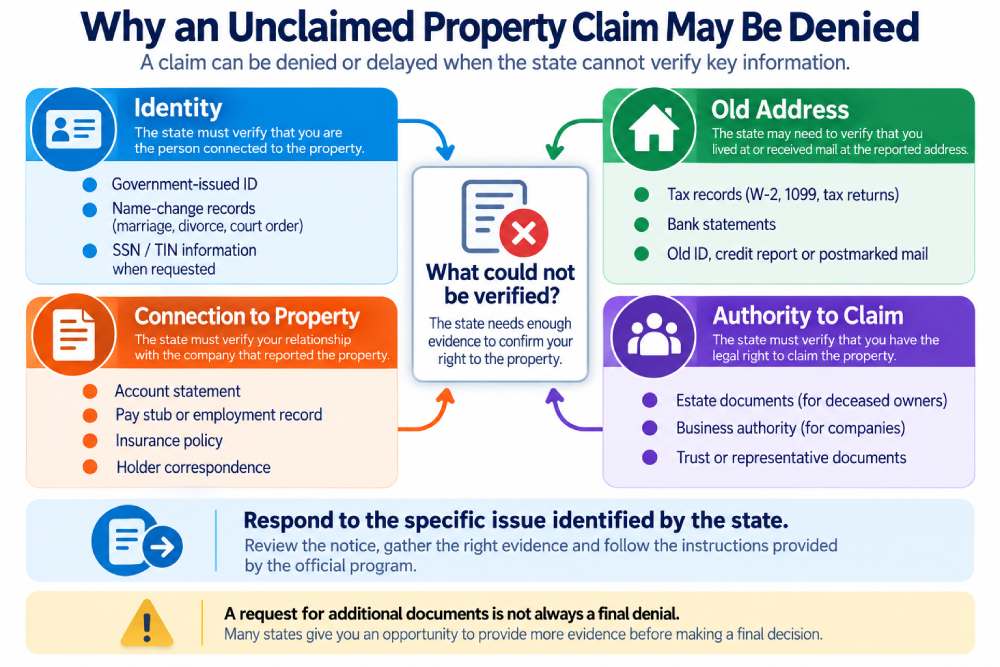
Why are unclaimed property claims denied?
Although every claim is different, denials or stalled claims often come back to one central problem:
The state could not sufficiently verify that the claimant is entitled to the property.
Common issues include:
| Problem | What the state may be unable to verify | Possible next evidence |
|---|---|---|
| Identity mismatch | That you are the person connected to the reported owner. | Government ID, SSN/TIN evidence when requested, name-change documentation. |
| Old address not proven | That you lived at or received mail at the reported address. | Tax records, bank statements, old ID, credit report, insurance records, old mail. |
| Holder connection not proven | That you had the account, employment, insurance or other relationship that generated the property. | Account statement, pay stub, policy, check, contract or correspondence. |
| Name change not documented | That the reported owner name and your current name belong to the same person. | Marriage certificate, divorce decree, court-ordered name change or other official record. |
| Wrong claimant relationship | That you have authority to file in the capacity selected on the claim. | Correct relationship plus supporting authority documents. |
| Deceased-owner documentation problem | That the property belonged to the deceased and that you may legally claim or act for the estate. | Death certificate, probate/estate documents, heirship evidence or other applicable records. |
| Business authority not proven | That you can legally act for the company that owns the property. | Business records, FEIN documentation, corporate authority, merger or dissolution documents. |
| Submission incomplete | That all procedural requirements were satisfied. | Missing signatures, forms, notarization where specifically required, or requested attachments. |
What if the state cannot verify my identity?
A state may have a matching name but still lack enough information to prove that you are the actual owner.
Arizona, for example, states that it will not pay claims based on name similarity alone. Its current guidance requires additional identifying evidence and explains that insufficient information can lead to denial.
Arizona — Evidence for an Original Owner
If identity is the problem, look for exactly what the state says is missing.
Possible evidence can include:
- Government-issued photo identification.
- Social Security Number or tax-identification evidence when requested.
- Documentation connecting a former name with your current name.
- Date-of-birth information.
- Documents connecting you to the reported owner record.
Do not send additional sensitive documents randomly. Use only the submission method authorized by the state handling your claim.
What if my claim was denied because I cannot prove an old address?
This is one of the most common verification problems.
A state may know:
John Williams — 419 Elm Avenue — Bank ABC
but still need to prove that you are the John Williams connected to that address.
If you no longer have a utility bill, other evidence may work depending on the state, including:
- W-2 or 1099 forms.
- Old tax returns.
- Bank statements.
- Credit reports.
- Old driver’s licenses.
- Insurance records.
- School records.
- Pay stubs.
- Vehicle registrations.
- Court documents.
- Postmarked mail.
Arizona lists many of these as examples of address evidence, while also explaining that additional evidence may be requested depending on the claim.
Arizona — Evidence for a Reported Address
For a complete strategy, see How to Prove an Old Address for Unclaimed Property.
What if I cannot provide the exact document they requested?
Ask whether alternative evidence is accepted.
The important question is usually not:
“Do I own this exact piece of paper?”
It is:
“What fact is the examiner trying to verify?”
For example, if the state requests an old utility bill because it wants to establish your historical address, another reliable record showing your name and the same address may sometimes accomplish that purpose.
Arizona’s guidance specifically tells claimants who cannot provide the requested evidence to submit what they can and explain their circumstances; a claims specialist may be able to clarify the requirement.
What if the state says I cannot prove my connection to the holder?
Sometimes the reported address or SSN is missing or insufficient, so the claim turns on whether you can prove a relationship with the company that reported the property.
Depending on the property, evidence could include:
- An old bank statement.
- Account-opening documents.
- A passbook.
- An insurance policy.
- A payroll record or pay stub.
- An original check.
- A stock certificate.
- A contract.
- An invoice.
- Correspondence from the holder.
If the property type is wages and the holder was your former employer, a W-2 or pay stub can potentially connect several pieces of the record at once.
If it was an old bank account, account statements or documents containing the account number may be especially useful.
What if my name changed?
If the property was reported under a maiden name, former married name or another legal name, the state may need evidence showing that the names belong to the same person.
Possible documentation can include:
- Marriage certificate.
- Divorce decree.
- Court-ordered name change.
- Adoption documentation.
- Another official record linking the old and current names.
Do not edit historical documents to make the names match. Instead, create a legitimate documentary chain:
Reported owner name → legal name-change record → current identity.
What if the owner is deceased?
A deceased-owner claim can fail even when everyone agrees that the property belonged to the deceased person.
That is because the state may need to verify two separate things:
- Ownership: Was the deceased person really the owner?
- Authority or entitlement: Does the current claimant have the legal right to recover it?
Depending on the situation, documents may involve:
- Death certificate.
- Will.
- Letters Testamentary or Letters of Administration.
- Personal Representative documentation.
- Trust records.
- Small-estate affidavits or procedures.
- Birth or marriage certificates establishing relationships.
- Other heirship documentation.
Arizona’s deceased-owner guidance illustrates how estate claims can require both evidence connecting the decedent to the property and evidence establishing the claimant’s authority.
Arizona — Evidence for a Deceased Owner
If your denied claim involves a deceased relative, read Who Can Claim Unclaimed Money From Deceased Relatives? before resubmitting anything.
What if I selected the wrong relationship to the owner?
Claim forms often ask whether you are filing as:
- the owner;
- an heir;
- an executor or administrator;
- a trustee;
- a guardian;
- a business representative; or
- another authorized person.
Those categories are not interchangeable.
If you selected “Self” for property that actually belongs to your deceased parent, for example, the issue may be more fundamental than simply uploading one extra document.
Contact the state and explain the mistake. Ask whether:
- the existing claim can be corrected;
- you should submit additional relationship documentation; or
- a different claim process is required.
Do not create a second contradictory claim without knowing how the state wants the error corrected.
What if a business claim was denied?
For business-owned property, proving your personal identity is only part of the problem.
The state may also need to verify:
- that the business named in the record is entitled to the property;
- that the business still exists or has a lawful successor;
- that you are authorized to act for it; and
- that mergers, acquisitions, dissolutions or name changes are documented.
Possible evidence can include:
- FEIN documentation.
- Business registration records.
- Articles of incorporation or organization.
- Corporate resolutions.
- Power of attorney or authorization.
- Merger documents.
- Dissolution records.
- Purchase agreements.
- Documents connecting the business to the reported holder or address.
Arizona’s business-entity guidance, for example, requires different evidence depending on whether the business is a sole proprietorship, partnership or corporation.
Arizona — Evidence for a Business Entity
What should I do immediately after receiving a denial?
Use this process:
- Save the entire denial notice.
Do not keep only a screenshot of the word “Denied.” Save the full letter, email or portal message. - Write down your claim ID and property ID.
- Identify the exact stated reason.
What fact did the state say was not established? - Check whether the decision is final.
Look for words such as additional evidence, reconsideration, review, appeal, hearing or court action. - Look for a deadline.
If the notice gives one, calendar it immediately. - Gather targeted evidence.
Do not send unrelated paperwork. - Contact the official program if the reason is unclear.
- Follow the state’s stated review procedure.
Should I submit the same claim again?
Not automatically.
Submitting duplicate claims can create more confusion if the original case is still open or if the state expects you to respond through the existing claim ID.
Before starting over, ask:
- Can I upload additional evidence to the existing claim?
- Can the claim be reopened or reconsidered?
- Do I need to correct the claimant relationship?
- Does the state require a new claim?
- Has the denial triggered a separate review procedure?
There is no universal national rule that every denied unclaimed property claim can simply be refiled.
Can I appeal an unclaimed property claim denial?
Possibly, but there is no single nationwide appeal process.
This is one of the most important points in this guide.
Each state can have its own:
- reconsideration procedure;
- administrative review;
- hearing process;
- refiling rules;
- court-review procedure; and
- deadlines.
Do not search for a generic “unclaimed property appeal form” and assume it applies everywhere.
Read the denial notice issued by the state holding your property.
California example: a formal denial can have a court-review deadline
California provides a useful example of why you must pay attention to the specific state’s law.
Under California’s current Unclaimed Property Law, the State Controller must give a claimant written notice if a claim is denied in whole or in part.
California Unclaimed Property Law — Code of Civil Procedure §1540
California law then provides a specific judicial-review route. A person aggrieved by the Controller’s decision may bring an action to establish the claim in an eligible superior court. The current statute provides a 90-day period after the Controller’s decision for that action, with a separate timing rule if the Controller fails to decide the claim within the statutory period.
That is a California procedure—not a national unclaimed property appeal rule.
Do I need a lawyer after a denied claim?
Not necessarily.
Many claim problems involve documentation rather than a legal dispute—for example:
- an old address that needs better proof;
- a missing name-change document;
- an incomplete business authorization;
- a missing death certificate; or
- a request for another account record.
Those situations may be resolved by working directly with the state program.
However, consider obtaining qualified legal advice if the issue involves:
- a formal court-review procedure;
- a disputed estate;
- competing heirs or owners;
- a significant business succession dispute;
- a trust interpretation problem;
- a substantial amount of property; or
- a deadline you do not understand.
Whether legal help makes sense depends on the amount involved and the complexity of the dispute.
What if the denial notice does not clearly explain the problem?
Contact the official state program and use your claim ID.
Ask a specific question:
“What element of ownership or entitlement was not established by the documents I submitted?”
That is much more useful than simply asking:
“Why did you deny me?”
Try to determine whether the issue is:
- identity;
- address;
- holder connection;
- property ownership;
- claimant relationship;
- estate authority;
- business authority; or
- a procedural filing requirement.
Once you know the missing element, you can look for evidence that addresses it directly.
What if I already sent the document they say is missing?
Do not assume the examiner overlooked it.
Possible explanations include:
- The file was unreadable.
- The document did not show the required information.
- The name or address did not match.
- The state needed a different type of certification.
- Only part of the document was uploaded.
- The document proved your identity but not ownership.
Contact the program and ask why the document did not satisfy the requirement.
Then submit a clearer or more relevant record if the state permits additional evidence.
Can submitting too many documents hurt the claim?
More paperwork is not automatically better.
If the state needs evidence of a 2009 address, sending:
- your current electric bill;
- five recent bank statements;
- your current insurance policy; and
- unrelated tax records
does not necessarily solve the 2009-address problem.
Focus on the specific element the state cannot verify.
A useful rule is:
One strong relevant document is usually more useful than ten unrelated documents.
For a broader explanation of supporting evidence, see What Documents Do I Need to Claim Unclaimed Property?.
What if the state asks for more documents after months of waiting?
That can be frustrating, but it does not necessarily mean the claim has failed.
Complex claims may require manual verification, especially when they involve:
- old records;
- deceased owners;
- businesses;
- multiple owners;
- securities; or
- insufficient holder data.
Respond to the request promptly and keep copies of what you submit.
Do not confuse processing time with denial. If your main issue is how long the review is taking, read How Long Do Unclaimed Property Claims Take?.
It can create a verification problem in some states when the agency lacks enough alternative information.
Arizona currently states that providing an SSN is optional, but warns that choosing not to provide it may leave insufficient information to establish ownership and, in some cases, can result in denial.
Arizona — SSN and Claim Verification
That does not create a nationwide rule requiring every claimant to submit an SSN in every state.
If you do not want to provide a particular identifier, ask whether the state accepts another method of proving ownership.
What if someone else also claims the same property?
A competing claim can make verification more complicated because the state must determine who is actually entitled to the property.
This can occur with:
- joint owners;
- estates;
- multiple heirs;
- business successors;
- trusts; or
- people with similar names.
Do not assume that being the first person to file creates ownership.
If another claimant is involved, focus on establishing your own legal connection and authority rather than trying to resolve the dispute through multiple contradictory submissions.
What should I include when responding to a denied or incomplete claim?
When the state allows a response, keep it organized.
Consider including:
- Your claim ID.
- Your property ID.
- A short explanation of what you are responding to.
- The specific new evidence requested.
- A brief explanation of any discrepancy.
- Your current contact information.
A simple cover note might say:
“I am responding to the request for evidence connecting me to the reported address. Attached is my 2011 W-2 showing my name and the address listed on Property ID XXXXX.”
That is usually clearer than uploading several documents without explaining what they establish.
Should I use a third-party recovery company after a denial?
A denied claim does not automatically mean you need to pay a finder or recovery company.
First determine why the official program denied or delayed the claim.
If the problem is simply missing evidence, you may be able to resolve it directly with the state for free.
Be especially cautious with anyone who:
- guarantees approval;
- claims to have a secret way around state requirements;
- asks you to falsify information;
- requests payment before explaining the property; or
- asks you to send sensitive documents through an unverified channel.
See Is Unclaimed Property a Trap? for safety guidance.
Step-by-step: what to do after an unclaimed property claim is denied
- Read the entire decision or status message.
- Confirm whether it is a final denial or only a request for additional evidence.
- Identify the exact verification issue.
- Save your claim ID, property ID and all correspondence.
- Gather evidence targeted to that specific issue.
- Ask the state about acceptable alternatives if you cannot obtain the requested document.
- Do not create a duplicate claim unless instructed.
- Check the notice for reconsideration, appeal or review instructions.
- Calendar any stated deadline immediately.
- Consider legal advice if the dispute requires court review or involves a complex estate, business or ownership question.
Frequently asked questions
Why was my unclaimed property claim denied?
Common reasons include insufficient identity evidence, inability to prove an old address, lack of connection to the reporting holder, missing name-change records, incorrect claimant relationship, incomplete estate documents or insufficient business authority. Your state’s notice should identify the specific problem.
Does “additional documentation required” mean my claim was denied?
No. It generally means the state needs more evidence before it can finish reviewing the claim. Follow the document request rather than assuming the decision is final.
Can I send more documents after a denial?
Possibly, but the procedure varies. The state may allow supplementation, reconsideration, refiling or a separate review route. Follow the instructions in the decision or contact the program before sending additional material.
Can I submit the claim again?
Do not automatically file a duplicate claim. Ask the state whether the existing claim can be corrected, reopened or supplemented and whether a new filing is appropriate.
Can I appeal a denied unclaimed property claim?
Some jurisdictions provide review or appeal options, but there is no nationwide appeal procedure. California, for example, has a specific statutory court-review route after a Controller decision. Other states may operate differently.
How long do I have to appeal?
There is no universal deadline. Read the denial notice and current law for the state handling your property. California’s current statute, for example, provides a 90-day judicial-review period after a Controller decision, but that rule should not be applied to another state.
What if I cannot prove my old address?
Ask whether the program accepts alternative evidence such as tax records, old IDs, bank statements, credit reports, insurance records, employment documents or direct evidence connecting you with the holder.
What if I cannot provide the exact document requested?
Contact the program and ask what fact needs to be established and whether another accepted document can prove that same fact.
Do I need a lawyer to challenge a denial?
Not always. Many documentation issues can be handled directly with the state. Legal advice may be more appropriate when a formal court process, disputed estate, business succession issue or significant ownership dispute is involved.
Can the state deny me just because someone has the same name?
A matching name alone is usually not enough to prove entitlement. The state may need additional identifiers such as an address, SSN, holder relationship or other ownership evidence.
What if my claim is simply taking a long time?
Delay is not the same as denial. Check the official claim status and look for requests for additional information before assuming the claim was rejected.
Bottom line
An unclaimed property claim denial does not tell you what to do next until you know why the claim failed.
Start by separating:
- a request for more documentation;
- an incomplete or invalid submission;
- a claim still under review; and
- a formal denial.
Then identify what the state could not verify:
- your identity;
- your old address;
- your relationship with the holder;
- ownership of the property;
- your authority to act for a deceased owner or business; or
- another procedural requirement.
Respond to the specific problem rather than simply submitting more paperwork.
If the decision is final, read the state’s review or appeal instructions carefully. Procedures and deadlines vary, and a California court-review rule, Arizona evidence process or New York documentation procedure should never be assumed to apply nationwide.
If you need better evidence, start with our guides to documents for an unclaimed property claim and proving an old address.
If you need to locate the correct agency, use our Unclaimed Property by State directory.
Important information: UnclaimedPropertyGuide.net is an independent informational website and is not affiliated with any state or federal government agency. Claim-review, reconsideration, refiling, appeal and court procedures vary by jurisdiction. This article is general information, not legal advice. Follow the official instructions and deadlines provided by the state handling your specific claim.
[…] If that has already happened, see Unclaimed Property Claim Denied? What to Do Next. […]