Finding and claiming unclaimed property is usually free when you use official state programs. If a business, bank, insurance company, government agency or another organization owed you money but lost contact with you, the property may eventually have been transferred to a state Unclaimed Property Program.
The process normally starts by searching your name in the states where you have lived or done business. If you find a possible match, you can then follow that state’s claim process and provide whatever information is needed to prove that the property belongs to you.
What is unclaimed property?
Unclaimed property is generally money or other assets that an organization owes to someone but has been unable to return after losing contact with the owner.
Common examples include:
- Checking and savings accounts.
- Uncashed checks.
- Payroll checks and wages.
- Insurance proceeds.
- Refunds.
- Utility deposits.
- Stocks, bonds and other securities.
- Dividends.
- Customer credits.
- Certain contents of safe deposit boxes.
After the applicable dormancy period, the holder may be required to transfer the property to a state.
The state then holds the property until the rightful owner or another legally eligible claimant can recover it.
Is it really free to search for unclaimed property?
Yes, when you use the official state Unclaimed Property Program.
The National Association of Unclaimed Property Administrators, or NAUPA, states that there is no fee to search for and claim missing money through official state programs.
Find your official state Unclaimed Property Program
Private companies may also offer finder or recovery services.
Some of those companies operate legally, but you do not need to hire a private finder simply to search your state’s official database or file a normal claim yourself.
How to find unclaimed property step by step
The basic search process is straightforward.
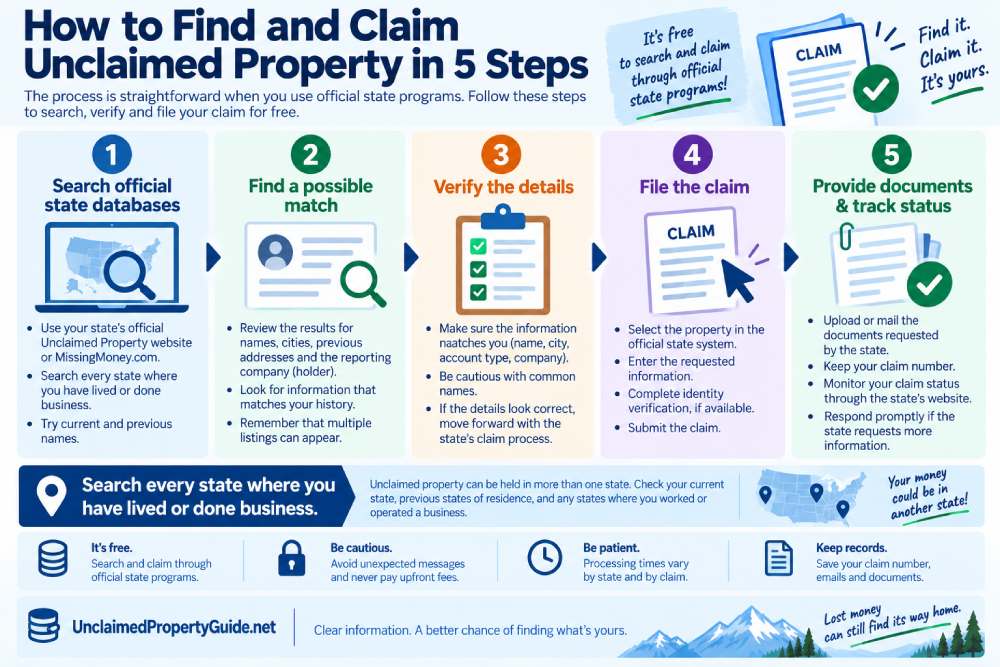
- Make a list of every state where you have lived.
- Include states where you previously worked or operated a business.
- Visit the official Unclaimed Property database for each state.
- Search your current legal name.
- Search previous names and common variations.
- Check old addresses shown in possible matches.
- Review the holder or reporting organization.
- Investigate any result that appears connected to you.
Do not limit yourself to your current state.
NAUPA specifically recommends checking every state where you have lived or done business.
Use our Unclaimed Property by State directory to locate the appropriate program.
Where should you search for unclaimed property?
You have two particularly useful starting points.
1. Official state Unclaimed Property websites
Each state maintains its own program and database.
NAUPA provides a directory that links directly to official state programs:
2. MissingMoney.com
MissingMoney.com allows you to search participating state databases from one place.
It is sponsored by NAUPA and is free to use.
However, MissingMoney should not replace checking the individual state programs when necessary.
Not every possible source of unclaimed money is contained in one database.
How should you search your name?
Do not perform only one search.
Try:
- Your full current legal name.
- First and last name only.
- Your middle initial.
- Your full middle name.
- A maiden name.
- Previous married names.
- Common spelling variations.
- A business name you owned.
For example, someone named:
Robert James Anderson
might try:
- Robert Anderson
- Robert J Anderson
- Robert James Anderson
- Bob Anderson
Different databases have different search systems, so a variation that produces nothing in one search may reveal a match in another.
What should you look for in a search result?
A matching name is only the beginning.
Depending on the state, a property listing may show information such as:
- The owner’s name.
- A previous city or address.
- The holder or reporting organization.
- The property type.
- A property identification number.
- An approximate value or value range.
Not every state displays all of these details publicly.
Compare the available information with your own history.
For example, a result becomes much more interesting if:
- The name matches yours.
- The city matches a former residence.
- You recognize the bank, employer or insurance company.
- The property type makes sense.
What does “holder” mean?
The holder is generally the business or organization that originally had the property before reporting it as unclaimed.
Examples can include:
- A bank.
- An employer.
- An insurance company.
- A utility company.
- A brokerage.
- A government agency.
The holder can be a useful clue when deciding whether a listing actually belongs to you.
What does “property type” mean?
The property type describes the kind of asset that became unclaimed.
You may see terms such as:
- Checking account.
- Savings account.
- Wages.
- Refund.
- Insurance proceeds.
- Securities.
- Dividends.
- Warrants.
Some terms are not immediately obvious.
For example, if your result says “Warrants”, read our guide explaining what warrants mean in unclaimed property.
How do you know whether a match really belongs to you?
Do not claim every listing simply because the owner has your name.
Instead, compare:
- The name.
- Previous addresses.
- City or state.
- The holder.
- The type of property.
- Any account or identifying information shown.
If you recognize several details, you may have a legitimate match.
Ultimately, the state will decide whether the evidence is sufficient to establish ownership.
How to claim unclaimed property
Once you identify a likely match, the general process is:
- Select the property in the official state database.
- Choose your relationship to the property or owner.
- Enter the requested claimant information.
- Submit the initial claim.
- Complete identity verification when available.
- Provide supporting documents if required.
- Submit any additional evidence requested by the state.
- Save your claim or confirmation number.
- Monitor the claim status.
- If approved, wait for the state to return the property or applicable proceeds.
The exact steps vary by state.
Some claims can now be verified automatically, while others require manual document review.
What documents do you need to claim unclaimed property?
There is no universal document checklist for every state and every property.
Depending on the claim, you may be asked for evidence of:
- Your identity.
- Your Social Security number or other identifying information.
- Your current address.
- Your connection to an old address.
- Ownership of a business.
- Your connection to the original holder.
- Your authority to represent another person.
A state may accept different documents depending on what it needs to verify.
How do you prove an old address?
An old address can be one of the strongest pieces of evidence connecting you to unclaimed property.
Possible supporting records can include:
- Old bank statements.
- Tax records.
- Utility bills.
- Insurance documents.
- Employment records.
- Mortgage or lease records.
- Other official correspondence.
What the state accepts depends on its own claim rules.
If you no longer have the document being requested, contact the official program and ask what alternative evidence it accepts.
How long does an unclaimed property claim take?
There is no nationwide processing time.
A simple claim that can be verified electronically may move quickly.
Claims involving:
- Manual document review.
- Deceased owners.
- Businesses.
- Multiple owners.
- Securities.
- Conflicting information.
can take considerably longer.
Some state expedited systems can process qualifying claims in days, while complicated claims can take several months.
Read our dedicated guide on how long unclaimed property claims take.
What if the owner is deceased?
Unclaimed property belonging to someone who died may still be recoverable.
However, being a relative does not automatically establish the right to receive it.
Depending on state law, the appropriate claimant may be:
- An executor.
- An administrator.
- A personal representative.
- A trustee.
- An eligible heir.
The state may require documentation proving:
- The owner’s death.
- The deceased person’s ownership of the property.
- Your relationship to the owner.
- Your legal authority to claim the property.
Read who can claim unclaimed money from a deceased relative before filing an estate claim.
Can you search for a deceased relative?
Yes.
Try searching the relative’s:
- Full legal name.
- Previous names.
- Last known state.
- Previous states of residence.
If you find a match, determine who has legal authority over the estate before filing.
Can you claim property from more than one state?
Yes.
There is nothing unusual about one person having property held in several states.
This can happen when someone:
- Moved several times.
- Worked in different states.
- Owned businesses elsewhere.
- Maintained financial accounts in multiple locations.
Each state’s claim is usually handled separately.
One state’s approval does not automatically transfer property being held elsewhere.
What other databases should you search?
State Unclaimed Property Programs hold much of the unclaimed money in the United States, but they do not cover everything.
USA.gov specifically notes that there is no single place to search for every type of unclaimed government money.
Other official databases may be relevant depending on what you are looking for.
| Type of money | Where to search |
|---|---|
| Unpaid wages | U.S. Department of Labor |
| Unclaimed pensions | Pension Benefit Guaranty Corporation (PBGC) |
| VA life insurance funds | U.S. Department of Veterans Affairs |
| FHA insurance refunds | U.S. Department of Housing and Urban Development |
| Federal tax refunds | IRS |
| Funds from failed banks | FDIC |
| Closed credit union deposits | NCUA |
| Matured U.S. savings bonds | TreasuryDirect / Treasury Hunt |
| Bankruptcy unclaimed funds | U.S. Courts Unclaimed Funds Locator |
For the current official links to these specialized databases, see:
USA.gov — Find unclaimed money from the government
Is MissingMoney.com legitimate?
Yes.
MissingMoney.com is promoted by NAUPA as a free resource for searching the databases of participating states.
It can be a useful way to perform a broader search.
However, remember:
- Not every type of unclaimed money is in MissingMoney.
- You may still need to use individual state websites.
- Federal sources often have separate databases.
When you find property, follow the link to the appropriate official program and complete the claim there.
How often should you search for unclaimed property?
There is no required schedule.
However, searching again periodically can be useful because new property is reported to states over time.
Finding nothing today does not mean nothing will ever appear.
Consider searching again after:
- Moving.
- Changing your name.
- Closing financial accounts.
- Changing jobs.
- Handling a deceased relative’s estate.
Does unclaimed property expire?
The answer depends on the type of property and state rules.
In many cases, states act as custodians of the value for rightful owners.
However, certain tangible property, such as safe deposit box contents, can eventually be sold under applicable state law.
If you find an old record, do not assume it is too late.
Check the official state program holding the property.
Is unclaimed property taxable?
Not automatically.
Tax treatment depends on what the property originally represented.
For example:
- Returning your own old bank-account principal is different from taxable interest.
- Unpaid wages can have tax consequences.
- Life insurance can follow different rules.
- Inherited property can follow different rules.
Read Is Unclaimed Property Taxable? for a detailed explanation.
Will you get a Form 1099?
Not every claim generates a Form 1099.
The form, if any, depends on what the recovered money originally represented.
Possible forms can include:
- 1099-INT.
- 1099-G.
- 1099-R.
- Other applicable information returns.
See Will I Get a 1099 for Unclaimed Property?.
Is unclaimed property a scam?
Official state Unclaimed Property Programs are legitimate.
But scammers use the subject of unclaimed money to steal personal information and collect fake fees.
The FTC warned in 2026 about calls and texts claiming that people were entitled to thousands of dollars in unclaimed funds.
Warning signs include:
- An unexpected text containing a claim link.
- Pressure to act immediately.
- A demand for an upfront processing fee.
- A request for sensitive information before you have independently verified the agency.
- A government-sounding organization that you cannot verify.
Read our full guide on unclaimed property scams and suspicious offers.
Do you have to pay a finder?
No.
You can search and claim directly through official state programs.
A private finder may offer a convenience service, but you should understand exactly what the company is charging before signing anything.
Before hiring anyone:
- Search the official databases yourself.
- Determine whether you can file directly.
- Check what percentage or fee the finder wants.
- Read the agreement carefully.
- Check whether your state regulates finder fees or agreements.
Can someone else claim your unclaimed property?
A state should not release property simply because another person knows your name.
The claimant normally needs to establish ownership or legal authority.
However, another person may legitimately file in certain situations, such as:
- An executor acting for an estate.
- An administrator.
- A trustee.
- An authorized representative.
- An eligible heir under state law.
The state decides whether the evidence is sufficient.
What happens after you submit the claim?
The state may:
- Confirm receipt.
- Verify your identity electronically.
- Review documents.
- Request additional information.
- Research ownership.
- Approve or deny the claim.
- Issue payment or return the property if approved.
Do not submit another identical claim simply because your first claim remains pending.
Use the state’s claim-status system whenever one is available.
What should you keep after filing?
Save:
- Your claim number.
- The original property listing.
- Confirmation emails.
- Copies of documents submitted.
- Letters from the state.
- Payment records.
- Any tax forms received later.
These documents can be useful if the state asks for more information or if you later need to determine the tax treatment of the payment.
Common mistakes to avoid
Avoid these mistakes:
- Searching only your current state.
- Searching only one version of your name.
- Assuming every matching name belongs to you.
- Paying a finder before searching official databases.
- Uploading sensitive documents to an unverified website.
- Sending documents the state did not request.
- Submitting duplicate claims unnecessarily.
- Assuming every type of unclaimed money appears in one database.
Frequently asked questions about finding and claiming unclaimed property
How do I find out if I have unclaimed property?
Search your name through the official Unclaimed Property Programs for every state where you have lived or done business. NAUPA provides a directory of official state programs, and MissingMoney can search participating state databases.
Is searching for unclaimed property free?
Yes. Official state Unclaimed Property Programs allow you to search for and claim your own property without paying a search fee.
What is the best website to find unclaimed money?
Start with the official state programs listed by NAUPA. MissingMoney.com is also a free NAUPA-sponsored resource for searching participating states.
Is there one national database for all unclaimed money?
No. USA.gov states that there is no single place to search for every type of unclaimed money. Certain federal funds, pensions, tax refunds, bankruptcies and other assets use separate databases.
How do I claim money after finding my name?
Open the property through the official state website, begin a claim, provide the information requested and submit supporting documentation if necessary.
How long does a claim take?
Processing can range from days for certain automated claims to several months for more complicated claims. Each state has its own procedures.
What if the property belongs to a deceased relative?
An executor, administrator, personal representative, trustee or eligible heir may be able to claim it depending on state law and estate circumstances.
Do I need to know the exact amount before claiming?
No. Some state databases do not publicly show the exact value of every property before the claim is verified.
Can I search for property in another state?
Yes. You should search every state where you previously lived, worked, operated a business or maintained financial relationships.
Do I need to hire a company to claim my property?
No. Most owners can begin by searching and filing directly with the official state program for free.
Can unclaimed property be taxable?
Yes, some types can be taxable. The treatment depends on what the property originally represented rather than simply on the fact that it was unclaimed.
How can I avoid unclaimed property scams?
Use official government databases, avoid unexpected links, never pay an upfront fee simply to release supposedly found money and verify the agency independently before providing sensitive personal information.
Bottom line
Finding and claiming unclaimed property does not have to be complicated or expensive.
Start by searching the official Unclaimed Property database in every state where you have lived or done business.
Use:
- NAUPA to locate official state programs.
- MissingMoney.com to search participating states.
- USA.gov when looking for specialized federal sources such as pensions, tax refunds, failed-bank funds, savings bonds or bankruptcy money.
If you find a likely match, verify the details, file directly with the state, provide only the documentation requested and save your claim information.
Most importantly, you do not need to pay someone simply to search official state databases or file a normal claim.
Continue with our Unclaimed Property by State directory, or read how long an unclaimed property claim can take after filing.
Important information: UnclaimedPropertyGuide.net is an independent informational website. We are not affiliated with NAUPA, MissingMoney, any state Unclaimed Property Program or any U.S. government agency. We do not hold property or process claims. Always submit sensitive personal information through verified official government channels.