The documents needed to claim unclaimed property depend on the state, the type of property and your relationship to the owner. For a straightforward claim in your own name, you may be asked for identification and evidence connecting you to the reported property. More complex claims—such as those involving a deceased owner, business, trust or legal representative—can require additional documentation.
There is no single document checklist that applies to every unclaimed property claim in the United States. In some online claims, the state may verify much of your information electronically and initially request little or no uploaded documentation. In others, you may receive a specific list of documents after filing.
What documents are commonly needed for an unclaimed property claim?
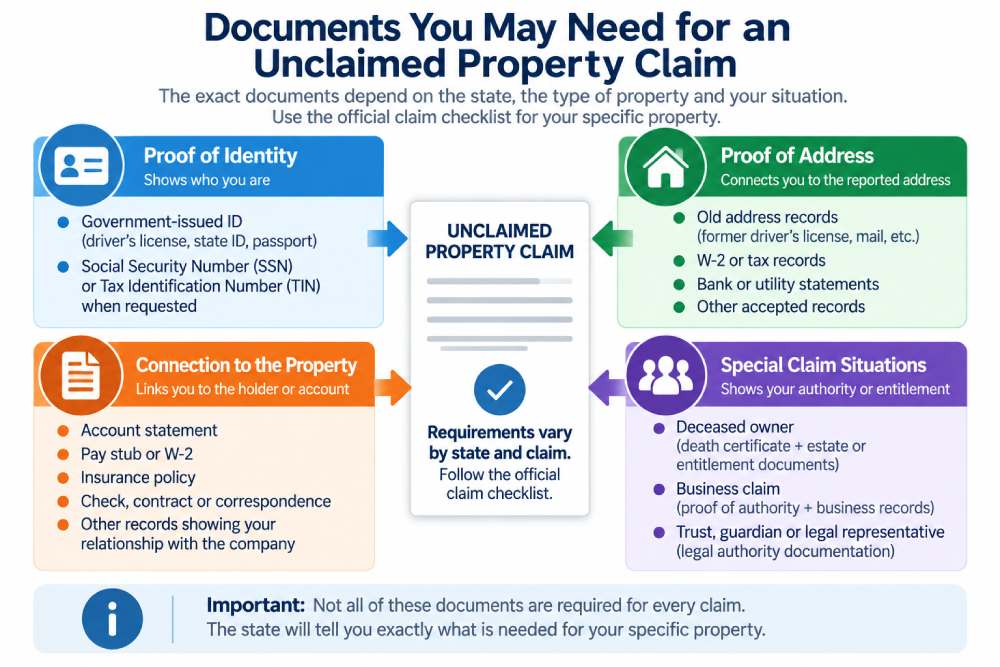
Not every claim requires every item below, but these are the main categories you are likely to encounter:
| What the state needs to verify | Documents that may be requested |
|---|---|
| Your identity | Driver’s license, state-issued ID, passport or another accepted government identification. |
| Your current information | Current address information and, in some cases, a utility bill, bank statement, pay stub or other proof of current address. |
| Your connection to an old address | Old driver’s license, tax forms, bank statements, utility bills, pay stubs, school records, insurance records, mortgage documents, postmarked mail or other records linking you to the reported address. |
| Your connection to the holder or property | Old account statements, pay stubs, insurance policies, checks, bank records, contracts, correspondence or other documents connecting you to the organization that reported the property. |
| A name change | Marriage certificate, divorce decree, court order or another accepted document linking your former and current names. |
| A deceased owner’s property | Death certificate plus estate, probate, trust, heirship or other documents showing your right or authority to claim. |
| A business claim | Business tax ID, formation or registration documents, evidence of your authority to act, and records linking the business to the property. |
| Authority to act for another person | Power of attorney, guardianship/conservatorship order, trust documentation or other evidence of legal authority, depending on the situation. |
The state is generally trying to answer three questions:
1. Who are you?
2. How are you connected to this property?
3. If the property is not simply yours personally, why are you authorized or entitled to claim it?
Do I always need to upload documents to file a claim?
No. Some claims can begin electronically without immediately uploading a full package of supporting documents.
For example, California currently allows eligible claims to be filed electronically after the claimant provides the information requested by its secure system. California also notes that some more complex claims may require additional proof of ownership.
California State Controller — How to Claim Property
New York similarly explains that if you file online, you may later receive an email requesting documentation to prove ownership.
New York Office of Unclaimed Funds — Required Documentation
So do not assume that you must gather twenty documents before you even start.
Begin with the official claim process. The state may be able to verify some information electronically and tell you exactly what additional evidence is needed.
What identification might I need?
Government-issued identification is one of the most common types of verification used in claims that require supporting documents.
Depending on the state’s instructions, acceptable identification may include:
- Driver’s license.
- State-issued photo ID.
- Passport.
- Another government-issued photo identification accepted by the program.
Tennessee, for example, lists a copy of the claimant’s driver’s license, passport or state-issued identification among its standard forms of claimant ID.
Tennessee Department of Treasury — Prove Your Ownership
The state may also request information such as your date of birth or Social Security Number to help match you with the property.
A Social Security Number can be an important way to match a claimant to information originally reported by the holder.
For example, New York’s online claim system currently explains that a U.S. citizen can provide an SSN when submitting an online claim and that it is used to help verify identity and entitlement to the funds. New York also provides a mail route for a claimant who does not wish to provide the SSN through the online process.
New York — How to Search & Claim Property
However, an SSN match is not available for every property. Older holder records may not contain one, which is one reason a state can ask for alternative ownership evidence such as an old address or account documentation.
Do I need proof of my old address?
Often, old-address evidence is extremely useful when the reported property is connected to a previous address.
Imagine the state’s record says:
Owner: Jennifer Smith
Reported address: 214 Oak Street, Denver
but Jennifer now lives in another state.
The state may need evidence establishing that the claimant actually had a connection to that old address.
New York currently lists numerous forms of evidence that can help establish an old address, including copies of:
- an old driver’s license or non-driver ID;
- bank or utility statements;
- W-2 or 1099 tax records;
- insurance, school, medical or military records;
- a mortgage or other legal records;
- certain certificates showing the address; or
- postmarked mail.
New York — Acceptable Proof of Address
Tennessee similarly identifies old mail, tax forms, credit reports, bank statements and other records as examples that can help establish an owner’s connection to a reported address.
What if I no longer have proof of the old address?
Do not abandon the claim simply because you no longer have an old utility bill.
First check what information the state actually needs.
Depending on the program and the information originally reported by the holder, another type of evidence may establish ownership.
You can look for:
- Old W-2 or 1099 forms.
- Tax returns or tax transcripts.
- Bank or credit-card statements.
- Credit reports showing former addresses.
- Mortgage or property records.
- Insurance records.
- Old employment records or pay stubs.
- School records.
- Medical records containing the old address.
- Postmarked correspondence.
Do not assume all of these will be accepted everywhere. They are examples of evidence used by official programs such as New York and Tennessee.
If you cannot produce the requested evidence, contact the state and explain exactly what is missing. Ask what alternative documentation it accepts for your particular claim.
What can prove my connection to the company that reported the property?
Sometimes the holder did not report enough identifying information for the state to verify ownership through an SSN or address alone.
In those cases, evidence showing that you actually had a relationship with the holder can become important.
Depending on the property, useful records may include:
- Bank statements.
- Account statements.
- An insurance policy.
- An old uncashed check.
- Pay stubs or W-2 forms.
- Contracts.
- Invoices.
- Stock certificates.
- Correspondence from the company.
- Other records containing an account or policy number.
Tennessee’s official guidance specifically explains that when the reporting company did not provide an SSN or last known address, evidence connecting the claimant to the company that reported the property may be used to establish ownership.
Tennessee — Ownership Documentation
What if my current name is different from the owner name?
A former or changed name does not necessarily prevent you from claiming the property, but you may need to establish the connection between the two names.
Depending on the reason for the change, documentation might include:
- Marriage certificate.
- Divorce decree.
- Court-ordered name change.
- Other official documentation showing the transition from the reported name to your current identity.
California’s current unclaimed property guidance specifically identifies marriage certificates and court documents as examples that may establish a claimant’s name change.
California — Claiming Property FAQ
What documents are needed if the owner is deceased?
Deceased-owner claims usually require more than a standard claim in your own name.
There are generally two separate things to establish:
- The deceased person was the owner of the property.
- You have the legal right or authority to claim it.
New York’s current deceased-owner guidance describes this directly and requires proof of the deceased person’s ownership, proof of the claimant’s entitlement and a copy of the death certificate.
New York — Claims for Deceased Owners and Estates
Depending on the estate and state rules, additional documents could involve:
- Death certificate.
- Letters Testamentary.
- Letters of Administration.
- Probate court documents.
- Will.
- Trust documents.
- Small-estate documentation.
- Birth or marriage certificates establishing family relationships.
- Heirship documentation.
Do not assume every heir must provide the same documents. The correct package depends on whether there is an estate, whether a representative has been appointed, the value and nature of the property and the state’s rules.
Before filing a deceased-owner claim, read our detailed guide: Who Can Claim Unclaimed Money From Deceased Relatives?.
What documents are needed for a business claim?
If the unclaimed property belongs to a company, the company is the owner. The state needs to establish both that the business is connected to the property and that the person signing the claim is authorized to act for it.
Depending on the circumstances, documentation might include:
- Employer Identification Number (EIN/FEIN) documentation.
- Articles of incorporation or organization.
- Business registration records.
- Corporate resolutions or authorization letters.
- Company letterhead identifying the authorized representative.
- Business identification.
- Documents showing a merger, acquisition or name change.
- Evidence of the business relationship with the reporting holder.
New York’s current required-documentation page provides separate examples for organizations, including evidence of authorization to sign and documentation for name changes, mergers or acquisitions.
New York — Proof for Organizations
Tennessee similarly distinguishes ordinary business claims, dissolved businesses and sold businesses because each can require different proof.
What if the business has closed or changed names?
A closed, merged, acquired or renamed business can make a claim more complex because the state must determine who now has authority or entitlement to the old entity’s property.
You may need records such as:
- Articles of dissolution.
- Merger agreements.
- Purchase agreements.
- Certificates of name change.
- Secretary of State records.
- Tax documentation.
- Corporate ownership records.
Do not submit the property as your personal claim simply because you formerly owned, managed or worked for the business.
What if I am claiming as a trustee, guardian or power of attorney?
You may need documentation establishing both your own identity and your legal authority to act for the owner.
Depending on the role, that can include:
- Trust agreement or trustee documentation.
- Guardianship or conservatorship order.
- Power of attorney.
- Another court order or legal authorization.
The exact authority required depends on the situation, and some forms of authority end or change when the owner dies.
If the owner is deceased, do not automatically assume that a power of attorney still provides authority to claim. Follow the state’s deceased-owner or estate process.
Do joint owners need additional documents?
They may.
A record involving two or more owners can raise additional questions, such as:
- whether all owners are still living;
- whether each person must participate in the claim;
- whether one owner has authority to act for another;
- whether one owner is deceased; and
- what the original ownership arrangement was.
The public listing alone may not establish who is entitled to what percentage of the property.
Follow the state’s instructions for that specific multi-owner claim instead of assuming one claimant can collect the full amount.
Do I need my old account number?
Not necessarily.
An account number can be excellent proof if you still have it, but many people are claiming property precisely because an account has been forgotten for years.
States can use other evidence to establish ownership.
If you have any of the following, however, keep them:
- Old statements.
- Account-opening records.
- Bank books.
- Policy numbers.
- Check numbers.
- Pay stubs.
- Correspondence from the holder.
These details can make it easier to connect you with the reported property.
Do unclaimed property documents need to be notarized?
Sometimes—but there is no nationwide notarization rule for every claim.
Requirements can depend on the state, claim value and type of property.
California provides a good example of why you must check the specific state’s instructions. Its current forms guidance says that a claimant’s signature must be notarized when the claim amount is $1,000 or more, and that claims involving securities or safe deposit boxes must also be notarized.
California — Claim Filing Instructions and Forms
Should I send original documents?
Do not send original documents unless the official claim instructions specifically require them.
Different states and document types have different rules. A program may accept a copy of identification but require an original or certified version of another document.
Before mailing:
- Read the exact claim instructions.
- Check whether the state requests an original, copy or certified copy.
- Keep your own copies of everything submitted.
- Use the address generated by the official claim system.
- Consider trackable mail for important paper packages when appropriate.
Never assume that because one state requests an original form, another state’s process works the same way.
Should I upload every document I have?
Usually, no.
More documents do not automatically create a stronger claim.
Submitting large amounts of unrelated material can make the claim harder to review and exposes more personal information than necessary.
A better approach is:
- Start the official claim.
- Read the state’s requested-document checklist.
- Submit strong evidence that directly addresses each requirement.
- Keep additional records available in case the examiner asks for more.
Think in terms of relevance, not volume.
What happens if my claim is missing a document?
A missing document does not necessarily mean the claim is permanently denied.
States can request additional information when they cannot verify ownership from the initial submission.
New York, for example, explains that an online claimant may receive an email asking for documentation, while mailed claims can also result in a later request for additional proof.
California similarly emphasizes that providing required documents can help avoid delays and that more complex claims may need additional proof.
If the state asks for something else:
- Read the request carefully.
- Identify exactly what fact the examiner is trying to verify.
- Submit the requested evidence through the official channel.
- If you do not have that document, ask what alternatives are accepted.
- Include the claim or property ID when communicating with the program.
A request for additional documentation can lengthen the process, which is one reason complete initial claims can sometimes be reviewed more efficiently.
For realistic processing expectations, see How Long Do Unclaimed Property Claims Take?.
How do I know exactly which documents my claim needs?
The official state claim instructions for your specific property are the source that matters most.
Use this process:
- Find the property in the official state database.
- Start the claim.
- Choose your correct relationship to the owner.
- Complete any identity-verification steps.
- Read the state’s generated document requirements.
- Submit only through the official claim system or mailing address.
- Save your claim number and copies of what you submitted.
If you have not located the correct program yet, use our Unclaimed Property by State directory.
For the entire process from search through submission, see How to Find and Claim Unclaimed Property.
Quick document checklist before you start
You do not necessarily need all of these, but gathering the documents you already have can make the claim easier:
- ☐ Current government-issued ID.
- ☐ Social Security or tax-identification information if requested.
- ☐ Current contact information.
- ☐ Records showing your old reported address.
- ☐ Records connecting you with the holder.
- ☐ Old account, policy, payroll or payment records.
- ☐ Name-change documents if applicable.
- ☐ Death certificate if claiming for a deceased owner.
- ☐ Estate or representative authority if applicable.
- ☐ Business ownership/authorization documents for a business claim.
- ☐ Property ID and claim number.
Then compare this with the official state’s actual requirements. The state’s checklist wins if it differs from a general guide.
Frequently asked questions
What documents do I need for a basic unclaimed property claim?
A straightforward owner claim may require identity information and evidence connecting you to the property, such as an old address, account or reporting holder. Some online claims can be verified without immediately uploading documents.
Do I need a driver’s license?
A driver’s license is a common form of accepted identification, but official programs may accept other government-issued photo IDs. Check your state’s instructions.
Not necessarily. A state may use your Social Security Number or request documentation verifying it, but acceptable evidence and submission procedures vary.
What can I use as proof of an old address?
Depending on the state, accepted evidence may include old IDs, W-2 or 1099 forms, utility or bank statements, credit reports, mortgages, insurance records, school records or postmarked correspondence.
What if I cannot prove my old address?
Contact the state program and ask what alternative evidence it accepts. The state may be able to verify the claim through other information, such as your SSN or records connecting you to the holder.
Do I need the original bank statement or check?
Not always. Requirements vary by state and claim. Do not send an irreplaceable original unless the official instructions specifically request it.
What documents do I need to claim money for a deceased parent?
You may need the death certificate, evidence connecting the deceased owner to the property and documents proving your entitlement or authority to claim. The exact estate documentation depends on the circumstances and state rules.
Can I claim for a business using my personal ID?
Your personal identification may verify who is signing, but the state will generally also need evidence that you are authorized to act for the business and that the business is entitled to the property.
Does my claim need to be notarized?
Possibly, but not every claim requires notarization. Requirements vary by state, property type and sometimes claim value.
What happens if the state asks for more documents?
Provide the requested information through the official claim channel. If you do not have the requested document, contact the program and ask whether alternative evidence is acceptable.
Should I send my ID or SSN by ordinary email?
Do not send sensitive personal information through an unverified email address. Use the secure upload, mail or other method specified by the official state Unclaimed Property Program.
Bottom line
There is no universal document package for every unclaimed property claim.
The documents you need depend mainly on:
- who owns the property;
- who is filing the claim;
- what information the holder originally reported;
- the property type; and
- the state administering the property.
For a normal owner claim, the state may need enough information to verify your identity and your connection to the property. If you are claiming for a deceased person, business, trust or someone else, you may also need to prove your authority or entitlement.
The best approach is not to upload every record you can find. Start the official claim, read the specific document request, and submit evidence that directly answers what the state needs to verify.
Use our state-by-state directory to locate the correct program or follow our complete unclaimed property claim guide for the next steps.
Important information: UnclaimedPropertyGuide.net is an independent informational website and is not affiliated with any state or federal government agency. Documentation requirements vary by state, claimant relationship and property type. Always follow the document instructions generated by the official program handling your claim and use approved channels when submitting sensitive personal information.
[…] If you are still gathering evidence, read What Documents Do I Need to Claim Unclaimed Property?. […]