Unclaimed property is managed primarily at the state level in the United States. If a bank, employer, insurance company, utility, government agency or another organization lost contact with you, money or property may eventually have been transferred to a state’s Unclaimed Property Program.
That means there is an important rule when searching:
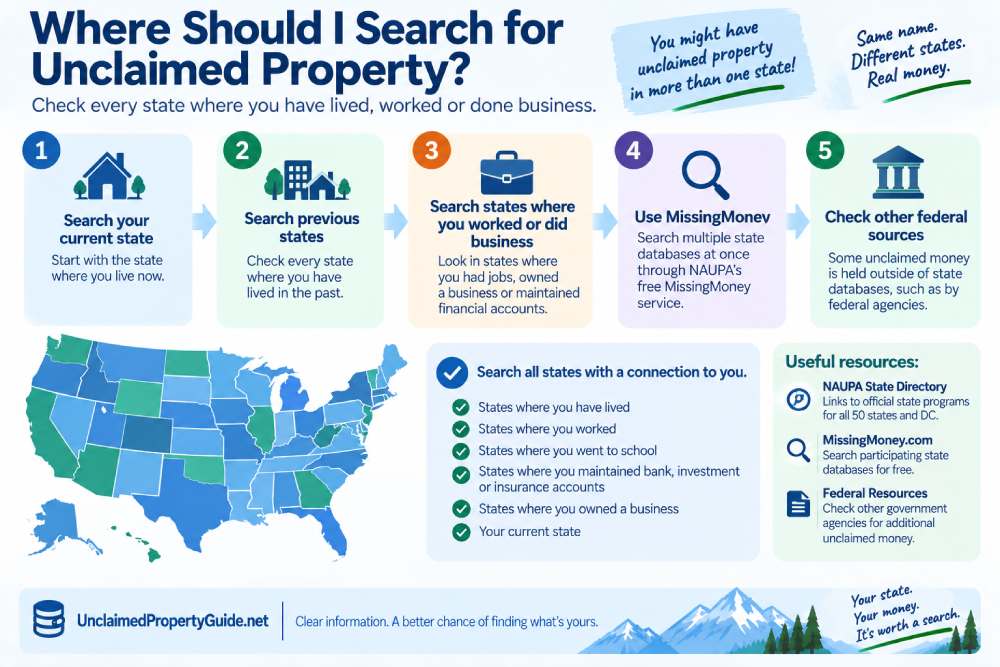
Check every state where you have lived, worked, owned a business or maintained financial accounts.
The state where you live today may not be the state holding your money.
Jump directly to the state directory and find the official program for your state.
How to search for unclaimed property by state
The safest starting point is the National Association of Unclaimed Property Administrators (NAUPA).
NAUPA provides a directory linking to the official Unclaimed Property Program for each state.
The general process is:
- Search your current state.
- Search every state where you previously lived.
- Search states where you worked or operated a business.
- Try your current and previous names.
- Review any possible matches.
- File directly through the official state program.
For the complete process after you find a match, read our guide to finding and claiming unclaimed property.
Why should you search more than one state?
Unclaimed property is frequently connected to the owner’s last known address.
Imagine that you:
- Opened a bank account while living in California.
- Moved to Nevada.
- Later moved to Texas.
If the California bank eventually lost contact with you, the property may have been reported according to the address associated with that account.
Searching only Texas could therefore miss the property.
NAUPA specifically recommends checking every state where you have lived or done business.
Unclaimed Property Programs by state
Below are the 50 states plus the District of Columbia.
Use the official NAUPA directory above to access the current government search program for any state.
Where we have developed a detailed state guide, you can also use our guide for additional information about searching, claiming, documents and state-specific procedures.
| State | State guide |
|---|---|
| Alabama | Use the official state program through NAUPA. |
| Alaska | Alaska Unclaimed Property guide |
| Arizona | Use the official Arizona Department of Revenue program through NAUPA. |
| Arkansas | Use the official Arkansas program through NAUPA. |
| California | Use the official California State Controller program through NAUPA. |
| Colorado | Use the official Colorado program through NAUPA. |
| Connecticut | Connecticut Unclaimed Property guide |
| Delaware | Use the official Delaware Unclaimed Property program through NAUPA. |
| District of Columbia | Use the official DC Unclaimed Property program through NAUPA. |
| Florida | Use the official Florida Treasure Hunt program through NAUPA. |
| Georgia | Use the official Georgia Department of Revenue program through NAUPA. |
| Hawaii | Use the official Hawaii Unclaimed Property program through NAUPA. |
| Idaho | Use the official Idaho Unclaimed Property program through NAUPA. |
| Illinois | Use the official Illinois I-CASH program through NAUPA. |
| Indiana | Use the official Indiana Unclaimed Property program through NAUPA. |
| Iowa | Use the official Iowa Treasurer program through NAUPA. |
| Kansas | Use the official Kansas Unclaimed Property program through NAUPA. |
| Kentucky | Use the official Kentucky State Treasury program through NAUPA. |
| Louisiana | Use the official Louisiana Unclaimed Property program through NAUPA. |
| Maine | Use the official Maine Unclaimed Property program through NAUPA. |
| Maryland | Use the official Maryland Unclaimed Property program through NAUPA. |
| Massachusetts | Use the official Massachusetts Unclaimed Property program through NAUPA. |
| Michigan | Use the official Michigan Unclaimed Property program through NAUPA. |
| Minnesota | Use the official Minnesota Unclaimed Property program through NAUPA. |
| Mississippi | Use the official Mississippi Treasury program through NAUPA. |
| Missouri | Use the official Missouri State Treasurer program through NAUPA. |
| Montana | Use the official Montana Unclaimed Property program through NAUPA. |
| Nebraska | Use the official Nebraska State Treasurer program through NAUPA. |
| Nevada | Use the official Nevada State Treasurer program through NAUPA. |
| New Hampshire | Use the official New Hampshire Unclaimed Property program through NAUPA. |
| New Jersey | Use the official New Jersey Unclaimed Property Administration through NAUPA. |
| New Mexico | Use the official New Mexico Taxation and Revenue program through NAUPA. |
| New York | Use the official New York State Comptroller Unclaimed Funds program through NAUPA. |
| North Carolina | Use the official NC Cash program through NAUPA. |
| North Dakota | Use the official North Dakota Unclaimed Property program through NAUPA. |
| Ohio | Use the official Ohio Unclaimed Funds program through NAUPA. |
| Oklahoma | Use the official Oklahoma State Treasurer program through NAUPA. |
| Oregon | Use the official Oregon Unclaimed Property program through NAUPA. |
| Pennsylvania | Use the official Pennsylvania Treasury program through NAUPA. |
| Rhode Island | Use the official Rhode Island Unclaimed Property program through NAUPA. |
| South Carolina | Use the official South Carolina State Treasurer program through NAUPA. |
| South Dakota | Use the official South Dakota Unclaimed Property program through NAUPA. |
| Tennessee | Use the official Tennessee Treasury program through NAUPA. |
| Texas | Use the official ClaimItTexas program through NAUPA. |
| Utah | Use the official Utah MyCash program through NAUPA. |
| Vermont | Use the official Vermont State Treasurer program through NAUPA. |
| Virginia | Use the official Virginia Unclaimed Property program through NAUPA. |
| Washington | Washington Unclaimed Property guide |
| West Virginia | Use the official West Virginia State Treasury program through NAUPA. |
| Wisconsin | Use the official Wisconsin Department of Revenue program through NAUPA. |
| Wyoming | Use the official Wyoming State Treasurer program through NAUPA. |
Can you search several states at once?
Yes.
MissingMoney.com can search unclaimed property records from participating states.
NAUPA describes MissingMoney as a free service it manages for searching participating state databases.
However, most states participate — not necessarily every possible source of property.
For a thorough search, it can still be worth checking the individual official state programs.
Is MissingMoney.com an official government website?
MissingMoney is not itself a state government agency.
It is a free search service managed by NAUPA that searches participating state databases and directs users toward the appropriate government claim process.
That distinction is useful.
MissingMoney helps with discovery, while the actual property is administered by the state holding it.
Is searching for unclaimed property by state free?
Yes.
NAUPA states that there is no fee to search for or claim your own unclaimed property when you use an official state program.
You generally do not need to pay:
- A search fee.
- A government activation fee.
- A release fee.
- A finder simply to search the database.
Private recovery companies can offer services for a fee, but they are not necessary for ordinary state searches.
Read Is Unclaimed Property a Trap? for our complete scam and safety guide.
Which state holds my unclaimed property?
It is not always your current state.
The appropriate state often depends on information associated with the property before it became unclaimed.
For consumers, the easiest strategy is not to attempt to predict exactly where every asset should have been reported.
Instead:
Search every state with a meaningful connection to you.
That can include states where you:
- Lived.
- Worked.
- Attended college.
- Operated a business.
- Maintained financial accounts.
- Owned property.
What if I moved many times?
Search every state you remember living in.
Start with:
- Your current state.
- Your previous state.
- States connected to older addresses.
- States where you worked for major employers.
- States where you had bank, investment or insurance relationships.
You do not need to submit a claim simply because your name appears.
First compare the result with your history.
What names should I search?
Try more than one variation.
Useful searches include:
- Your current full legal name.
- First and last name only.
- Middle initial.
- Full middle name.
- Maiden name.
- Previous married names.
- Previous legal names.
- Business names.
Older records may not match the exact way you currently write your name.
What types of property can states hold?
State Unclaimed Property Programs commonly handle assets such as:
- Bank accounts.
- Uncashed checks.
- Wages.
- Refunds.
- Customer credits.
- Utility deposits.
- Insurance proceeds.
- Stocks and securities.
- Dividends.
- Certain safe deposit box contents.
The exact categories and terminology vary.
If you see an unfamiliar property type such as “Warrants”, read our explanation of warrants in unclaimed property.
Does every state use the same claim process?
No.
Although the general concept is similar, states can differ in:
- Online identity verification.
- Documents required.
- Claim status systems.
- Expedited claims.
- Automatic matching.
- Estate requirements.
- Payment methods.
- Processing time.
For example, Washington currently has a Fast Track process for qualifying claims.
Read our Washington Unclaimed Property guide.
Connecticut uses programs including CT FastTrack and CT Big Match.
Read our Connecticut Unclaimed Property guide.
Alaska’s program is administered through the Department of Revenue’s Treasury Division.
Read our Alaska Unclaimed Property guide.
How do you claim property after finding it?
The general process is:
- Open the property through the official state system.
- Identify your relationship to the owner.
- Enter the requested claimant information.
- Complete identity verification when available.
- Provide supporting documents if requested.
- Submit the claim.
- Save your claim number.
- Monitor your claim status.
- Respond to requests for additional information.
Our complete How to Find and Claim Unclaimed Property guide explains this process in more detail.
How long do state claims take?
There is no national processing time.
Certain automated claims can be processed quickly.
Other claims can take weeks or several months, particularly those involving:
- Deceased owners.
- Multiple owners.
- Businesses.
- Missing documentation.
- Securities.
- Manual ownership research.
Read How Long Do Unclaimed Property Claims Take? for current examples.
Can you search for a deceased relative by state?
Yes.
If a relative died, search:
- The state where they last lived.
- Previous states of residence.
- States where they worked.
- States where they maintained accounts or businesses.
Finding the person’s name does not automatically prove that you are entitled to collect the property.
The appropriate claimant may be an:
- Executor.
- Administrator.
- Personal representative.
- Trustee.
- Eligible heir.
Read who can claim unclaimed money from a deceased relative before filing.
Is all unclaimed money held by states?
No.
State governments hold much of the unclaimed property in the United States, but not every type of missing money is in a state database.
USA.gov specifically explains that there is no single place to search for every type of unclaimed money.
Other sources can include:
| Possible source | Where to search |
|---|---|
| Unpaid wages | U.S. Department of Labor |
| Unclaimed pensions | Pension Benefit Guaranty Corporation |
| Federal tax refunds | IRS |
| Failed bank deposits | FDIC |
| Closed credit union deposits | NCUA |
| U.S. savings bonds | U.S. Treasury |
| Bankruptcy unclaimed funds | U.S. Courts |
| VA insurance funds | Department of Veterans Affairs |
Use:
USA.gov — Find unclaimed money from the government
for current official links to specialized federal searches.
What about Puerto Rico and U.S. territories?
Unclaimed property resources are also available outside the 50 states.
NAUPA’s current directory includes resources for jurisdictions such as:
- Puerto Rico.
- Guam.
- U.S. Virgin Islands.
Use the NAUPA official directory to locate the current resource for these jurisdictions.
Can unclaimed property appear in several states?
Yes.
One person can have multiple properties in multiple states.
For example:
- An old employer in Illinois may have reported unpaid wages.
- A former bank in Florida may have reported an account balance.
- An insurer may have reported money using an address in Georgia.
These are separate properties and may require separate claims.
Should you search states where you never lived?
Usually, start with states where you had a real connection.
However, a property can sometimes be associated with:
- A company’s state of incorporation.
- A business relationship.
- An address you do not immediately recognize.
MissingMoney can therefore be useful for discovering matches outside the states you initially expected.
How often should you search state databases?
There is no required schedule.
But new property is reported continuously, so finding nothing today does not guarantee that nothing will appear later.
Searching periodically can make sense, particularly if you:
- Moved recently.
- Changed your legal name.
- Closed financial accounts.
- Changed employers.
- Are handling a deceased relative’s estate.
Is an official state claim taxable?
The state holding the money does not by itself determine whether the payment is taxable.
Tax treatment depends primarily on what the underlying property represented.
For example:
- Old bank account principal.
- Interest.
- Wages.
- Insurance proceeds.
- Inherited property.
- Investment income.
can have different federal tax consequences.
Read Is Unclaimed Property Taxable? for a detailed explanation.
Frequently asked questions about unclaimed property by state
Which state should I search for unclaimed property?
Search your current state and every state where you previously lived, worked or did business. Property is frequently associated with an owner’s previous address.
Is there one website for all states?
NAUPA maintains a directory linking to official state programs. MissingMoney can also search participating states, but there is no single database containing every form of unclaimed money.
Is MissingMoney free?
Yes. NAUPA describes MissingMoney as a free service for searching participating state databases.
Do all states have unclaimed property programs?
Yes. Official state programs receive qualifying unclaimed property and work to return it to owners and eligible claimants.
Can I claim property from a state where I no longer live?
Yes. You do not normally need to currently live in the state holding the property. If it belongs to you, follow that state’s claim process.
Can one person have unclaimed property in several states?
Yes. This is common for people who have moved, changed employers or maintained accounts in different states.
Do states charge to search for unclaimed property?
Official state searches and claims are free. Private finders may charge for optional services.
How do I know a state website is legitimate?
Use NAUPA’s directory or navigate from the state’s official government website rather than relying on unsolicited emails, calls or text messages.
Can I search for a deceased parent or relative?
Yes. Search the states connected to the deceased person’s life and finances. If property is found, estate or heirship documentation may be required.
Why can’t I find my name even though I think money is missing?
The property may not yet have been reported, it may be listed under another name, another state may hold it or the money may be in a separate federal or specialized database.
Should I create a claim for every matching name?
No. Review the holder, address, city and property type before filing. A matching name alone does not prove ownership.
Bottom line
The best way to find unclaimed property is to search state by state.
Start with:
- Your current state.
- Every state where you previously lived.
- States where you worked or operated a business.
- MissingMoney for a broader participating-state search.
- Specialized federal databases when appropriate.
Use the official NAUPA state directory to identify the correct government program.
If you find a match, you can then use our complete claim guide to understand the next steps.
Detailed guides currently available on UnclaimedPropertyGuide.net:
More state guides should only be necessary when a state’s procedures or search demand justify a dedicated explanation.
Important information: UnclaimedPropertyGuide.net is an independent informational website. We are not affiliated with NAUPA, MissingMoney, any state Unclaimed Property Program or any U.S. government agency. State websites and procedures can change. Always use verified official government channels when filing a claim or submitting sensitive personal information.