Unclaimed property is not automatically taxable simply because you claim it from a state. The federal tax treatment generally depends on what the money or property originally represented.
For example, recovering your own previously deposited money is very different from receiving unpaid wages, taxable interest or investment income.
The fact that an asset was transferred to a state’s Unclaimed Property Program does not, by itself, determine whether you owe federal income tax.
Does the IRS tax unclaimed property?
There is no special federal tax category called simply “unclaimed property income.”
Instead, you generally have to determine what the recovered property represented before it became unclaimed.
The IRS explains in Publication 525 that income is generally taxable unless a specific rule excludes it.
That means the right question is usually not:
“Did this come from an Unclaimed Property Program?”
but rather:
“What kind of money was this originally?”
IRS Publication 525 — Taxable and Nontaxable Income
When can unclaimed property be taxable?
Unclaimed property may involve taxable income when the underlying payment would normally have been taxable.
Examples can include:
- Unpaid wages or compensation.
- Interest.
- Certain investment income.
- Certain refunds or recoveries.
- Retirement distributions.
- Other income that would ordinarily be included in gross income.
The tax rules can differ substantially depending on the source.
When might unclaimed property not be taxable?
Some recovered property may simply represent money or assets that already belonged to you rather than new taxable income.
For example, if a bank transferred the remaining balance of an old account to a state because it could no longer contact you, recovering the principal that was already your money is different from earning new interest.
Other categories can have specific exclusions under federal tax law.
Examples include certain:
- Life insurance death benefits.
- Gifts.
- Inheritances.
- Federal income tax refunds.
However, even within these categories, interest, gains or other income associated with the property may still be taxable.
Tax treatment depends on the type of unclaimed property
The easiest way to understand the issue is to look at the original source.
| Type of unclaimed property | Possible federal tax treatment |
|---|---|
| Old bank account principal | Returning money that was already yours generally does not create new income merely because the state returned it. |
| Interest | Generally taxable as interest income unless a specific exclusion applies. |
| Unpaid wages | Wages and compensation are generally taxable income. |
| State income tax refund | May be taxable depending on whether you received a prior federal tax benefit from deducting the state tax. |
| Federal income tax refund | Generally not included in taxable income. |
| Life insurance death proceeds | Generally excluded from gross income, although interest can be taxable. |
| Inheritance | Property received by inheritance is generally not included in federal income, but later income or gains can be taxable. |
| Stocks or securities | Receiving or recovering securities is different from selling them. A later sale can create a taxable capital gain or loss. |
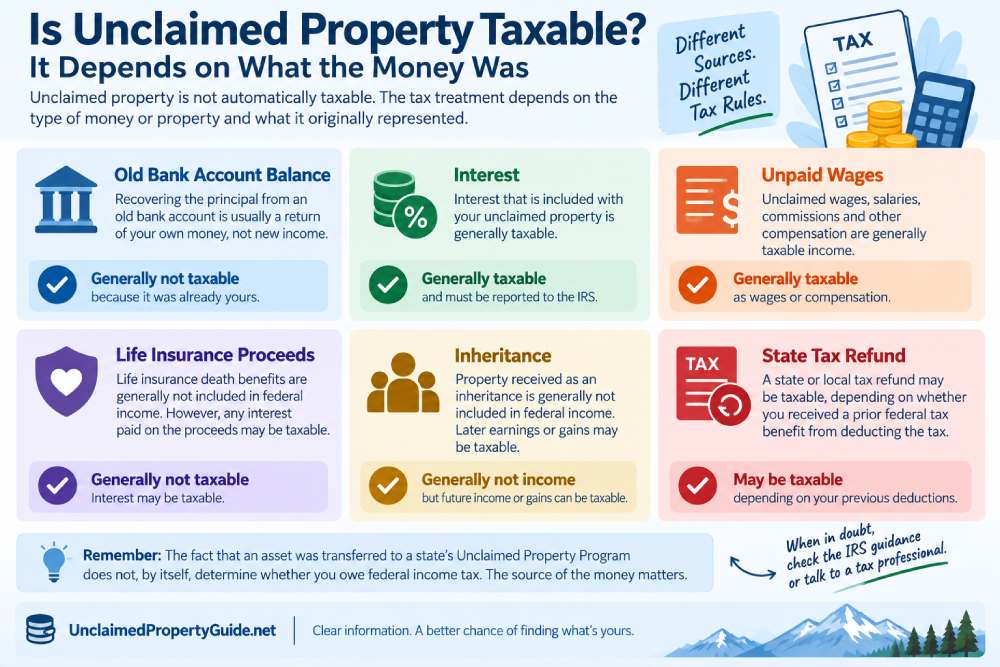
This table is a general overview, not a substitute for determining the facts of a specific payment.
Is interest on unclaimed property taxable?
Taxable interest generally must be reported.
The IRS states that most interest received or credited to you is taxable income unless a specific exclusion applies.
It also specifically explains that when you receive interest on a recovered amount, that interest must be reported as interest income in the year it is received.
IRS Topic 403 — Interest Received
For example, imagine that you recover:
- $2,000 that originally belonged to you, and
- $150 of separately identified taxable interest.
The tax analysis of the $150 can be different from the $2,000 principal.
Are unclaimed wages taxable?
Wages and other compensation for services are generally taxable.
If the unclaimed property originated from an old paycheck, commission, bonus or another type of employee compensation, the tax treatment can therefore be different from recovering the balance of an old personal bank account.
IRS Publication 525 states that compensation such as wages, salaries, commissions, fees and tips is generally included in gross income.
However, the tax year in which income should be reported can become more complicated when an old payment was issued or made available in an earlier year.
For that reason, if you recover a substantial amount of old compensation, check the tax documents associated with the payment and consider obtaining professional tax advice.
Is an unclaimed state tax refund taxable?
Possibly.
A recovered state or local income tax refund can be taxable for federal purposes depending on whether you previously received a tax benefit from deducting the tax.
The IRS explains that:
- If you did not itemize deductions for the year that generated the refund, the state income tax refund generally is not included as income for this reason.
- If you deducted the state or local income tax in an earlier year, you may have to include all or part of the recovered refund in income.
This is commonly referred to as the tax benefit rule.
IRS guidance on state tax refunds and Form 1099-G
What about an unclaimed federal income tax refund?
Federal income tax refunds are treated differently.
IRS Publication 525 states that federal income tax refunds are not included in income because federal income taxes are not deductible from federal taxable income in the way required for the recovery rule.
That is another example of why the phrase unclaimed property alone cannot tell you whether a payment is taxable.
Is unclaimed life insurance taxable?
Life insurance is another important category of unclaimed property.
The IRS states that life insurance proceeds received by a beneficiary because of the death of the insured are generally not included in gross income.
However, any interest paid on those proceeds is generally taxable.
IRS guidance on life insurance proceeds
For example:
| Payment component | General treatment |
|---|---|
| Qualifying life insurance death benefit | Generally not included in gross income. |
| Interest paid on the proceeds | Generally taxable interest. |
Special circumstances can change the result, including certain transfers of life insurance policies for valuable consideration.
Is inherited unclaimed property taxable?
An inheritance is generally not included in the beneficiary’s federal gross income merely because it was inherited.
The IRS states that property received as a gift, bequest or inheritance generally is not included in income.
However, income subsequently generated by inherited property can be taxable.
For example:
- Interest earned by inherited money can be taxable.
- Dividends can be taxable.
- Rent generated by inherited property can be taxable.
- Selling inherited investments or property can produce a taxable gain or loss.
IRS Publication 559 — Survivors, Executors, and Administrators
If you are trying to recover money belonging to someone who died, also see who can claim unclaimed money from a deceased relative.
What if the unclaimed property is stocks or securities?
Unclaimed property can include:
- Stocks.
- Bonds.
- Mutual fund interests.
- Dividends.
- Other securities-related property.
Tax treatment depends on what is actually returned.
For example, recovering ownership of an investment is not necessarily the same event as selling the investment.
If the asset is later sold, you may need to determine:
- Your tax basis.
- The sale price.
- How long the asset was held.
- Whether a capital gain or loss occurred.
If a state previously liquidated a security and returns cash proceeds instead, the analysis can be more complicated.
For significant securities claims, keep all records provided by the state and consider discussing the transaction with a tax professional.
Will I receive a 1099 for unclaimed property?
Possibly, but not simply because you claimed unclaimed property.
Whether a Form 1099 is issued depends on the type of income or payment involved and the applicable reporting rules.
Possible forms can include:
- Form 1099-INT for certain interest income.
- Form 1099-G for certain government payments, including state or local tax refunds.
- Other information returns depending on what the original property represented.
Receiving a 1099 also does not necessarily mean that every dollar shown on your unclaimed property payment is taxable in exactly the same way.
We cover this separately in Will I Get a 1099 for Unclaimed Property?.
What if I do not receive a 1099?
Not receiving a tax form does not automatically mean an amount is tax-free.
The IRS states, for example, that taxable interest still has to be reported even if you do not receive Form 1099-INT.
Similarly, tax obligations generally depend on the character of the income, not solely on whether an information return arrives in the mail.
If you receive a significant unclaimed property payment and cannot determine its origin, keep the documentation and identify the reporting holder or original source before filing your tax return.
Does claiming unclaimed property create a new tax?
No special federal “unclaimed property tax” is imposed merely because you file a claim.
The tax question concerns the underlying asset or income.
This distinction matters.
For example:
- Recovering your own existing cash balance does not suddenly convert that principal into wages.
- Recovering unpaid wages does not stop them from being compensation simply because a state held them.
- Recovering life insurance does not automatically change the federal rules that apply to life insurance proceeds.
The Unclaimed Property Program is generally acting as a custodian or intermediary.
Does it matter which state returns the money?
For federal income tax, the nature of the original payment is generally more important than the fact that California, Texas, New York or another state ultimately returned it.
However, state income tax rules can differ.
A state may have:
- Its own income tax rules.
- No individual income tax.
- Different treatment of certain categories of income.
- Different filing requirements.
This article focuses primarily on U.S. federal income tax treatment.
For state-specific tax questions, check the tax authority for the state where you have a filing obligation.
Is a warrant from unclaimed property taxable?
The term warrant does not determine tax treatment either.
As explained in our guide to warrants in unclaimed property, a government payment warrant often functions similarly to a check.
To determine whether the recovered payment is taxable, you still need to know what the warrant originally paid.
For example:
- A warrant for taxable compensation can have one treatment.
- A warrant returning previously owned funds can have another.
- A warrant representing a tax refund may depend on the applicable refund rules.
What records should you keep after claiming unclaimed property?
Keep enough information to establish what the property was and where it came from.
Useful records can include:
- The original unclaimed property listing.
- The name of the reporting holder.
- The property type.
- The claim confirmation.
- The amount received.
- Any breakdown between principal and interest.
- Letters from the state.
- Forms 1099 or other tax documents.
- Documents establishing investment cost basis when relevant.
- Estate or inheritance records when applicable.
Example: old bank account
Suppose a bank transfers an old account balance to a state after losing contact with the account owner.
Years later, the owner claims:
$4,000 of account principal.
The fact that the $4,000 passed through an Unclaimed Property Program does not, by itself, turn the owner’s existing money into new wages or interest.
If the payment also contains separately identifiable taxable interest, however, that interest can have a different tax treatment.
Example: unclaimed wages
Suppose an employer owed an employee compensation but the payment was never successfully delivered and was eventually transferred to a state.
Because wages are generally taxable compensation, the fact that the employee later recovers the money through an Unclaimed Property Program does not automatically transform the payment into tax-free money.
The timing and reporting can be more complicated when the payment relates to an earlier tax year, so tax documents and professional advice may be appropriate.
Example: life insurance proceeds
Suppose a beneficiary discovers an old life insurance payment through an Unclaimed Property Program.
If the payment qualifies as life insurance proceeds paid because of the insured person’s death, those proceeds are generally excluded from federal gross income.
However, interest associated with the proceeds can be taxable.
The owner should therefore identify whether the state returned only the insurance proceeds or also a separately identifiable interest component.
Example: inherited unclaimed property
Suppose you legally recover unclaimed property belonging to a deceased parent.
The fact that you received the property as an inheritance can matter.
Inherited property is generally not included in income merely because you inherited it, but income or gains connected with that inherited property can still create tax consequences.
This is one reason heirs should keep estate and claim documentation.
Frequently asked questions about taxes on unclaimed property
Do you pay taxes when you claim unclaimed property?
Not necessarily. Tax treatment depends on what the property originally represented. Some recovered amounts may be taxable, while others may not create new taxable income merely because they were returned by the state.
Is unclaimed money considered income?
Sometimes. If the money represents wages, interest or another taxable type of income, it may be taxable. If it represents the return of money that was already yours, the analysis can be different.
Is interest paid with unclaimed property taxable?
Taxable interest generally must be reported as interest income. The IRS specifically states that interest received on recovered amounts is reportable as interest income.
Will the state send me a 1099?
It depends on the type of property and applicable information-reporting rules. Some payments may generate a Form 1099-INT, 1099-G or another form, while others may not.
Is unclaimed life insurance taxable?
Life insurance proceeds received because of the insured person’s death are generally not included in gross income, but interest paid on those proceeds is generally taxable.
Is inherited unclaimed property taxable?
Property received by inheritance is generally not included in federal gross income merely because it was inherited. However, interest, dividends, rents or gains associated with inherited property can be taxable.
Are unclaimed wages taxable?
Wages and compensation are generally taxable income. Recovering an old wage payment through an Unclaimed Property Program does not automatically make the underlying compensation tax-free.
Is an unclaimed state tax refund taxable?
It can be. Federal treatment generally depends on whether you previously received a federal tax benefit from deducting the state or local income tax that was later refunded.
Is an unclaimed federal tax refund taxable?
Federal income tax refunds generally are not included in federal taxable income.
What if I receive no tax form?
The absence of a Form 1099 does not automatically mean the payment is tax-free. Determine what the original property represented and keep the claim documentation.
Bottom line
Unclaimed property is not automatically taxable or tax-free.
The key question is what the property originally represented.
An old bank balance, unpaid wages, taxable interest, a state tax refund, life insurance proceeds, inherited assets and investments can all appear in an Unclaimed Property database, but they do not all receive the same federal tax treatment.
If your claim includes interest, wages, investment proceeds or another type of potentially taxable income, review the documentation carefully and keep any Forms 1099 you receive.
For a large or complicated payment, especially one involving securities, old compensation, an estate or several tax years, consider discussing the facts with a qualified tax professional.
Next, read Will I Get a 1099 for Unclaimed Property? or see our complete guide to finding and claiming unclaimed property.
Important information: UnclaimedPropertyGuide.net is an independent informational website and does not provide individualized tax, legal or accounting advice. Federal and state tax treatment depends on the facts of each payment and can change. For questions about your own tax return, consult current IRS guidance or a qualified tax professional.
[…] For the broader tax treatment, read Is Unclaimed Property Taxable?. […]