In unclaimed property, a dormancy period is the period of inactivity or other legally defined time that must pass before property can be treated as abandoned and reported to the state. It is part of the pre-transfer stage—before the money or property enters a state unclaimed property program.
The dormancy period does not usually mean:
- how long the state will take to review your claim;
- how long you must wait after filing; or
- an automatic deadline to recover money once the state has it.
What is a dormancy period in unclaimed property?
The simplest way to think about dormancy is:
“How long can this property sit without the legally relevant owner activity or payment event before it may be reported as unclaimed?”
NAUPA describes unclaimed property as money or property that has gone uncollected or inactive and is eventually turned over to state unclaimed property programs. It also makes clear that dormancy periods are part of the reporting side of the process and vary by state and property type.
NAUPA — What Is Unclaimed Property?
That means dormancy is not one universal national number of years. A wage payment, a savings account and a security may all be treated differently.
When does the dormancy clock start?
There is no single starting event for every type of property.
Depending on the asset, the dormancy period may run from:
- the date money became payable;
- the date an obligation to pay or distribute property arose;
- the maturity date of an account or instrument;
- the owner’s last indication of interest; or
- another property-specific trigger set by law.
That is why a general question like “When does dormancy start?” usually needs a follow-up question:
“What type of property are we talking about?”
If the property is a bank deposit, the rule may focus on maturity and the owner’s last activity. If it is a wage payment, the key event may be when the wages became payable. If it is a security, the trigger may involve returned mail and attempts to contact the owner.
Why does the dormancy period vary by property type?
Different kinds of property behave differently in the real world. State law reflects that.
A paycheck that should have been cashed shortly after issuance is not the same as a deposit account designed to remain open over time. A stock or investment account can involve different communications and ownership signals than an ordinary refund.
Washington is a useful example of this property-by-property approach.
Its current law provides, among other examples:
- Wages, commissions and bonuses: one year after the amount becomes payable.
- Demand, savings or time deposits: three years after the later of maturity, if applicable, or the owner’s last indication of interest.
- Utility deposits or refunds: one year after the deposit or refund becomes payable.
Washington RCW 63.30.040 — Property presumed abandoned
Those are Washington examples only. They help show why you should not reduce dormancy to one nationwide “3-year rule” or similar shortcut.
What about securities? Are the rules different?
Yes, often very different.
Securities may have special rules that do not fit the ordinary “X years since the last transaction” assumption.
Washington’s security provision is a good example. It provides that, subject to the owner-interest rules, a security is presumed abandoned three years after certain returned-mail events. It also addresses situations where the holder communicates by email and must attempt to confirm the owner’s interest.
Washington RCW 63.30.100 — Security presumed abandoned
So if someone tries to calculate dormancy for securities only by counting years since the last stock purchase, that can be misleading.
What counts as owner activity or indication of interest?
This is one of the most important practical questions.
The dormancy period is often affected by the owner’s indication of interest—in other words, evidence that the owner still knows about or is engaging with the property.
Washington’s current statute gives a very useful example of what that can include. It recognizes several types of apparent-owner activity, including:
- a record communicated by the owner concerning the property or account;
- an oral communication, if the holder records and preserves it;
- presentment of a check or another payment instrument;
- owner-directed account activity or access to account information;
- a deposit into or withdrawal from an account, including certain automatic deposits or withdrawals previously authorized by the owner; and
- other actions reasonably demonstrating that the owner knows the property exists.
Washington RCW 63.30.120 — Indication of apparent owner interest in property
This section is especially helpful because it shows that “activity” does not always mean a classic financial transaction. Depending on the applicable rule, communication and account access can matter too.
Does any automatic activity reset the dormancy clock?
Not necessarily.
This is where many people oversimplify the issue.
Some owner-authorized automatic activity may count, but not every automatic internal event or system-generated change means you personally showed interest in the property.
For example, Washington’s owner-interest provision specifically mentions that an automatic deposit or withdrawal previously authorized by the owner can count, but it distinguishes that from an automatic reinvestment of dividends or interest.
That is one reason you should avoid broad assumptions such as:
- “Interest posted to the account, so the clock restarted.”
- “The balance changed automatically, so it can’t be dormant.”
- “The institution kept mailing statements, so that proves the account stayed active.”
The legally relevant question is whether the type of owner activity recognized by the applicable rule actually occurred and was recorded.
What happens when the dormancy period ends?
The end of dormancy does not automatically mean the property is instantly visible in a public state database.
There are usually additional steps between dormancy and a searchable state listing.
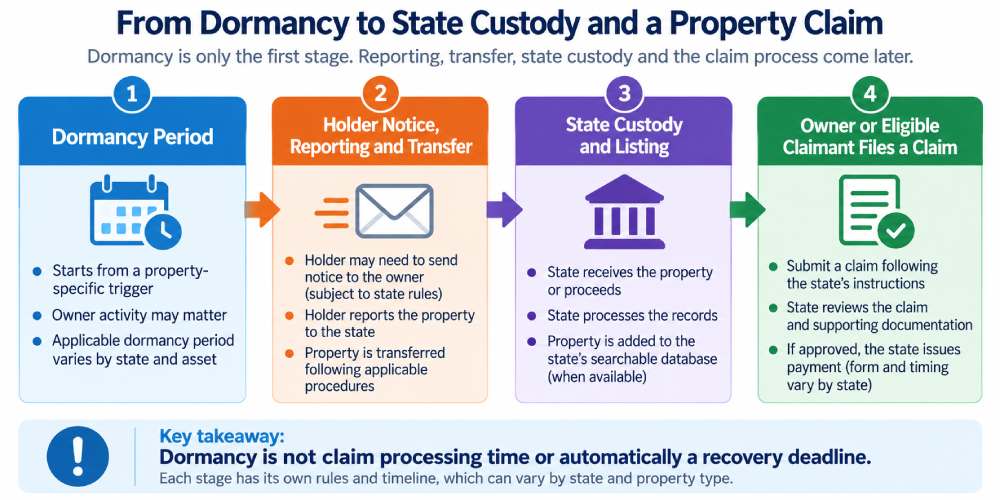
In broad terms, the sequence often looks like this:
- The property reaches the applicable legal dormancy point.
- The holder follows any applicable notice, reporting and transfer procedures.
- The holder reports and delivers the property as required.
- The state processes and loads the information into its system.
- Later, the owner or other eligible claimant may find and claim the property.
Washington’s current notice provision illustrates this distinction. Subject to conditions, a holder of property presumed abandoned must send notice to the apparent owner by first-class mail not more than 180 days and not less than 60 days before filing the report if the holder has a valid address and the value threshold is met.
Washington RCW 63.30.280 — Notice to apparent owner by holder
So even after the dormancy period has been satisfied, the property may still be in the holder’s reporting pipeline rather than already sitting in the public state database.
How is dormancy different from a claim deadline?
This is where many readers get confused, so it helps to separate the concepts clearly.
| Term | What it answers |
|---|---|
| Dormancy period | When can this property be treated as unclaimed under the applicable legal rule? |
| Reporting / transfer process | When and how does the holder report and deliver the property to the state? |
| Database availability | When does the property become searchable in the state system? |
| Claim deadline | Is there a legal time limit to recover property through this route? |
| Claim processing time | How long does the state take to review the claim after submission? |
Dormancy is the front-end clock. Claim processing time is a back-end review issue. They are different stages.
And dormancy should not automatically be treated as a recovery deadline. For example, the New York State Comptroller’s Unclaimed Funds page states that after money becomes abandoned property and is turned over, there is no fee or time limit to claim it through that program.
New York State Comptroller — Unclaimed Funds
That is a New York program example, not a blanket statement for every jurisdiction or every kind of property. But it shows exactly why a dormancy period should not be confused with “the last day you can recover your money.”
If you already filed your claim and want to know how long review may take, read How Long Do Unclaimed Property Claims Take?.
Does dormancy mean I have done something wrong?
No.
A dormant or unclaimed status usually means the holder no longer has the type of owner activity or contact required under the applicable rule. That can happen for many ordinary reasons, such as:
- moving and not updating an address;
- not cashing a payment;
- forgetting an old account;
- not responding to a notice;
- using an account less actively than expected; or
- the owner having died without the property being claimed.
So “dormant” does not automatically mean neglect in a moral sense. It is mainly a legal and administrative classification.
What should I do if I receive a dormancy notice?
If a bank, employer or other institution warns you that property may be transferred as unclaimed, act promptly.
- Verify that the notice is genuine.
Use the institution’s official contact route rather than phone numbers or links you do not trust. - Ask what property is involved.
Find out whether it is wages, a deposit account, a refund, securities or another category. - Ask what date and activity history the holder has recorded.
This helps you understand why the property is being treated as dormant. - Ask what action is needed to resolve it.
Depending on the case, that may involve confirming your identity, updating contact details, cashing a payment or otherwise showing continued interest. - Keep records.
Save the notice and your response in case the property is later reported anyway.
You do not need to wait for property to transfer to the state if the holder can still resolve it directly.
What if the property has already been transferred?
If the property has already been delivered to a state program, the dormancy stage is behind you.
Your next step is usually to:
- identify the correct state program;
- search the state database if needed;
- confirm the record details; and
- follow that state’s claim process.
Use our state-by-state unclaimed property directory to find the right official program.
Then continue with How to Find and Claim Unclaimed Property.
How can I estimate the relevant dormancy rule?
Start with the property type.
If you do not even know whether the record is wages, a checking account, a utility refund or securities, it is very hard to interpret the dormancy question correctly.
That is why our guide to Property Type in Unclaimed Property is useful here.
Once you know the category, you can look more intelligently at:
- the type of trigger involved;
- the kind of owner activity that may matter; and
- the state handling the property.
Frequently asked questions
What is a dormancy period in unclaimed property?
It is the legally relevant period of inactivity or other defined time that must pass before property can be treated as abandoned and reported to the state.
Does dormancy mean the state already has my money?
No. Dormancy is part of the pre-reporting stage. After that, there may still be notice, reporting, transfer and database-processing steps before the property appears in a public state search system.
Does the dormancy clock start the same way for every asset?
No. The trigger depends on the property type and the applicable state rule. It might involve when an amount became payable, maturity, the owner’s last indication of interest or another legally defined event.
Can owner activity affect dormancy?
Yes. Depending on the applicable rule, communication, account access, transactions and other evidence of owner interest may matter.
Does automatic interest or automatic reinvestment always reset dormancy?
No. You should not assume that every automatic internal event counts as owner activity. The recognized activity depends on the applicable law and facts.
Is a dormancy period the same as a claim deadline?
No. Dormancy relates to when property becomes reportable as unclaimed. A claim deadline, if any, concerns how long recovery is allowed. Those are different questions.
Is a dormancy period the same as claim processing time?
No. Claim processing time refers to how long the state takes to review a claim after you submit it.
What should I do if I get a dormancy notice?
Verify the notice, contact the institution through an official channel, ask what property is involved, ask what activity history it has recorded, and keep documentation of your response.
Bottom line
A dormancy period is the pre-transfer clock used to determine when property may be treated as unclaimed.
The most important points are:
- the dormancy period depends on the property type and the state’s rules;
- the clock may run from when money became payable, when an obligation arose, maturity, or the owner’s last indication of interest;
- owner activity matters, but not every automatic event counts the same way;
- the end of dormancy does not mean instant publication in a state database; and
- dormancy is not the same as claim processing time or automatically the same as a recovery deadline.
If you are dealing with a possible dormant or unclaimed asset, start by identifying the property type, confirming the holder or state involved, and following the correct official process for that stage.
Use our Unclaimed Property by State directory and our claim guide to take the next step.
Important information: UnclaimedPropertyGuide.net is an independent informational website and is not affiliated with NAUPA, any state unclaimed property office or any other government agency. Dormancy, reporting and owner-interest rules vary by jurisdiction and by property type. Always verify the specific rules that apply to your property and the state handling it.